
How to Navigate the Local Business Permit Process

Start by confirming the correct jurisdiction for your business address, verifying zoning compliance, completing your Secretary of State registration, and obtaining a federal Employer Identification Number (EIN) from the IRS. Those four steps must happen before you submit a single local permit application.
Before you apply, gather these documents:
- State business registration certificate (from your Secretary of State)
- Federal EIN confirmation letter (IRS Form SS-4)
- Signed lease or proof of property ownership
- Floor plans or site diagrams (required for building, health, and occupancy permits)
- Proof of general liability insurance
- Government-issued photo ID
Core federal and state resources to contact first:
- U.S. Small Business Administration: lists federal activities that require federal licenses or permits and directs entrepreneurs to the relevant federal agencies
- IRS EIN registration: apply online at IRS.gov/EIN for immediate issuance
- Your state’s Secretary of State office: handles business entity registration, which most local offices require before processing local applications
- The Texas Business Permit Office and similar state-level permit offices offer ombudsman-style guidance for businesses working through state and local permit interactions
Pro Tip: Before paying any application fee, use the official jurisdiction locator on your county or city government website to confirm whether your address falls inside city limits, in an unincorporated county area, or within a special district. A Las Vegas mailing address, for example, can place a business in unincorporated Clark County rather than the City of Las Vegas — two separate licensing authorities with different requirements and fees.
Key Takeaways
Completing state registration and confirming jurisdiction before submitting any local permit application prevents the most common and costly delays entrepreneurs face in the U.S. licensing process.
| Point | Details |
|---|---|
| Confirm jurisdiction first | Use an official jurisdiction locator to verify whether your address falls under city or county licensing authority. |
| Finish state filings before local ones | Local portals require state registration documents; applying locally first commonly triggers rejections. |
| General licenses often issue in 30 days | Complete applications with no outstanding questions can issue within approximately 30 days in many jurisdictions. |
| License taxes recur annually | Local business licenses are a privilege to operate and typically require annual renewal, often based on gross receipts. |
| Request a compliance visit before opening | Cities like Chicago explicitly offer pre-opening informational visits that identify compliance gaps before formal inspection. |
Table of Contents
- How do you navigate the local business permit process step by step?
- What permits does your local business typically need?
- What timelines and fees should you expect?
- How do you avoid delays, rejections, and permit fraud?
- How do state and city one-stop portals help you file faster?
- Why should you request an informational compliance visit before opening?
- What do you need to do after permits are issued?
- Why local permit guidance matters: a note from Thecentralgeorgian
- Official portals and resources to bookmark
- Sources
How do you navigate the local business permit process step by step?
The local licensing process for businesses follows a defined sequence. Skipping steps or filing out of order is the most common reason applications stall or get terminated without a refund.
Step 1: Confirm your jurisdiction
Your business address determines which government entity licenses you. City limits, unincorporated county areas, and special districts each have separate licensing offices, fee schedules, and requirements. Do not assume your mailing address matches your licensing jurisdiction. Use the official jurisdiction locator on your local government’s website before doing anything else. Clark County, Nevada, for instance, publishes a jurisdiction locator tool and requires applicants to complete specific pre-application steps before submitting a local license application online.

Step 2: Verify zoning and Certificate of Occupancy requirements
Contact the Planning or Zoning Department before signing a lease. Confirm that your intended business activity is a permitted use at that address under the local zoning code. If you plan to occupy a commercial space, a Certificate of Occupancy (CO) may be required before the business license is issued. Building or Code Enforcement offices handle CO inspections. Retail food service, manufacturing, and assembly occupancies almost always trigger a CO review. Confirm this before committing to a location.
Step 3: Complete state-level registrations
Local licensing offices typically require proof of state registration before they will process a local application. File your business entity with the Secretary of State (LLC, corporation, or other structure), obtain a state business license where your state requires one, and register for state tax accounts (sales tax, employer withholding) through your state’s Department of Revenue. Keep certified copies of all state filings. You will attach them to local applications.
Step 4: Obtain your federal EIN
The IRS issues Employer Identification Numbers at no cost through the online EIN application at IRS.gov. The process takes minutes and produces an immediate confirmation. Most local licensing offices require an EIN on the application form, even for sole proprietors with no employees. Store the IRS confirmation letter with your business records.
Step 5: Submit the local license application
With jurisdiction confirmed, zoning cleared, state filings complete, and an EIN in hand, you are ready to file the local business license application. Most municipal licensing offices route applications through a sequence of internal reviews: the licensing division receives the application, then routes it to Planning (zoning verification), Building (CO status), and Health or Fire departments as applicable. Each department signs off before the license issues.
The City of Las Vegas publishes a step-by-step process and states that general licenses are often issued within approximately 30 days when applications are complete and no questions arise. Incomplete applications stop that clock immediately.
Step 6: Schedule required inspections
After submission, some permits require a physical inspection before approval. Health department permits for food service, fire department permits, and building occupancy permits all commonly require on-site inspections. Contact each department to schedule inspections promptly after application submission. Delays in scheduling inspections are delays in opening.
Pro Tip: Call the licensing office directly after submitting your application to confirm receipt and ask for the name of the reviewer assigned to your file. That single contact reduces follow-up time significantly and gives you a direct line if the application stalls.
What permits does your local business typically need?
The specific permits required depend on your business type, physical location, and activities. The following catalog covers the most common municipal permits and the triggers that require each one.
- General business license: Required by most cities and counties for any commercial activity. The baseline permit for operating legally within a jurisdiction.
- Sales tax registration: Required at the state level when you sell taxable goods or services. Administered by the state Department of Revenue, not the city.
- Health department permit: Triggered by any food preparation, food service, or food retail activity. Applies to restaurants, food trucks, bakeries, and grocery operations.
- Building permit: Required when you construct, renovate, or alter a physical space. Issued by the Building Department. Triggers a CO inspection upon completion.
- Certificate of Occupancy: Required before occupying a commercial space for a new use. Confirms the building meets code for your specific business activity.
- Signage or public way permit: Triggered by installing exterior signs, awnings, or any structure that extends over a public sidewalk or right-of-way.
- Special events permit: Required for temporary outdoor events, street closures, or gatherings on public property. Issued by the city or county events or parks department.
- Alcohol or tobacco permit: Required at both state and local levels for any sale or service of alcohol or tobacco. State liquor control boards issue the primary license; cities may add a local endorsement.
- Fire department permit: Triggered by occupancies with public assembly, hazardous materials, commercial cooking equipment, or specific fire-suppression systems.
- Home-based business approval: Required in most jurisdictions when operating a business from a residential address. Zoning restrictions apply to signage, customer traffic, and employees on-site.
- Vendor or transient merchant permit: Required for mobile vendors, street vendors, or businesses without a fixed commercial address.
The SBA’s federal licenses and permits page identifies business activities that may also require federal authorization, including agriculture, broadcasting, transportation, and financial services. Check federal requirements separately from local ones.
What timelines and fees should you expect?
Processing times and fee structures vary by jurisdiction and permit type. Setting realistic expectations before you apply prevents costly delays in your opening date.
Typical review windows:
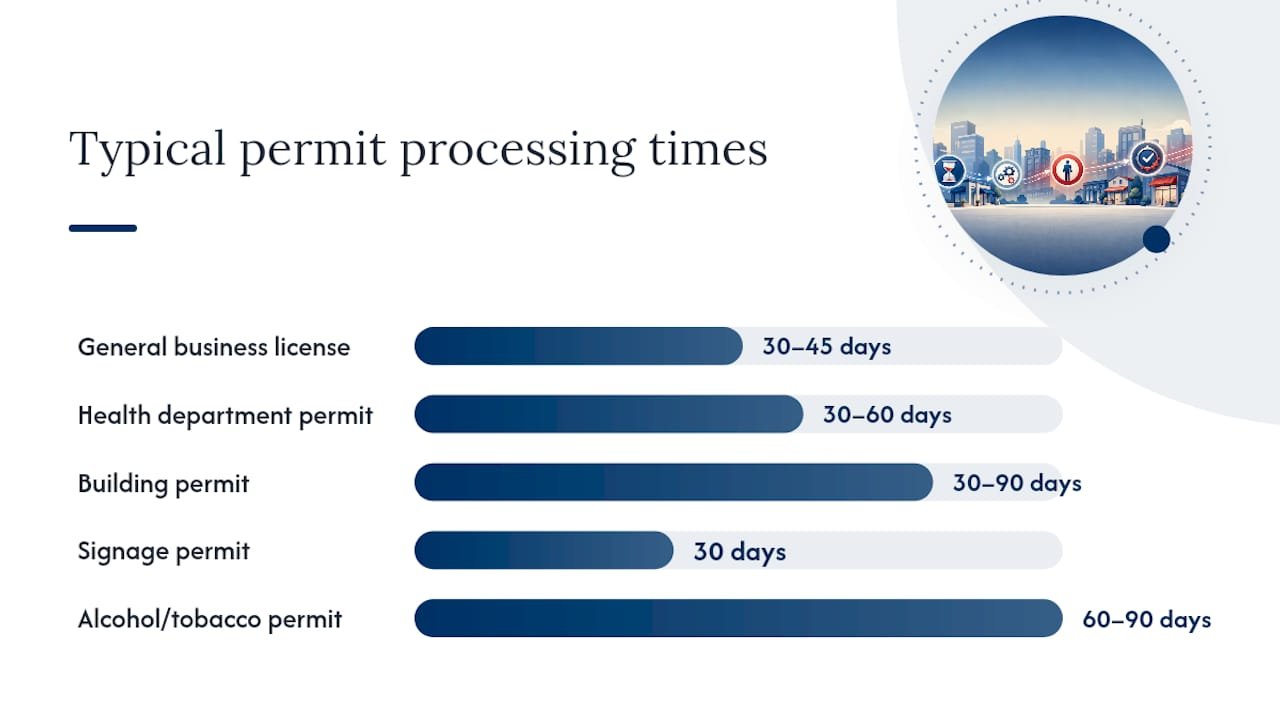
Most general business licenses issue within 30–45 days when the application is complete. The City of Las Vegas documents an expectation of approximately 30 days for complete applications with no outstanding questions. Building permits and health department permits often take longer, particularly when inspections are required. Complex projects in large cities can take 60–90 days or more.
Fee structures:
Fees fall into two categories. Flat application fees cover the administrative cost of processing and are paid at submission. Privilege or license taxes are calculated on estimated gross receipts and represent the cost of the right to operate. The City of Alexandria, Virginia describes local business licenses as a privilege to operate and notes that license taxes are often calculated on estimated gross receipts in the first year, then adjusted at renewal based on actual receipts. Underestimating gross receipts in year one can trigger back taxes at renewal.
| Permit Type | Typical Processing Time | Fee Structure |
|---|---|---|
| General business license | 30–45 days (complete application) | Flat fee plus gross receipts tax |
| Health department permit | 30–60 days, inspection required | Flat application fee |
| Building permit | 30–90 days depending on scope | Fee based on project valuation |
| Signage permit | 30 days | Flat fee |
| Alcohol/tobacco permit | 60–90 days (state + local) | State fee plus local endorsement fee |
Renewals:
Most local business licenses require annual renewal. Alexandria’s guidance confirms that renewal is standard and that license taxes recur as an annual privilege to operate. Mark renewal deadlines on your calendar at least 60 days in advance. Late renewals often carry penalty fees, and operating with a lapsed license can result in fines or forced closure.
Pro Tip: Budget for both the application fee and the first-year license tax when projecting startup costs. Many entrepreneurs account for the application fee but overlook the gross receipts-based tax due at or shortly after opening.
How do you avoid delays, rejections, and permit fraud?
The most common cause of application delays is missing or incomplete information. Municipal licensing officials consistently report that applicants who skip prerequisite steps — particularly zoning clearance and state registration — face the longest delays and the highest rejection rates.
Document checklist by permit type:
- General business license: State registration certificate, EIN, signed lease or proof of ownership, government-issued ID, and completed application form.
- Building or occupancy permit: Architectural or floor plans, contractor license numbers, proof of insurance, and state registration.
- Health department permit: Floor plans showing equipment layout, equipment specifications, proof of food handler certifications, and lease.
- Signage permit: Site plan showing sign location, sign dimensions and materials, and landlord authorization if applicable.
- Alcohol or tobacco permit: State liquor license (or application confirmation), background check documentation, lease, and floor plan.
Common errors that cause delays:
- Submitting a local application before completing state registration. Local portals frequently require a state registration number at the point of submission. Without it, the application is rejected or placed in a pending queue.
- Applying without zoning confirmation. If the Planning Department flags a zoning issue after submission, the application stops until zoning is resolved.
- Incomplete or inconsistent business name. The name on the local application must match the name on state registration documents exactly.
- Missing contractor license numbers on building permit applications.
- Applying for permits out of sequence. Building permits must typically be issued and inspections passed before a CO is issued, and a CO is often required before a business license issues.
If your application stalls:
- Contact the licensing office directly and ask for the status and the name of the reviewing department.
- Request a written status update or case number to track the application.
- If the application has been pending beyond the published review window, ask to speak with a supervisor or request escalation to a business ombudsman. The Texas Business Permit Office and similar state-level offices offer liaison resources specifically for businesses that encounter obstacles in the permitting process.
- Document every contact: date, name of the official, and what was communicated.
Fraud warning:
Fraudulent invoices and fake permit notices are a documented problem. The City of Reno’s business license guidance explicitly warns applicants about fraudulent emails impersonating city licensing offices. Verify any invoice or notice by calling the licensing office directly using the phone number listed on the official city or county website, not the number in the email. Official portals use .gov domains. Never pay a permit fee through a link in an unsolicited email.
How do state and city one-stop portals help you file faster?
State and local one-stop portals consolidate multiple filings into a single online interface and allow entrepreneurs to track application status without calling an office. Using the correct portal from the start reduces duplicate submissions and missed requirements.
Examples of official one-stop portals:
- PA Business One-Stop Hub (pa.gov): Pennsylvania’s centralized portal for business registration, licensing, and tax registration across state agencies.
- Texas Business Permit Office (gov.texas.gov): Provides centralized guidance on state and local permitting and connects businesses with liaison resources for complex permit interactions.
- Nevada Silver Flume (nvsilverflume.gov): Nevada’s one-stop portal for business registration and state licensing.
- CalOSBA / CalGOLD (calosba.ca.gov): California’s permit aggregation tool searches local, state, and federal permit requirements by business type and location, producing a customized list of required permits.
How to verify a portal is official:
- Confirm the domain ends in .gov or is a direct subdomain of a verified city or county .gov site.
- Cross-reference the portal’s contact information with the phone number and address listed on the city or county’s main website.
- Do not use portals found through paid search ads without independently verifying the URL against the official government site.
What portals typically require first:
Most local portals require a completed state registration before they will accept a local license application. The City of Reno’s guidance confirms that state registration documents must be on hand before filing locally. Have your state registration certificate and EIN ready before creating a portal account.
When you still need to contact a local office in person:
Portals handle standard applications well. However, businesses with unusual zoning situations, those requiring variances, or those applying for alcohol licenses often must appear in person or submit additional documentation outside the portal. When in doubt, call the licensing office before assuming the portal covers your full application.
Pro Tip (for entrepreneurs starting a new venture): Review common startup mistakes before filing. Permit errors are among the most expensive early mistakes because they delay opening dates and can result in non-refundable fees.
Why should you request an informational compliance visit before opening?
Some cities explicitly offer informational compliance visits as a pre-opening service. These visits allow a business compliance investigator to review your planned operations and physical space before you open, identifying gaps before they become violations.
Chicago’s business licensing guidance documents that entrepreneurs may request a visit from City Business Compliance Investigators to receive tailored regulatory guidance before beginning operations. This is not a formal inspection. It is an advisory visit designed to help businesses identify what permits they need and whether the space meets code requirements.
How to request a compliance visit:
- Contact the city’s business licensing or compliance office by phone or email using contact information from the official city website.
- Describe your business type, planned activities, and address.
- Ask specifically for an informational or pre-application compliance visit.
- Some cities accept these requests through their online business portal.
What to prepare for the visit:
- Proposed floor plan showing equipment placement, customer areas, and exits
- Description of all planned business activities
- Copies of any state registrations already completed
- List of questions about specific permit requirements or zoning concerns
- Site photos if the visit is conducted remotely
Document everything the investigator tells you. Take written notes during the visit and follow up with an email summarizing what was discussed. If the investigator identifies a compliance gap, ask for the specific code section in writing. That documentation protects you if there is a dispute later about what guidance was provided.
Municipal guidance consistently treats these visits as a compliance-prevention tool. Businesses that use them before opening report fewer surprises during formal inspections.
What do you need to do after permits are issued?
Receiving a permit is not the end of the compliance process. Maintaining permits in good standing requires ongoing recordkeeping, timely renewals, and prompt notification of material changes.
Schedule and pass required inspections. Some permits issue conditionally, pending a final inspection. Contact the relevant department immediately after permit issuance to schedule any required inspections. Health department permits for food service and building occupancy permits commonly require a final on-site inspection before the business may open.
Post required permits visibly. Most jurisdictions require the business license and certain other permits to be posted in a visible location on the premises. Confirm posting requirements with the licensing office.
Track gross receipts from day one. Because license taxes are often calculated on estimated gross receipts in the first year and adjusted at renewal, maintaining an accurate gross receipts record from the first day of operation prevents underpayment penalties. The City of Alexandria’s guidance confirms that incorrect estimates can trigger back taxes at renewal.
Set renewal calendar alerts. Annual renewals are standard for most local business licenses. Set a calendar reminder 60 days before the renewal deadline. Some jurisdictions send renewal notices by mail; others do not. Do not rely on a notice arriving.
Report material changes promptly. Ownership changes, address changes, and expansions of business activities typically require amended filings or new permit applications. Contact the licensing office before making any of these changes, not after. Operating under a permit that no longer matches your actual business structure is a compliance violation.
Maintain a permit file. Keep copies of all issued permits, inspection certificates, renewal confirmations, and correspondence with licensing offices in a single organized file. This file is your first line of defense in any audit or complaint.
If a permit is denied: Request the denial in writing and ask for the specific reason. Most jurisdictions have a formal appeal process. File the appeal within the stated deadline, which is often 30 days from the denial date. Include documentation that addresses the specific reason for denial. If the denial involves a zoning issue, consult with the Planning Department before filing the appeal.
Why local permit guidance matters: a note from Thecentralgeorgian
Thecentralgeorgian covers local government, public safety, and business developments across Central Georgia. This guide was compiled using municipal sources, official state and federal portals, and published guidance from city licensing offices across the United States.
Permit offices are not adversaries. They are administrative bodies with defined procedures, and early contact with those offices consistently produces better outcomes than attempting to complete the process without guidance. Local reporting plays a direct role in this: when municipal procedures change, when new fraud schemes target local businesses, or when a city updates its fee schedule, local news coverage is often the first place entrepreneurs encounter that information. Tracking local regulatory updates is a practical step for any business owner who wants to stay ahead of procedural changes.
If you encounter unclear municipal guidance, an unresponsive licensing office, or a suspected fraud scheme targeting local businesses, Thecentralgeorgian welcomes tips from the community. Contact the newsroom through Thecentralgeorgian to report permitting problems or procedural issues that may warrant local coverage.
Official portals and resources to bookmark
The resources below are the primary official sources for U.S. business permit and license filings. Verify each URL ends in .gov before submitting any information or payment.
| Resource | What it covers | Official URL |
|---|---|---|
| SBA federal licenses and permits | Federal-level permit requirements by business activity | sba.gov/business-guide/launch-your-business/apply-licenses-permits |
| IRS EIN online application | Free federal EIN issuance, immediate confirmation | irs.gov/businesses/small-businesses-self-employed/apply-for-an-employer-identification-number-ein-online |
| Secretary of State (your state) | Business entity registration; search “[your state] Secretary of State business registration” | Varies by state |
| PA Business One-Stop Hub | Pennsylvania statewide business registration and licensing | pa.gov |
| Texas Business Permit Office | Texas state and local permit guidance and ombudsman resources | gov.texas.gov/business/page/business-permits-office |
| City of Chicago business licensing | Step-by-step local license application and compliance visit requests | chicago.gov/city/en/sites/chicago-business-licensing |
| City of Las Vegas business license | Step-by-step local application with published processing timelines | lasvegasnevada.gov/Business/Business-License |
| Clark County, NV general license guide | Jurisdiction locator and pre-application steps for unincorporated areas | clarkcountynv.gov/business |
| City of Alexandria, VA new business guide | License tax structure, gross receipts guidance, and renewal procedures | alexandriava.gov/business-resources/new-business-guide |
| CalOSBA / CalGOLD (California) | Multi-level permit search by business type and location | calosba.ca.gov |
To verify any portal is official, confirm the .gov domain and cross-reference the contact information against the city or county’s main government website. If you are tracking permit-related announcements in Central Georgia specifically, Thecentralgeorgian’s coverage of local government announcements provides context on how to read and act on official municipal notices.
Sources
- Apply for a business license | City of Las Vegas
- General license guide | Clark County, NV
- Apply for licenses and permits | U.S. Small Business Administration
- Business Permit Office – Office of the Texas Governor
- New business guide | City of Alexandria, VA