
No Duty to Retreat in Georgia: O.C.G.A. §16-3-23.1 and Next Steps

Georgia is a Stand Your Ground state. Under O.C.G.A. §16-3-23.1, a person who is lawfully present and not the aggressor has no duty to retreat before using force, including deadly force, to defend against an unlawful attack. That right isn’t unlimited: any use of force still has to meet the reasonableness and proportionality rules in O.C.G.A. §16-3-21, and claiming self-defense doesn’t stop police from investigating or prosecutors from filing charges if the facts are disputed.
TL;DR:
- Self-defense in Georgia requires that force be reasonable and proportional, with deadly force justified only to prevent death or serious injury.
- The Castle Doctrine presumes force is justified in homes and workplaces during unlawful entry, while Stand Your Ground applies statewide to lawful presence without a duty to retreat.
- The success of a self-defense claim depends heavily on evidence showing the threat was imminent, the force was proportionate, and the defendant was not the initial aggressor.
- Cases often hinge on physical evidence, witness testimony, and timelines, with law enforcement and prosecutors carefully scrutinizing every detail.
- Civil lawsuits are possible regardless of criminal immunity, especially if injuries occurred or excessive force was used beyond the immediate threat.
Table of Contents
- What Georgia’s Self-Defense Statutes Actually Say
- When Is Force Legally Justified in Georgia?
- Castle Doctrine vs. Stand Your Ground: What’s the Difference?
- What Stand Your Ground Doesn’t Cover, and Where Civil Risk Creeps In
- How Police, Prosecutors, and Judges Evaluate a Stand Your Ground Claim
- What to Do Immediately After Using Force in Self-Defense
- How Georgia Courts Have Applied Stand Your Ground in Real Cases
- The Legal Process, Step by Step: From Incident to Possible Appeal
- Who Has to Prove What in a Stand Your Ground Case?
- How Stand Your Ground Shapes Police and Prosecutor Decisions
- A Local Newsroom’s View on Self-Defense Cases
- Where the Analysis Comes From: Statutes and Legal Resources
- Sources
What Georgia’s Self-Defense Statutes Actually Say
Three statutes do the heavy lifting in Georgia self-defense law, and reading them together matters more than reading any one in isolation.
O.C.G.A. §16-3-21 sets the baseline. It says a person is justified in using force against another when they reasonably believe it’s necessary to defend themselves or a third person against the other’s imminent use of unlawful force. Deadly force, though, is held to a stricter standard. It’s justified only to prevent death, great bodily injury, or the commission of a forcible felony. The statute also lists specific circumstances where force isn’t justified, including situations where the person claiming self-defense was the initial aggressor.
O.C.G.A. §16-3-23 covers defense of habitation, commonly called the Castle Doctrine. It gives occupants of a home, motor vehicle, or place of business the presumption that force, including deadly force, is justified against someone unlawfully and forcibly entering that space.
O.C.G.A. §16-3-23.1 is the actual Stand Your Ground provision. It states that a person who uses threats or force in accordance with §16-3-21, §16-3-23, or §16-3-24 has no duty to retreat and has the right to stand his or her ground and use force, including deadly force, if that force is otherwise justified.
A few terms recur throughout these statutes and shape how they get applied:
- Lawfully present means you had a legal right to be where you were when the confrontation happened.
- Non-aggressor means you didn’t start the conflict or provoke the attack.
- Forcible felony refers to a felony involving the use or threat of physical force against another person, such as armed robbery or aggravated assault.
- Imminence means the threat was happening or about to happen, not something that occurred earlier or might happen later.
- Proportionality means the force used matched the level of threat faced.
Georgia’s legislature didn’t define every term with precision, and that’s intentional. Courts fill the gaps using a reasonable person standard, meaning a jury asks whether an ordinary person in the defendant’s position, with the same information, would have believed force was necessary.
When Is Force Legally Justified in Georgia?
A self-defense claim rises or falls on a handful of factual elements, and Georgia juries weigh them together rather than checking boxes in isolation.
- You reasonably believed force was necessary. This isn’t about what you actually feared. It’s about whether a reasonable person facing the same situation, with the same information available, would have shared that belief.
- The threat was imminent. A threat that happened yesterday, or one you expect might happen next week, doesn’t satisfy this element. The danger has to be unfolding in that moment.
- You weren’t the initial aggressor. If you started the physical confrontation or provoked it, the law generally strips away your ability to claim self-defense, even if the other person escalated further.
- The force matched the threat. Responding to a shove with a punch might be reasonable. Responding to a shove with a firearm almost certainly isn’t, unless other factors elevated the danger.
- Deadly force met the higher bar. If deadly force was used, it has to be tied to preventing death, great bodily injury, or a forcible felony, not just a verbal threat or minor physical contact.
Evidence drives every one of these elements. Police reports, 911 call recordings, security or doorbell camera footage, medical records documenting injuries, and statements from independent witnesses all shape whether a claim holds up. A defendant’s own account carries weight, but it rarely stands alone. Prosecutors and defense attorneys both know that a claim resting solely on the defendant’s word, with no corroborating evidence, faces a much harder road than one backed by a timestamped video or a treating physician’s notes.
Claims commonly fail for three reasons: the person provoked the confrontation, the person continued using force after the threat ended, or the person was committing a felony at the time of the incident. Georgia law is explicit that self-defense doesn’t protect someone who was breaking the law when the confrontation started.
Pro Tip: If you’re ever involved in a self-defense incident, write down everything you remember as soon as you’re safe to do so, including exact timing, what was said, and who else was present. Memory fades fast, and a contemporaneous note can matter more than you’d expect months later when a case is being built.
Castle Doctrine vs. Stand Your Ground: What’s the Difference?
These two doctrines get confused constantly, and the mix-up costs people real legal ground.
The Castle Doctrine, under §16-3-23, is about location. It applies specifically to your home, your occupied vehicle, or your place of business. When someone unlawfully and forcibly enters one of those spaces, the law presumes you had a reasonable fear of death or great bodily injury, which makes justifying force considerably easier.
Stand Your Ground, under §16-3-23.1, is broader and location-neutral. It applies anywhere you’re lawfully present, whether that’s a parking lot, a public sidewalk, a restaurant, or a friend’s backyard. The core benefit is the same in both cases: no duty to retreat. But Castle Doctrine adds a legal presumption that Stand Your Ground doesn’t automatically provide outside the home.
Three quick scenarios show how this plays out:
- Home intrusion: Someone kicks in your back door at 2 a.m. Castle Doctrine applies directly, and the law presumes your fear of serious harm was reasonable.
- Parking-lot confrontation: A road-rage dispute escalates and the other driver approaches you with a weapon outside a gas station. Stand Your Ground applies since you’re lawfully present, but you don’t get the automatic presumption Castle Doctrine provides at home. You’ll need to show the threat was real and imminent.
- Workplace incident: A disgruntled former employee forces their way into your business after hours, threatening staff. This falls under Castle Doctrine’s place-of-business protection, similar in strength to the home scenario.
What Stand Your Ground Doesn’t Cover, and Where Civil Risk Creeps In
Stand Your Ground removes a duty to retreat. It does not hand out blanket immunity, and it does not erase the possibility of a lawsuit even when criminal charges disappear.
Several circumstances neutralize the defense entirely:
- Initial provocation: If you started the verbal or physical altercation, you generally lose the ability to claim self-defense, regardless of how the other person responded.
- Mutual combat: When both parties willingly engage in a fight, courts are often skeptical of either side claiming self-defense unless one party clearly tried to withdraw.
- Felony conduct: Committing a felony at the time force was used, such as burglary or drug trafficking, generally forecloses a self-defense claim.
- Excessive force for property alone: Georgia law does not allow deadly force purely to protect property with no threat to a person. Chasing down a fleeing thief and shooting them over a stolen bicycle isn’t defensible under these statutes.
Legal analysts note that Stand Your Ground functions as a defense, not a license to escalate, and juries evaluate the totality of circumstances rather than any single fact in isolation. Misapplying the doctrine, especially by using excessive force to defend property rather than a person, is one of the most common reasons a self-defense claim collapses at trial.
Civil exposure is the piece people overlook most. Even when a judge grants criminal immunity or a jury acquits, the person who was shot or injured, or their family, can still file a civil lawsuit. Criminal immunity and civil liability run on separate tracks with different burdens of proof, so a criminal win doesn’t automatically defeat a wrongful death or personal injury claim built on the same set of facts.
Advocacy groups that track these laws nationally point out that Georgia’s framework removes the duty to retreat but stops well short of creating blanket immunity, and outcomes vary widely depending on jurisdiction, available evidence, and how a local prosecutor’s office approaches self-defense cases.
How Police, Prosecutors, and Judges Evaluate a Stand Your Ground Claim
The legal process after a self-defense incident moves through several distinct stages, each with its own standard of proof and its own risks.
- Scene investigation. Responding officers gather statements, secure physical evidence, and often make an on-the-spot judgment about whether to arrest. What you say at this stage matters enormously, since early statements get compared against later testimony for inconsistencies.
- Charging decision. Prosecutors review the police file and decide whether to file charges, decline, or take the matter to a grand jury. They’re weighing whether the evidence realistically supports overcoming a self-defense claim at trial.
- Immunity hearing. Georgia law allows a defendant to request a pre-trial hearing where a judge, not a jury, decides whether the person is entitled to immunity. This hearing uses a preponderance-of-the-evidence standard, meaning the defendant has to show it’s more likely than not that the force was justified. That’s a considerably lower bar than the beyond-a-reasonable-doubt standard required for a criminal conviction.
- Trial, if immunity is denied. If the judge doesn’t grant immunity, the case proceeds toward trial, where a jury applies the reasonable-person standard and weighs the same evidence under the tougher criminal burden.
Judges and juries both lean on physical evidence, forensic timelines, and independent witness accounts far more than they lean on a defendant’s self-reported fear. Subjective terror alone rarely wins a case. What tends to move the needle is objective corroboration: a weapon recovered at the scene, a 911 call capturing real-time panic, or medical records showing injuries consistent with the account given.
Pro Tip: If you believe you have a legitimate Stand Your Ground claim, talk to a criminal defense attorney before an immunity hearing gets scheduled, not after. An attorney who understands how local judges apply the preponderance standard can shape which evidence gets presented and in what order, and that sequencing often determines whether the hearing succeeds.
The cost and exposure difference between winning at an immunity hearing and going to trial is significant. A successful immunity motion can end the case in weeks. A trial can drag on for a year or more, with all the financial and emotional weight that entails, which is exactly why early legal counsel changes outcomes so often.
What to Do Immediately After Using Force in Self-Defense
The minutes and hours after a self-defense incident shape everything that follows, both for your safety and for any legal proceeding down the line.
- Call 911 immediately and request medical assistance if anyone is injured, including the other party.
- Photograph the scene before anything gets moved or cleaned up, including injuries, weapons, and the surrounding environment.
- Get names and contact information for anyone who witnessed the incident, even bystanders who seem reluctant to get involved.
- Keep every piece of medical documentation related to injuries you sustained, since this becomes central evidence for reasonableness.
- Limit what you tell police at the scene. You’re required to identify yourself, but you’re not required to give a detailed narrative on the spot. Politely state that you acted in self-defense and that you want to speak with an attorney before answering further questions.
- Write a private, contemporaneous log of what happened as soon as you’re safe, including approximate times and exact words exchanged.
Pro Tip: Requesting an attorney isn’t an admission of guilt, and it won’t make you look suspicious to a judge later. It’s a standard legal protection, and skipping it is one of the most common ways people accidentally undermine a solid self-defense claim before a lawyer ever gets involved.
Once you’ve retained counsel, ask specifically about pursuing a pre-trial immunity hearing. Not every case qualifies, but when the facts support it, a lawyer can move to get that hearing scheduled early, which can shorten your legal exposure considerably compared to waiting for a full trial.
How Georgia Courts Have Applied Stand Your Ground in Real Cases
Georgia courts don’t apply Stand Your Ground as a rubber stamp, and case outcomes consistently turn on the same handful of facts: who moved first, whether the threat was still active, and what independent evidence existed beyond the defendant’s account.
Cases where courts have granted immunity or upheld acquittals tend to share common threads. The defendant had no realistic path to retreat, physical evidence corroborated an active and immediate threat, and the defendant hadn’t provoked the confrontation. Home invasion cases, where forced entry is documented and the resident acted within their own dwelling, tend to align closely with both Castle Doctrine and Stand Your Ground protections working together.
Cases where the defense has failed usually involve a gap between the claimed fear and the objective evidence. A defendant who continued using force after an attacker was already subdued, or who pursued a fleeing person before using force, has generally struggled to convince a judge or jury that the response stayed proportional. Prosecutors in these cases typically build their argument around timeline reconstruction, showing that the threat had already ended by the time force was applied.
The pattern across Georgia case law is consistent: the doctrine protects people who face a genuine, ongoing threat and respond proportionally, but it offers little cover once the confrontation shifts from defense to retaliation.
The Legal Process, Step by Step: From Incident to Possible Appeal
A Stand Your Ground case moves through a fairly predictable sequence, though the timeline can stretch from weeks to well over a year depending on how contested the facts are.
It starts with the investigation, where police collect physical evidence, canvas for witnesses, and decide whether probable cause exists for an arrest. An arrest may happen at the scene or later, once investigators complete their initial review. After that, the case goes to a prosecutor’s office, which decides whether to file formal charges, take the matter to a grand jury for indictment, or decline prosecution entirely.
If charges move forward, the defense can request a pre-trial immunity hearing, where a judge alone decides the self-defense question under the preponderance standard. A win there typically ends the case. A loss sends it toward trial, where a jury reconsiders much of the same evidence under the tougher beyond-a-reasonable-doubt standard.
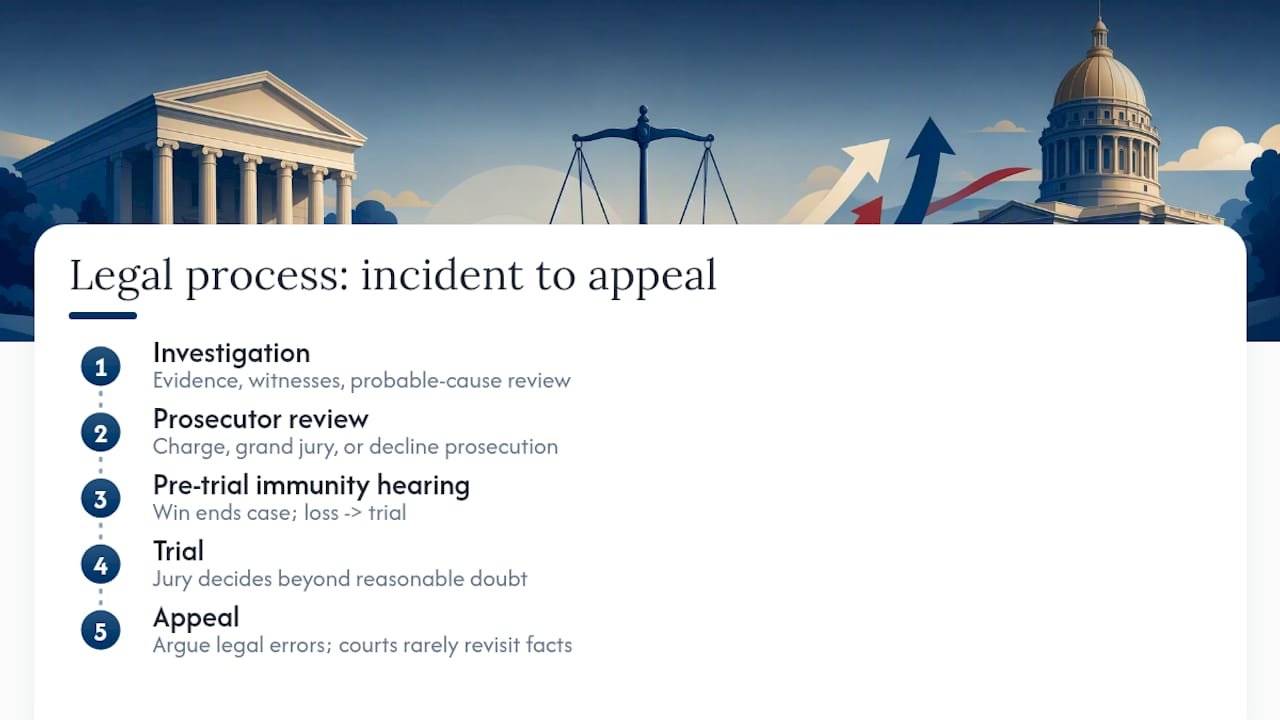
If convicted, a defendant can pursue an appeal, generally arguing that the trial court misapplied the self-defense statutes, excluded relevant evidence, or that the jury instructions misstated the reasonable-person standard. Appeals in Georgia self-defense cases rarely overturn a jury’s factual findings, since appellate courts focus on legal errors rather than re-litigating what happened.
Who Has to Prove What in a Stand Your Ground Case?
Burden of proof is where a lot of confusion sets in, mostly because it shifts depending on which stage of the process you’re in.
At a pre-trial immunity hearing, the defendant carries the burden and has to show, by a preponderance of the evidence, that the force used was justified under Georgia’s self-defense statutes. That means showing it’s more likely than not, a considerably lighter lift than what’s required at trial.
At trial, the calculus flips. Once a defendant raises self-defense as an issue supported by some evidence, the prosecution carries the burden of disproving it beyond a reasonable doubt. The defendant doesn’t have to prove innocence. The state has to prove the defense doesn’t apply.
Evidentiary requirements lean heavily on anything that corroborates the defendant’s account independently. Ballistics reports, autopsy findings in fatal cases, phone records establishing timeline, and surveillance footage all carry more weight than testimony alone, because they don’t depend on memory or motive. Cases with strong physical corroboration tend to resolve faster, whether that resolution favors the defendant or the prosecution.
How Stand Your Ground Shapes Police and Prosecutor Decisions
Stand Your Ground changes police behavior at the scene in a subtle but real way. Officers responding to a self-defense claim generally still make an arrest if the facts are unclear, since Georgia law doesn’t require police to resolve a legal defense on the spot. The statute affects what happens after the arrest far more than whether one occurs in the first place.
Prosecutors weigh Stand Your Ground claims when deciding whether a case is worth taking to a grand jury. A case with a credible, well-documented self-defense claim, especially one likely to succeed at an immunity hearing, carries real risk for a prosecutor’s office if pursued to trial and lost. That calculation shapes charging decisions across Georgia, though it varies by county and by the individual prosecutor’s approach to ambiguous cases.
Law enforcement agencies in Central Georgia handle these calls regularly, from domestic disputes that escalate to confrontations outside bars and convenience stores. The presence of a self-defense claim rarely stops an investigation. It shapes the questions investigators ask and the evidence they prioritize collecting, since a well-built case file matters just as much to prosecutors deciding whether to charge as it does to defense attorneys building an immunity argument.
A Local Newsroom’s View on Self-Defense Cases
Thecentralgeorgian has covered police-involved shootings, arrests tied to self-defense claims, and the courtroom proceedings that follow across Central Georgia, from Bibb County to surrounding communities. That reporting consistently shows the same pattern: cases that look straightforward at the scene often become legally complicated once investigators dig into timelines and evidence.
Local reporting matters here because state-level summaries of Stand Your Ground can’t capture how individual prosecutors, judges, and juries in Central Georgia actually apply these statutes case by case. Readers trying to understand a specific arrest or courtroom outcome get more value from coverage grounded in the actual facts of that case than from generic legal explanations alone.
For readers looking to track how these cases unfold locally, Thecentralgeorgian’s ongoing coverage follows arrests, indictments, and court proceedings across the region, including explainers like what a criminal indictment actually involves and how to find arrest records in Bibb County when a case moves through the local court system.
Where the Analysis Comes From: Statutes and Legal Resources
- Georgia Code § 16-3-23.1 — the statutory text on no duty to retreat.
- Analysis of Self-Defense in Georgia — GSU legal research on §16-3-21 and use-of-force limits.
- Georgia Castle Doctrine & Stand Your Ground Laws — breakdown of immunity hearings and habitation defense.
- Georgia Self-Defense Laws: Stand Your Ground & Castle Doctrine — plain-language overview of statutory interaction.
- Stand Your Ground in Georgia — national policy context from Giffords Law Center.
- Georgia Castle Doctrine: When Force Is Justified — case study analysis of boundaries and failures.
This article is general information, not a substitute for advice from a qualified lawyer. Consult a qualified legal professional about your own circumstances before acting on anything here.