March to May Is Georgia’s Tornado Season. How Residents Get Local Alerts
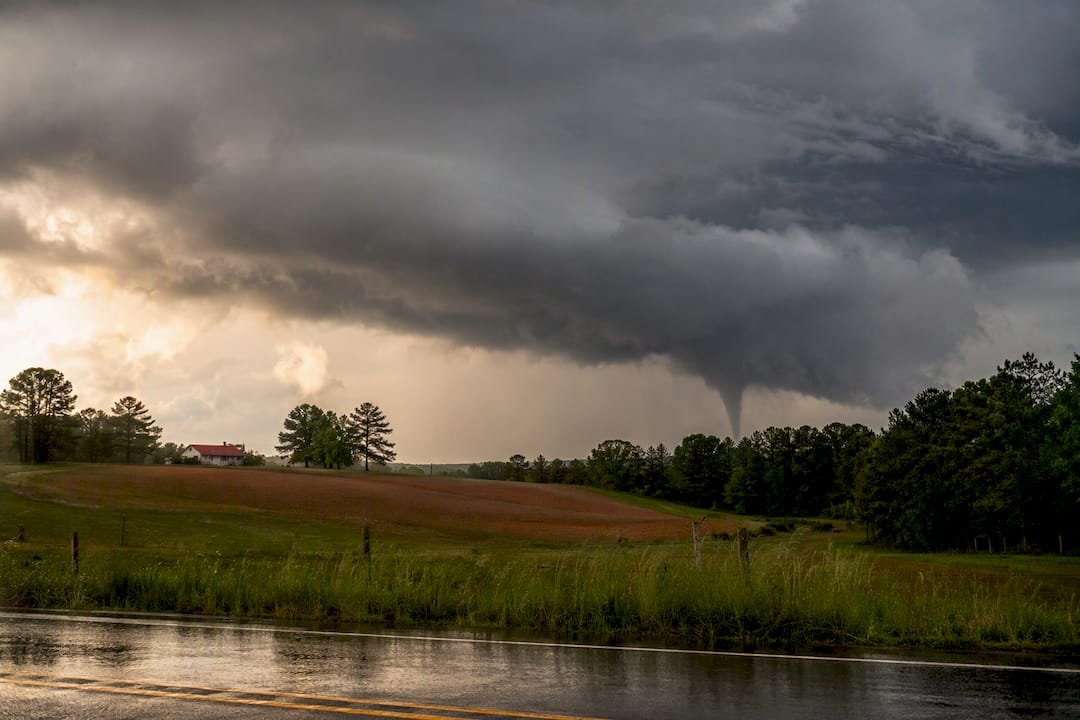
Tornado season in Georgia runs primarily from March through May, with April marking the state’s most active and dangerous month. The National Weather Service (NWS) office in Peachtree City and the Georgia Emergency Management and Homeland Security Agency (GEMA) both confirm this window, though tornadoes have struck in every month on record. Spring is when residents should be most vigilant.
TL;DR:
- Georgia’s tornado risk is highest in April, with most strong tornadoes (EF2 or higher) occurring during this peak month, but storms can happen year-round.
- Tornadoes in Georgia tend to form between 2 p.m. and 8 p.m., though overnight and quick spin-up events can occur at any hour, increasing unseen danger.
- Dense trees, rolling hills, and rain-wrapped storms make many Georgia tornadoes less visible and harder to predict, especially in mountainous and Piedmont regions.
- Reliable alerts include NOAA Weather Radio, NWS warnings, and GEMA updates, but residents should always layer sources and never rely solely on outdoor sirens.
- When a warning is issued, move to the lowest safe part of your home immediately, have a practiced plan, and consider leaving mobile homes to seek sturdier shelter.
Table of Contents
- When is tornado season in Georgia? Months, secondary peaks, and daily timing
- Why Georgia is vulnerable: geography, climate drivers, and regional differences
- Historical patterns and key statistics for Georgia
- How warnings, watches, and alerts work in Georgia
- What Georgia residents should do when a warning is issued
- How local reporting backs up the official alerts
- Three priorities for this tornado season
- How Thecentralgeorgian keeps you informed through severe weather
- Sources
When is tornado season in Georgia? Months, secondary peaks, and daily timing
Georgia’s tornado risk climbs sharply in March, peaks in April, and tapers through May. Historical NWS records show tornadoes have been reported in every month of the year in Georgia, but the concentration of strong tornadoes, storms rated EF2 or higher, clusters heavily in April.
Spring isn’t the only window worth watching. Late summer and fall bring a secondary bump in activity when tropical systems move inland. A weakening hurricane or tropical storm crossing Georgia can spin up brief, fast-moving tornadoes well away from the coast, often with little lead time. This is why Gulf-adjacent counties and areas along typical storm tracks stay on alert into September and October.
Time of day matters just as much as time of year. Georgia’s tornadoes tend to form in a predictable window:
- Mid afternoon through early evening, generally between 2 p.m. and 8 p.m., is the most favored period for tornado formation, driven by peak daytime heating and atmospheric instability.
- Overnight tornadoes, while less frequent, carry outsized danger because most people are asleep and unlikely to hear a warning without a working alert system nearby.
- Squall lines associated with fast-moving cold fronts can produce quick spin-up tornadoes at almost any hour, including well past midnight.
That overnight risk is the one Georgia residents underestimate most. A tornado warning issued at 2 a.m. only saves lives if something in the house is loud enough to wake you up.
Why Georgia is vulnerable: geography, climate drivers, and regional differences
Georgia sits in a meteorological collision zone. Warm, moist air pushing north from the Gulf of Mexico regularly meets cooler, drier air dropping down from the continental interior, and that clash builds the instability tornadoes feed on. Add a strong jet stream disturbance in spring, and the ingredients for rotating supercells come together fast.
Terrain complicates the picture. Dense tree cover across much of the state, combined with rolling hills, means many Georgia tornadoes are effectively invisible until they’re close. Storms here are frequently rain-wrapped, hidden inside heavy rainfall rather than standing out against a clear sky the way they might on the open Plains.
Risk isn’t uniform statewide. The Piedmont region and the coastal plain see more tornado days than the mountainous north, where terrain disrupts storm organization, though the mountains are not immune, and isolated events still occur there.
Historical patterns and key statistics for Georgia
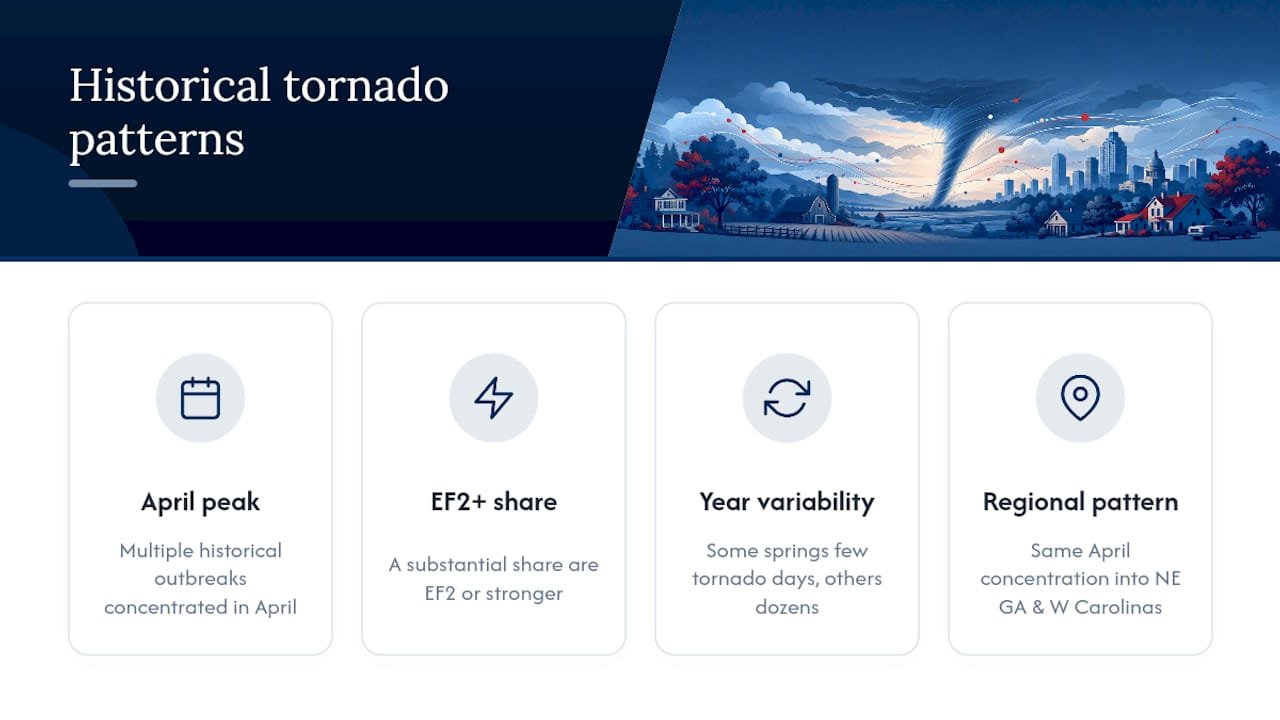
Georgia averages several tornado days per year, according to NWS Peachtree City climatology data, and roughly a substantial portion of the state’s tornadoes rate EF2 or stronger. That’s a meaningful share of significant, structurally damaging tornadoes, not just brief, weak spin-ups.
April’s dominance in the record isn’t a fluke of one bad year. Multiple historical outbreaks, including widely remembered spring events across the Piedmont, have concentrated in that single month, reinforcing NWS guidance that April deserves the most caution of any point on the calendar. Nearby regional data from NWS Greenville-Spartanburg shows the same April concentration extending into northeast Georgia and the western Carolinas, with violent tornadoes accounting for a disproportionate share of fatalities.
Year-to-year variability remains real. Some springs bring a handful of tornado days statewide; others bring dozens. Long-range seasonal forecasting can’t reliably predict which kind of year is coming, which is exactly why preparedness has to hold steady every spring, not just in years that look active in advance. Climate illustrates how much that variability swings from one year to the next across the broader Southeast.
How warnings, watches, and alerts work in Georgia
A tornado watch means conditions favor tornado development across a broad area. Stay alert, keep a way to receive alerts within reach, and review your shelter plan. A tornado warning means a tornado has been spotted or indicated by radar, and you need to act immediately, taking shelter now, not after checking the sky.
Here’s where to get reliable alerts, in rough order of priority:
- NOAA Weather Radio, which broadcasts warnings directly from the National Weather Service, day or night, with no internet required.
- NWS forecast office products, issued by Peachtree City for most of the state, including watches, warnings, and outlooks.
- GEMA alerts and preparedness updates, which translate NWS products into state-level guidance and action steps.
- Storm Prediction Center outlooks, which flag elevated severe weather risk days in advance.
- County and city government alert systems, often opt-in text or call services.
- Local news coverage, including outlets like Thecentralgeorgian, which layers in shelter locations, road closures, and community-specific detail official alerts don’t cover.
Pro Tip: Never rely on outdoor sirens alone. They’re built for people outside, not for anyone indoors, asleep, or more than a mile or two from the siren itself. Layer at least two alert sources so a single point of failure doesn’t leave you in the dark.
What Georgia residents should do when a warning is issued
When a tornado warning covers your area, move fast and move to the right spot:
- Get to the lowest floor, ideally a basement, and put as many walls as possible between you and the outside.
- If no basement exists, choose a small interior room, a bathroom or closet, away from windows.
- Cover your head and neck; a helmet or heavy blanket adds real protection against flying debris.
- If you live in a mobile home, leave it. Mobile homes offer almost no protection, even anchored ones, so get to a sturdy building or a designated community shelter before the storm arrives.
- If you’re driving, do not try to outrun a tornado. Get low in a sturdy building if one’s nearby, or as a last resort, get below road level in a ditch away from your vehicle.
Preparedness starts well before the sirens sound. Build a kit with water, a flashlight, a battery radio, and medications. Name a specific shelter spot in your home and walk it with everyone in the household so it’s not a debate in the moment. GEMA’s own guidance stresses that tornadoes are the state’s number-one weather-related killer precisely because they develop fast and punish hesitation.
Households with pets, older relatives, or family members with disabilities need a plan that accounts for extra time. Practice it. After the storm passes, stay off damaged roads, avoid downed power lines, and check on neighbors, especially anyone who lives alone.
Pro Tip: Rehearse getting to your shelter spot in under two minutes. That’s roughly the lead time some warned tornadoes give you.
How local reporting backs up the official alerts
Thecentralgeorgian delivers real-time coverage during severe weather, filling in details official alerts leave out: which roads are closed, which shelters are open, and how nearby communities are holding up. That local layer, paired with NWS and GEMA warnings, gives Central Georgia residents a fuller picture during fast-moving storms.
Three priorities for this tornado season
Georgia’s tornado risk rewards preparation over reaction. Build a household plan and name a shelter spot before spring arrives. Set up at least two independent alert channels, then actually test them. And once a storm passes, check on neighbors, particularly anyone elderly, alone, or without reliable transportation.
— Ernie
How Thecentralgeorgian keeps you informed through severe weather
Thecentralgeorgian gives Central Georgia residents something the national alert systems can’t: local detail delivered fast, from road closures to shelter openings to which neighborhoods took the hardest hit. Where NOAA and NWS tell you a warning is active, our newsroom tells you what’s happening on your street.
Our guide to monitoring local weather emergency updates walks through setting up redundant alert channels so a single dead phone battery or spotty signal doesn’t leave you uninformed. Pair that with our home preparedness checklist for natural disasters and our community resource partners at Areions for additional planning tools. If you’re tracking a specific incident, our tornado warning guidance for Macon residents breaks down immediate action steps by neighborhood. Sign up for local alerts and bookmark Thecentralgeorgian now, before storm season gives you a reason to scramble for it.
Sources
- Georgia Severe Weather Preparedness Week – Tornado Safety
- Tornadoes | Georgia Emergency Management and Homeland Security Agency
- Climate