Why Local News Matters for Your Community

Local news is defined as journalism that covers the events, institutions, and people within a specific geographic area, and it is the primary mechanism through which communities hold local power accountable. The American Press Institute identifies local news as essential to civic discourse, providing residents with the shared political knowledge required for collective self-governance. Research published in 2026 shows that declining local news coverage correlates directly with higher loneliness scores, reduced voter turnout, and increased municipal borrowing costs. Thecentralgeorgian covers Central Georgia with exactly this mission: to keep residents informed, connected, and civically engaged.
Why local news matters for community connection
Local news reduces social isolation in measurable ways. A 10-point increase in low-news counties correlates with a 1.4-point increase in individual loneliness scores, particularly in states with significant rural populations. That finding means the absence of local coverage is not just an information gap. It is a public health problem.
Human interest stories are the mechanism behind this effect. Coverage of a neighborhood fundraiser, a school sports championship, or a local business anniversary gives residents a shared reference point. These stories create what researchers describe as a common identity. Human interest coverage is often dismissed as “fluff,” yet it functions as critical infrastructure for community mental health.
National media and social platforms do not fill this gap. A story about a Washington, D.C., policy debate does not tell a Macon resident which city council member voted against road repairs on their street. Hyperlocal news serves a distinct function: it connects readers to the specific people and decisions that shape their immediate environment. That specificity is irreplaceable.
- Local news creates shared reference points that reduce feelings of isolation.
- Coverage of community events builds a sense of collective identity.
- Rural areas face the steepest loneliness increases when local outlets close.
- National media cannot replicate the geographic specificity of local reporting.
Pro Tip: If you want to feel more connected to your community, read at least one local news story per day. Readers who follow local coverage consistently report stronger neighborhood ties than those who rely solely on national outlets.
How does local news strengthen democratic participation?
Local news is the primary driver of informed voting at the municipal level. UK government research through the Department for Digital, Culture, Media and Sport establishes a strong positive correlation between local news availability and voter turnout in local elections. That correlation holds across different types of communities and different electoral systems.

The American Press Institute describes local news as an “on-ramp” to civic membership. Readers who follow local coverage learn the names of their school board members, understand zoning decisions, and track how public funds are spent. That knowledge translates directly into participation. Residents who lack access to local news are less likely to vote in local elections, attend public meetings, or contact their representatives.
Democracy and rule of law depend on a shared sense of place and common political knowledge. Without local journalism, that shared foundation erodes. Residents form opinions based on national partisan narratives that have little connection to the specific conditions in their city or county.
| Civic outcome | Effect of strong local news coverage |
|---|---|
| Voter turnout | Increases in local municipal elections |
| Public meeting attendance | Higher rates of resident participation |
| Political knowledge | Residents better informed on local candidates and issues |
| Community trust | Stronger confidence in local institutions |
- Local news coverage directly increases voter turnout in municipal elections.
- Readers gain specific knowledge about local candidates and ballot measures.
- Civic participation extends beyond voting to include public comment and community organizing.
- Communities with active local news outlets show stronger institutional trust.
How does local journalism hold government accountable?
Local reporters function as the primary check on government spending and official conduct. Without that scrutiny, public officials face no external pressure to act responsibly with taxpayer funds. The case of Bell, California, is the clearest documented example. Without local media oversight, the city manager’s annual compensation reached $787,637. That figure was not discovered until a local reporter began asking questions.
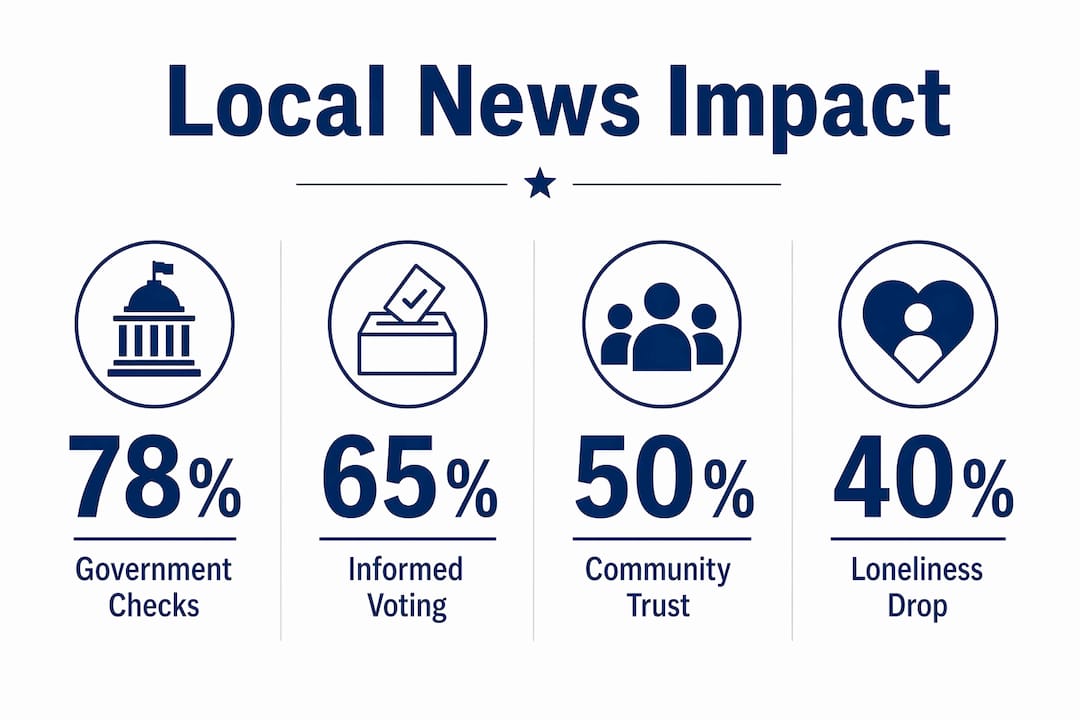
The fiscal consequences of absent local journalism extend beyond individual cases. Research shows that local news lowers the risk premium on municipal bonds by increasing government accountability in public spending and procurement. When local reporters are not watching, municipalities borrow at higher rates because investors price in the risk of unchecked fiscal mismanagement. Local journalism, in this sense, saves taxpayers money.
Investigative work at the local level also produces national impact. The Connecticut Mirror, a nonprofit local outlet, produced Pulitzer-winning reporting that exposed harms long ignored by state and federal media. The reporting focused on sustained scrutiny rather than sensationalism. That approach, applied consistently over months or years, is what produces legal and policy reforms.
Local investigative journalism gives voice to residents who have been ignored and exposes harms that have gone unseen for years. The most impactful work comes from reporters who stay in a community long enough to understand it, not from parachute journalists who arrive after a crisis.
The role of the local reporter is not glamorous. It involves attending budget meetings, filing public records requests, and following up on tips that most national outlets would never pursue. That unglamorous work is precisely what protects public funds and keeps officials honest.
What are the biggest threats to local news today?
Local news outlets are closing at a rate that creates what researchers call “news deserts.” These are geographic areas with no regular local coverage. The consequences are predictable: information vacancies fill quickly with partisan national media and social platforms built to maximize engagement through anger and outrage. Those replacements do not serve the civic functions that local journalism performs.
The advertising model that sustained local newspapers for a century has collapsed. Digital platforms captured the classified and display advertising revenue that once funded local newsrooms. The result is fewer reporters covering more ground with less time for the deep, sustained reporting that produces accountability journalism.
Several responses have shown promise. Collaborative models pair small local newsrooms with larger nonprofit outlets, enabling the kind of investigative scrutiny that small teams cannot achieve alone. Community-supported journalism, where readers pay directly for coverage, has sustained outlets in markets where advertising alone cannot. Philanthropic funding from local foundations has also kept some newsrooms operating.
- News deserts leave residents with no reliable source of local information.
- Partisan national media fills the gap but does not cover local government or community events.
- Collaborative reporting between local and nonprofit outlets produces high-impact journalism.
- Reader-supported models give communities direct control over their local news.
- Philanthropic investment in local journalism has grown as the advertising model has declined.
Pro Tip: Subscribing to or donating to a local news outlet is one of the most direct civic investments you can make. Even a small monthly contribution helps fund the reporters who cover your school board, city council, and local courts.
Key Takeaways
Local news is the foundation of informed communities, and its absence produces measurable harm to civic health, public finances, and social well-being.
| Point | Details |
|---|---|
| Loneliness and local news | A 10-point rise in low-news counties correlates with a 1.4-point increase in individual loneliness scores. |
| Voter turnout | Strong local news availability correlates with higher participation in municipal elections. |
| Government accountability | Local reporters prevent fiscal abuse, as shown by the Bell, California case involving a $787,637 city manager salary. |
| Municipal bond costs | Local journalism lowers borrowing costs by keeping government spending under public scrutiny. |
| News deserts | When local outlets close, partisan media and social platforms fill the gap, reducing civic discourse quality. |
The case for local news I keep coming back to
I have covered enough community stories to know that the most consequential journalism rarely makes national headlines. A city council vote on a zoning variance. A school board decision about curriculum. A sheriff’s department budget that quietly doubled over three years. These are the stories that change people’s daily lives, and they get covered only when a local reporter shows up.
The Bell, California case stays with me. A city manager earning nearly $800,000 in a working-class city of 35,000 people. That situation persisted for years because no one was watching. One local reporter changed that. The accountability function of local journalism is not theoretical. It is the difference between a city that works for its residents and one that works against them.
What I find underappreciated is the social function. Readers often tell me they feel more connected to their neighborhood after following local coverage for a few months. That is not a coincidence. Local news helps residents see each other, recognize shared concerns, and act collectively. That function cannot be replicated by an algorithm or a national broadcast.
Thecentralgeorgian exists because Central Georgia deserves that kind of coverage. The community reporting, the public safety alerts, the crime investigations. All of it serves the same purpose: keeping residents informed about the place where they live.
— Ernie
Thecentralgeorgian and the community it serves
Thecentralgeorgian covers Macon and Middle Georgia with the depth and consistency that civic health requires. From breaking crime investigations to public health advisories, the platform delivers the kind of reporting that keeps residents safe and informed.

The coverage at Thecentralgeorgian goes beyond headlines. Each story connects readers to the people, institutions, and decisions that shape life in Central Georgia. Public safety alerts, government accountability reporting, and community event coverage all serve the same goal: a more informed and connected citizenry. Readers who stay current with local news are better equipped to participate in civic life, protect their families, and hold local officials accountable.
FAQ
Why does local news matter more than national news?
Local news covers the specific decisions, officials, and events that directly affect your daily life. National media cannot report on your city council, local courts, or neighborhood public safety issues.
How does local news reduce loneliness?
Research shows that a 10-point increase in low-news counties correlates with a 1.4-point rise in individual loneliness scores. Human interest stories and community event coverage create shared identity and social connection.
What is a news desert?
A news desert is a geographic area with no regular local news coverage. When local outlets close, partisan national media and social platforms fill the gap, reducing the quality of civic information available to residents.
How does local journalism protect taxpayers?
Local reporters hold government officials accountable for public spending. Research shows that communities with active local news coverage face lower municipal borrowing costs because investors price in less fiscal risk.
Why does local reporting win awards?
Local reporting wins awards because it produces sustained, community-specific investigations that expose injustices ignored by national media. Outlets like the Connecticut Mirror have earned Pulitzer Prizes through long-term scrutiny of local institutions.