
What Is a News Tip? A Guide for Community Members

A news tip is defined as a specific, verifiable piece of information that alerts a journalist to a potentially newsworthy story. In professional newsrooms, this practice is also called a “tip” or “lead,” and it forms the foundation of public-interest reporting. Community members are experts on their own experiences and regularly surface stories that reporters would otherwise miss. Understanding what is a news tip, and how to submit one effectively, gives you real influence over what gets covered in your community.
What are the essential elements of a good news tip?
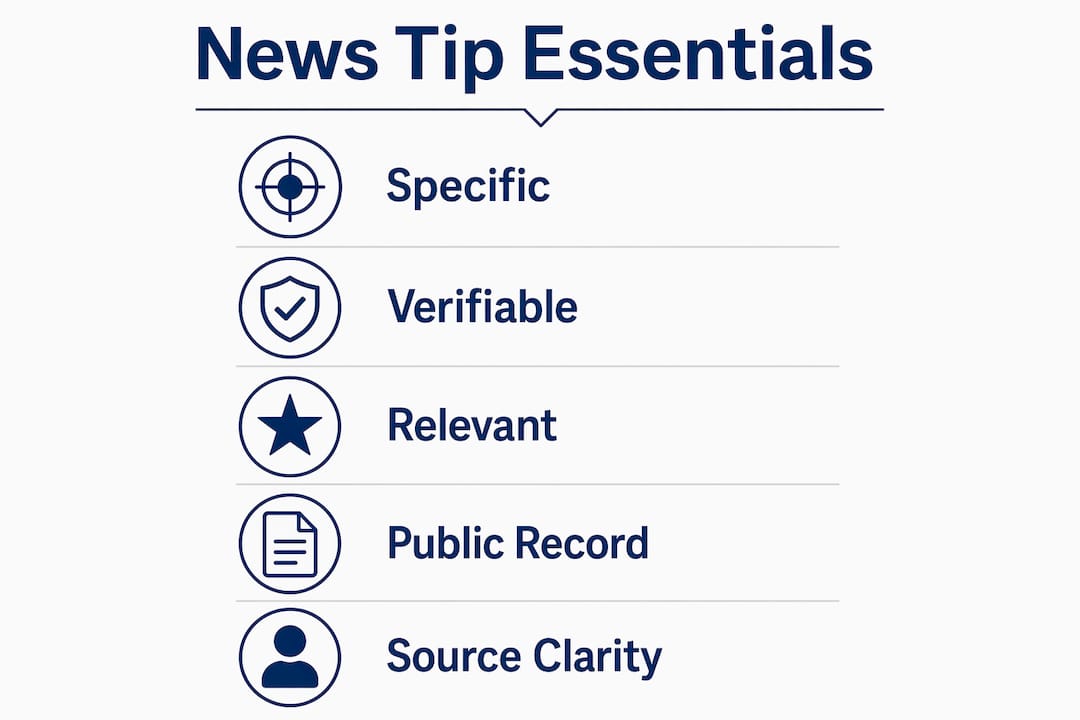
A strong news tip is specific, verifiable, and rooted in public interest, answering who, what, when, where, and why it matters to the community. Newsrooms prioritize leads on municipal policy, business developments affecting the local economy, and public safety issues. Vague impressions or unconfirmed rumors rarely advance to full stories. Specificity and evidence are what separate a useful tip from noise.
The core elements of a good news tip include:
- Who is involved. Name the individuals, agencies, or organizations at the center of the issue.
- What is happening. Describe the specific event, decision, or pattern you observed.
- When it occurred or is occurring. Provide dates, times, or a timeline.
- Where it is taking place. Include addresses, districts, or jurisdictions.
- Why it matters. Explain the public impact, whether that is safety, spending, or accountability.
- Evidence or documentation. Reference any public records, photos, or official filings you have access to.
A weak tip says, “I think something shady is happening at City Hall.” A strong tip says, “The city council approved a no-bid contract for $400,000 to a vendor connected to the mayor’s office at the March 12 meeting. The contract is listed in the public meeting minutes.”
Pro Tip: Before you send a tip, write one sentence that explains why this story matters to people who are not directly involved. If you cannot write that sentence, the tip needs more work.

Verifiability is the single most important quality a tip can have. Public records improve tip quality and reader trust by giving journalists a clear verification path. Meeting minutes, contracts, court filings, and official budgets all qualify as documentary support. A tip backed by a public record is far more likely to become a published story.
How do journalists handle news tips and maintain ethical standards?
Journalists treat incoming tips as raw material, not finished stories. Reporters verify and investigate leads thoroughly before publishing, which means your tip starts a process rather than ending one. Newsrooms have formal protocols for receiving, assessing, and protecting the information they receive.
Standard newsroom practices for handling tips include:
- Confidentiality by default. Anonymous tips are standard practice. Reporters do not publish source identities without explicit consent.
- Secure submission channels. Reporters offer encrypted messaging and secure online forms to protect sensitive submissions.
- Follow-up as a rule. The vast majority of investigative cases require follow-up contact to clarify details and confirm facts before a story moves forward.
- Ethical review. Reporters assess whether a tip serves genuine public interest or primarily benefits the person submitting it.
- Source protection. Journalists follow established ethical guidelines that prohibit revealing confidential sources without consent.
Explicitly labeling whether your tip is on-the-record, off-the-record, or anonymous establishes clarity and protects both you and the journalist during any follow-up. On-the-record means your name can be used. Off-the-record means the information can guide reporting but not be published directly. Anonymous means your identity is withheld entirely. Choosing the right label upfront prevents misunderstandings and keeps the process clean.
Journalists also prioritize tips based on public impact. A tip about a local zoning decision that affects hundreds of residents ranks higher than a tip about a personal dispute between neighbors. Reporters are looking for stories that serve their audience, not individual grievances.
How can community members effectively give news tips in 2026?
Giving a news tip effectively requires preparation, clarity, and the right submission method. Preliminary research by the tipper can turn a vague hunch into a compelling story that attracts reporter attention. The steps below apply whether you are contacting a national outlet or a local publication like Thecentralgeorgian.
- Do your homework first. Search public records, government websites, and official meeting archives before you write anything. Identify the specific document or filing that supports your tip.
- Write a clear, brief message. Effective pitches under 200 words with direct, personalized messaging increase the chances of coverage. State the core claim in your first sentence.
- State your record status. Tell the journalist upfront whether you are speaking on-the-record, off-the-record, or anonymously. This single step protects you and speeds up the reporter’s decision.
- Match the tip to the right journalist. Tailoring your tip to a journalist’s specific beat and citing their prior work shows genuine relevance and increases acceptance. A crime tip goes to the crime reporter. A school board tip goes to the education reporter.
- Choose a secure submission method. Options include encrypted messaging apps, secure online tip forms, or direct email. Many newsrooms publish dedicated tip lines on their websites.
- Include your contact information. Even if you want anonymity in print, giving the reporter a way to reach you for follow-up questions makes your tip far more useful.
- Follow up once. If you do not hear back within a week, one brief follow-up message is appropriate. Repeated contact can work against you.
Pro Tip: Attach or link to the specific public record that supports your tip. A journalist who can open a document and verify your claim immediately is far more likely to pursue the story.
Matching your tip content to the appropriate public record type, such as legislation, meeting minutes, or contracts, guides the journalist’s verification path and reduces the time between tip and publication. The easier you make the reporter’s job, the faster your story gets told.
What are common news tip examples and their impact on local reporting?
News tips have driven some of the most consequential local journalism. The table below illustrates how different types of tips translate into published stories and community outcomes.
| Tip type | Example | Outcome |
|---|---|---|
| Government accountability | Resident flags a no-bid contract in city council minutes | Reporter investigates procurement process; city revises bidding policy |
| Public safety | Neighbor reports repeated code violations at a rental property | Outlet publishes inspection records; city issues citations |
| Business practices | Worker tips off reporter about unpaid wages at local employer | Investigation leads to state labor board inquiry |
| Community initiative | Resident alerts reporter to a grassroots food program serving 500 families | Feature story increases donations and volunteer sign-ups |
| Environmental concern | Tip about illegal dumping near a public park | Reporter obtains EPA filings; cleanup ordered within 30 days |
News tips lead to impactful stories by uncovering waste, fraud, community issues, and local government activities, holding power accountable. Each row in the table above started with one person deciding to speak up. The tip did not need to be a complete investigation. It needed to be specific, credible, and tied to a verifiable fact.
Balancing anonymity with credibility is the central challenge in tip-driven reporting. A tip from an anonymous source still gets published when the underlying documents are solid. Reporters at outlets like Thecentralgeorgian regularly use public records to confirm anonymous tips before a single name appears in print. The record does the work that the anonymous source cannot.
Key Takeaways
A news tip is most effective when it is specific, tied to a public record, and clearly labeled with the source’s preferred level of anonymity.
| Point | Details |
|---|---|
| Definition of a news tip | A news tip is specific, verifiable information that alerts a journalist to a story of public interest. |
| What makes a tip strong | Include who, what, when, where, why, and at least one supporting public record or document. |
| Journalist handling | Reporters treat tips as starting points and verify all claims before publishing. |
| Submission best practices | Keep messages under 200 words, state your record status, and match the tip to the right reporter. |
| Community impact | Tips on government, safety, and business practices regularly lead to accountability reporting and policy change. |
Why community tips are the backbone of local journalism
Local journalism depends on community members more than most readers realize. Reporters cover entire cities, counties, and regions with small teams. They cannot attend every meeting, read every contract, or witness every incident. You can.
The tips I find most valuable are not the dramatic ones. They are the quiet, specific ones: a reader who noticed a line item in a budget that did not add up, a worker who kept a copy of a policy memo, a parent who photographed a safety hazard at a school. Those tips are credible precisely because they come with documentation and a clear explanation of why the issue matters.
Reporters are not looking for finished investigations. They are looking for a door to open. Your job as a tipper is to point to the door and hand over the key, which is the public record or the specific fact that makes the story real. Do not wait until you have the whole story. Send the tip when you have something specific and verifiable.
One practical note: do not be discouraged if a reporter does not respond immediately. Newsrooms are busy, and not every tip fits the current news cycle. A tip submitted today may become a story three months from now when a related event makes it timely. Persistence, done respectfully, pays off.
— Ernie
Thecentralgeorgian and your role in Central Georgia news
Thecentralgeorgian covers breaking news, crime investigations, public safety alerts, and community events across Central Georgia. The reporting here is built on verified facts and direct community engagement.

Readers who notice something worth reporting are encouraged to reach out directly. Whether you have spotted a public safety concern, a government decision affecting your neighborhood, or a community story that deserves attention, your information matters. Submit your tip through Thecentralgeorgian’s news platform and include the specific details, dates, and any public records you have found. The newsroom reviews all submissions and follows up when additional information is needed. Your participation strengthens local accountability journalism.
FAQ
What is a news tip in journalism?
A news tip is specific, verifiable information submitted to a journalist that alerts them to a potentially newsworthy story. It serves as the starting point for reporting, not a finished account.
How do I give a news tip to a local reporter?
Write a brief message under 200 words, state whether you are on-the-record or anonymous, include any supporting public records, and send it to the reporter who covers that specific beat.
Does a news tip have to be from a named source?
No. Anonymous tips are standard practice in newsrooms. Reporters protect source identities and use public records and independent verification to confirm the facts before publishing.
What makes a news tip more likely to be covered?
Tips tied to public records such as contracts, meeting minutes, or official filings are significantly more likely to advance to a published story because they give reporters a clear verification path.
Who should I send a news tip to?
Send tips to the journalist who covers the relevant beat, whether that is local government, crime, education, or public health. For Central Georgia stories, Thecentralgeorgian accepts tips directly through its website.