How Local Sports Events Are Funded in the U.S.

How local sports events get their funding
Local sports events in the United States draw from several distinct funding sources, and no single mechanism covers all costs on its own. Government trust funds, state grant programs, local council contributions, private sponsorships, and grassroots fundraising all play defined roles. Organizers who understand each source, and how they interact, are better positioned to build a complete event budget.
The core funding paths for most local sports events include:
- State trust funds and reimbursement programs that return event-generated tax revenue to organizers
- State and local grant programs targeting youth sports, amateur competition, and community events
- Local government capital investment in facilities and infrastructure
- Private sector sponsorships tied to marketing value
- Grassroots fundraising including direct donation campaigns and community drives
- Earned revenue from ticket sales, merchandise, and registration fees
- In-kind donations and volunteer labor that reduce direct cash expenditures
Table of Contents
- Key government funding programs that support sports events
- How local councils and communities contribute to sports funding
- Grassroots and supplemental fundraising strategies
- Applying for grants and meeting reporting requirements
- Crowdfunding approaches for local sports events
- How ticket sales and merchandise affect event financing
- In-kind donations and volunteer contributions
- Budget planning and financial management best practices
- Key Takeaways
Key government funding programs that support sports events
State-level programs represent the most structured path to significant funding for local sports events. Three programs illustrate how these mechanisms work in practice.
Texas Event Trust Funds operate through a reimbursement model tied directly to economic impact. A municipality, county, or endorsed nonprofit organizing committee can apply for state tax reimbursements when hosting a qualifying event. The state matches contributions at a ratio requiring applicants to contribute $1 in local tax gains for every $6.25 the state contributes. If sufficient tax receipts are deposited, 100% of allowable expenses may be funded. The program covers sales, hotel, auto rental, and alcoholic beverage taxes generated during the event period, and there is no fixed maximum or minimum award amount.
Washington State Sports Commission works to attract sporting events to Washington by connecting organizers with state resources, venue support, and promotional assistance. The Commission functions as a liaison between event organizers and local host communities, helping structure bids for regional and national competitions.
North Carolina Youth Outdoor Engagement Commission administers youth sports grants available to government agencies and 501©(3) nonprofits across all 100 counties. Awards reach up to $5,000 for travel funding and up to $25,000 for hosting state, regional, or national youth sporting events. Eligible uses include equipment, facility upgrades, and event operations.
| Program | Award Structure | Eligible Applicants | Key Use |
|---|---|---|---|
| Texas Event Trust Funds | Reimbursement; no fixed cap | Municipalities, counties, endorsed nonprofits | Facilities, operations, travel |
| NC Youth Sports Grants | Up to $25,000 (hosting); up to $5,000 (travel) | Government agencies, 501©(3) nonprofits | Equipment, facility upgrades, event hosting |
| Washington State Sports Commission | Varies by event | Event organizers, local host committees | Bid support, venue coordination |
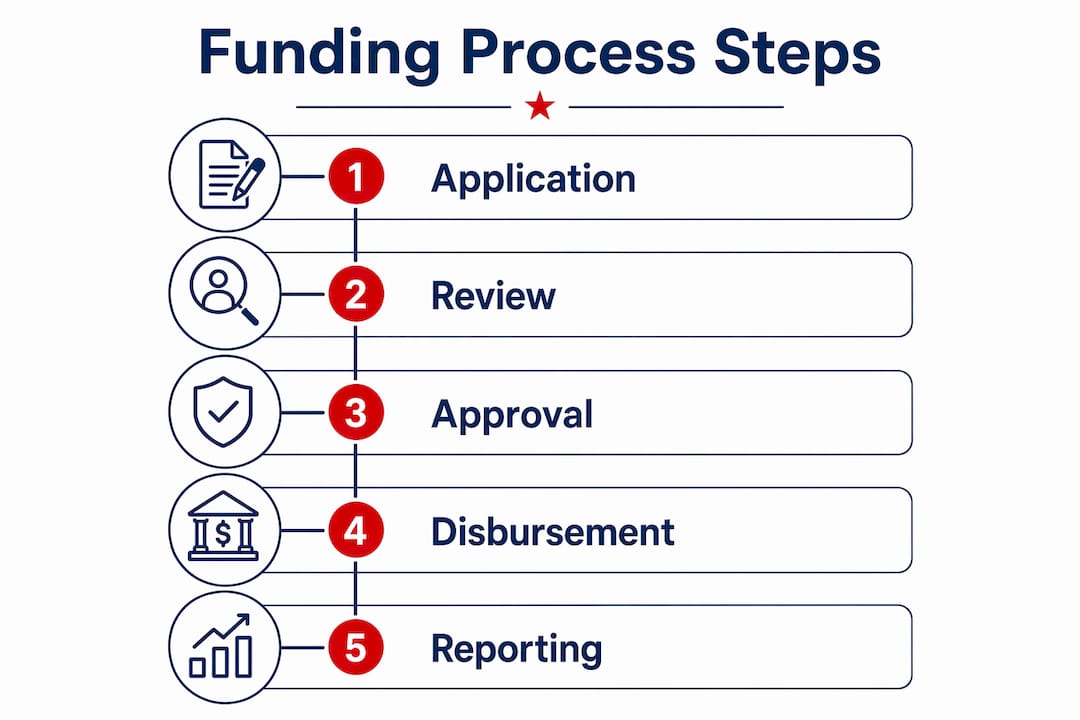
Grant awards under programs like the Texas Event Trust Funds are disbursed on a reimbursement basis after the event concludes and submitted costs are reviewed by the Governor’s Office.
How local councils and communities contribute to sports funding
Local governments provide a layer of support that state programs alone cannot replace. The most direct contribution is capital investment in sports facilities, which reduces the infrastructure costs event organizers would otherwise absorb.
Nebraska offers a clear example of tax-based financing at the local level. Under state law, cities can direct up to 70% of new sales taxes generated near sports facilities toward construction bonds. Smaller cities receive a 25% turnback on state sales tax for five years to support sports complex development. These mechanisms allow communities to build or upgrade venues without relying entirely on state grants.

Community foundations and nonprofit organizations also serve as funding intermediaries. They can receive donations, administer grant funds, and coordinate with local governments on event support. For organizers, nonprofit partnerships often open access to grant eligibility categories that public agencies cannot reach on their own.
Large capital projects typically require voter approval, which means community buy-in is a practical prerequisite, not just a formality. Local councils weigh economic impact projections, facility utilization rates, and long-term event potential when deciding how much public funding to commit.
Grassroots and supplemental fundraising strategies
Government grants rarely cover every line item in an event budget. Grassroots fundraising fills the gap, and the format chosen matters as much as the effort invested.
Direct digital donation campaigns with short deadlines consistently outperform traditional fundraising events. They require fewer volunteers, create a defined urgency window, and generate returns without the logistical overhead of a gala or auction. For smaller organizing committees with limited staff, this format is often the most practical starting point.
Local business sponsorships represent a separate and reliable revenue stream. Businesses allocate marketing budgets annually, and tiered sponsorship packages that specify deliverables, such as logo placements, social media mentions, and on-site signage, give sponsors a clear return on their investment. Vague requests for “support” rarely convert; structured packages with defined benefits do.
Administrative compliance is a prerequisite for recurring funding approval. Maintaining clear, exportable transaction records and following district or organizational reporting requirements improves approval chances.pdf) and builds the track record funders look for in subsequent cycles.
Pro Tip: Match your fundraising format to your volunteer capacity. A fundraising format that requires 20 volunteers to execute is not viable for a committee of five. Digital campaigns are feasible for small teams; complex events are not.
For youth team organizers specifically, resources like smart youth fundraising ideas outline practical approaches that avoid door-to-door sales and other high-effort, low-return methods.
Applying for grants and meeting reporting requirements
The grant application process follows a predictable structure across most programs. Organizers submit a proposal detailing the event, its economic impact, the budget, and how funds will be used. Most programs require applications well in advance of the event date, with national and international event applications often due six months or more before the event.
Submitting a concise, one-page funding proposal at least two weeks before a deadline, with clear event details and a stated commitment to financial oversight, is standard practice for approval. After the event, reimbursement-based programs require organizers to submit verified cost documentation before funds are released.
Reporting requirements typically include post-event financial statements, participant counts, and evidence of how grant funds were spent. Programs that fund recurring events, such as annual tournaments, often review prior-year reporting before approving subsequent applications. Clean records from previous cycles directly affect future eligibility.
Crowdfunding approaches for local sports events
Crowdfunding platforms give organizers direct access to community donors without requiring a formal grant application. Campaigns work best when they are tied to a specific, tangible goal, such as covering referee fees for a regional tournament or purchasing new equipment for a youth league.
Effective campaigns set a defined funding target, communicate a clear deadline, and update donors on progress. Campaigns that stall at low percentages of their goal early tend not to recover. Launching with a base of committed donors who contribute in the first 48 hours signals momentum to casual visitors and increases overall conversion.
Platform fees vary, and organizers should account for them in the campaign target. All-or-nothing models, where funds are only collected if the goal is met, can increase donor confidence but carry the risk of returning all contributions if the target falls short.
How ticket sales and merchandise affect event financing
Earned revenue from ticket sales and merchandise reduces dependence on grants and donations. For events with broad community appeal, ticket pricing should reflect both the audience’s willingness to pay and the cost recovery goal. Underpricing tickets to maximize attendance can leave organizers short of covering venue and staffing costs.
Merchandise, including event-branded apparel and equipment, generates revenue while extending the event’s visibility. Pre-event merchandise sales also provide early cash flow, which helps cover deposits and advance payments before grant reimbursements arrive.
Registration fees for participant-entry events, such as road races or youth tournaments, function similarly to ticket sales. They are predictable, collected upfront, and directly tied to event scale.
In-kind donations and volunteer contributions
In-kind donations reduce the cash budget without reducing event quality. Donated goods and services, such as venue space, catering, printing, or equipment, carry real dollar value and should be recorded as both income and expense in the event budget. This practice matters for grant reporting, where funders often want to see the full cost picture.
Volunteer labor is the most common in-kind contribution. Hours contributed by volunteers represent a direct offset to staffing costs. Many grant programs recognize volunteer time as a form of match funding, which can help organizers meet contribution requirements tied to state programs.
Budget planning and financial management best practices
A complete event budget accounts for all costs before any funding is secured. Organizers who build their budget around confirmed grants risk a shortfall if an application is denied. The more reliable approach is to identify the full cost first, then map each line item to a specific funding source.
Separate accounts for grant funds and general event revenue prevent commingling, which can create compliance problems during post-event audits. Tracking expenses in real time, rather than reconstructing them after the event, produces the clean documentation that reimbursement programs require.
Contingency planning for a 10%–15% budget overrun is standard practice. Venue costs, travel expenses, and official fees frequently run higher than initial estimates, particularly for first-time events at a given location.
Key Takeaways
Local sports events in the United States are funded through a combination of state reimbursement programs, local government investment, private sponsorships, and grassroots fundraising, with no single source covering all costs.
| Point | Details |
|---|---|
| State trust funds reimburse costs | Texas Event Trust Funds require $1 in local tax gains for every $6.25 the state contributes, with 100% of allowable costs covered if tax receipts are sufficient. |
| NC youth grants reach up to $25,000 | North Carolina offers up to $25,000 for hosting youth sports events and up to $5,000 for travel, available to government agencies and 501©(3) nonprofits. |
| Nebraska tax turnbacks fund infrastructure | Nebraska cities can direct up to 70% of new sales taxes near sports facilities toward construction bonds. |
| Digital campaigns outperform traditional events | Short online fundraising sprints require fewer volunteers and generate higher returns than labor-intensive fundraising events. |
| Clean records drive repeat funding | Maintaining exportable transaction reports and meeting reporting requirements directly improves approval chances for future grant cycles. |
Stay current on local funding decisions and community event coverage at Thecentralgeorgian, Central Georgia’s source for local news and civic affairs.