Breaking News Alert Explained: What You Need to Know

What is a breaking news alert?
A breaking news alert is an urgent notification designed to inform the public of a significant, unfolding event that requires immediate attention. According to the Columbia Journalism Review, the term describes timing, not certainty — it signals that an event is new and currently developing, not that all facts have been confirmed. Natural disasters, major public safety threats, and significant policy changes are among the most common triggers.
Key characteristics of a breaking news alert:
- Signals an event is new and unfolding, not necessarily fully verified
- Interrupts scheduled content to deliver time-sensitive public information
- Covers events such as severe weather emergencies, active public safety threats, and major government actions
- Prioritizes urgency and timing over comprehensive detail
Key components and timing of breaking news alerts
Effective breaking news alerts share a consistent structure regardless of the platform delivering them. Each alert typically includes an urgency indicator, a brief factual description of the event, source attribution, and a call to action when public safety is involved. Clarity and brevity are not stylistic preferences — they are functional requirements when readers have seconds to decide how to respond.
Core components found in well-constructed alerts:
- Urgency indicator: A label or tone that signals the alert requires immediate attention
- Brief description: A factual summary of what is known at the time of publication
- Source attribution: Identification of the originating agency or outlet
- Call to action: Instructions for public response when personal safety is at stake
- Timing: Alerts are typically sent within minutes of an event’s occurrence
Newsrooms also apply protocols to prevent alert fatigue. Sending too many notifications causes readers to disable them entirely, which defeats the alert’s purpose. Feature alerts, for example, are generally scheduled during daytime hours to avoid unnecessary disruption.
How breaking news alerts are created, verified, and delivered

Verification is the central discipline behind trustworthy breaking news alerts. Reuters confirms information with a primary source such as police, fire, or federal agencies before sending any text alert to subscribers. The 2018 Hawaii false missile alert — which sent residents into panic for nearly an hour — illustrates precisely what happens when that discipline fails.

Reputable newsrooms follow a three-layer verification process: confirm with a primary source, seek independent corroboration from at least one additional credible outlet, and avoid publishing details based solely on speculation. Editorial decisions also govern alert frequency. NPR, for instance, categorizes alerts as breaking news that subscribers need immediately versus feature alerts covering investigative work or new programming, with separate timing rules for each category.
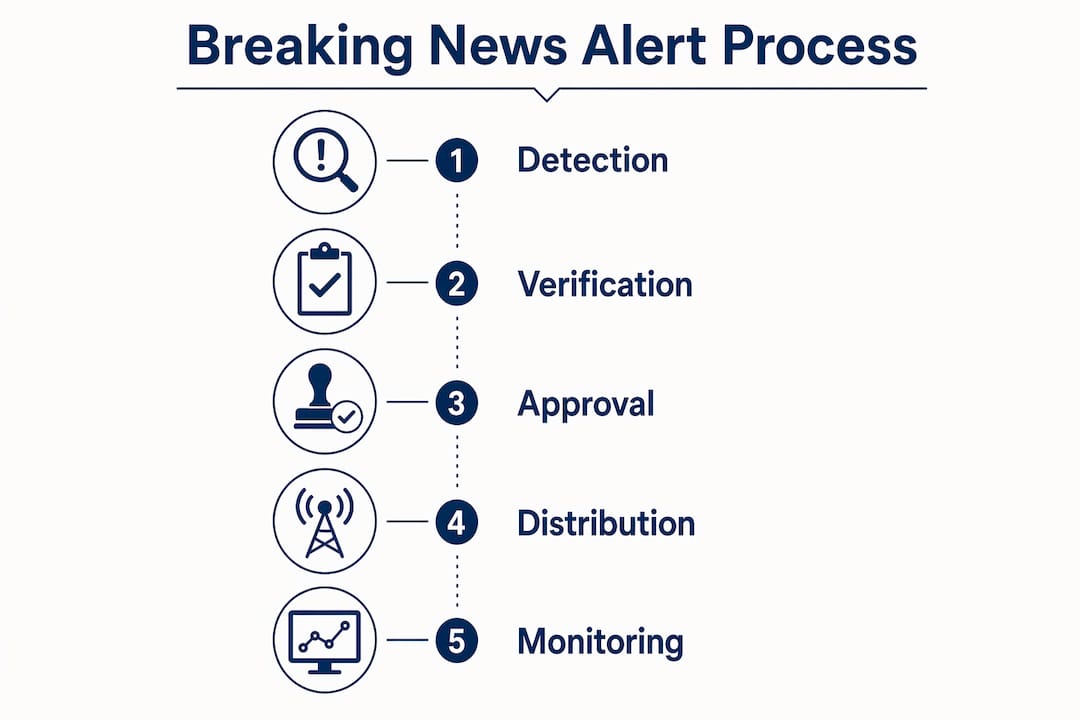
Delivery channels include mobile push notifications, SMS, email, and broadcast interruptions. Each channel carries different audience expectations and engagement patterns.
Pro Tip: Treat a breaking news alert as a prompt to pay attention, not as a complete account. The first alert is typically the least stable version of any story — fuller reporting follows.
How breaking news alerts differ from related news terms
Understanding the distinctions between related news terms helps readers interpret the urgency and reliability of what they receive.
- Breaking news alert: Signals a new, unfolding event requiring immediate public awareness. Facts may still be incomplete or unconfirmed at the time of delivery.
- Headline news: Covers the significant stories of the day or ongoing developments. Does not carry the same urgency signal as a breaking alert.
- News flash: A brief, urgent bulletin, historically used in broadcast media to interrupt programming for critical developments. Similar in urgency to a breaking alert but typically shorter in scope.
- Special report: Provides extended, in-depth coverage of a major event, often after initial breaking details have been confirmed and context has developed.
- Developing story: Signals that key facts are still changing and that responsible readers should expect updates, corrections, and revised framing as reporting matures.
The practical difference for readers: a breaking alert warrants immediate awareness, while a developing story warrants continued monitoring. Headline news and special reports generally indicate a higher level of editorial confirmation.
How to safely receive and manage breaking news alerts
Safe consumption of breaking news begins with source verification. Before accepting or sharing an alert, readers should check the original publisher, confirm the claim with at least one independent reputable outlet, and watch for language that signals uncertainty, such as “reports suggest” or “early indications.” Reacting to unconfirmed details — or sharing them — carries real risk of spreading inaccurate information.
Practical steps for managing alerts responsibly:
- Set alert preferences to prioritize trusted, verified sources over aggregators or social media accounts
- Limit the number of outlets sending push notifications to reduce overload
- Pause before sharing any breaking alert until at least one independent confirmation exists
- Recognize that speed can undermine accuracy — waiting for follow-up reporting produces better understanding
- Create personal boundaries for news intake, particularly during high-volume news cycles
Readers also benefit from cross-comparing multiple sources rather than reading multiple versions from a single outlet. When different credible outlets agree on core facts, confidence in those facts improves.
Pro Tip: Before sharing any breaking alert, run a 30-second check: identify the source, confirm the claim exists at a named outlet, and reduce the headline to one plain factual sentence. If any step fails, hold the item.
How to get breaking news alerts on your phone
Most readers receive breaking news notifications through news apps, mobile push alerts, or SMS from trusted sources. Setting up alerts requires granting notification permissions within each app’s settings, then customizing which topics or alert categories trigger a notification.
Steps for setting up reliable breaking news notifications:
- Download apps from established news organizations that apply editorial verification standards
- Enable push notifications in your device’s settings for each trusted app
- Review each app’s alert categories and select only “need-to-know” or urgent news tiers
- Set quiet hours in your device settings to prevent overnight disruptions from non-urgent alerts
- Periodically audit which apps have notification permissions and remove sources that over-alert or lack clear editorial standards
For Central Georgia residents, Thecentralgeorgian provides timely local alerts covering public safety, crime investigations, and community developments. The Local News Alert Checklist offers a practical framework for evaluating and acting on local alerts responsibly.
How Thecentralgeorgian applies local breaking news protocols
Thecentralgeorgian covers breaking news in Central Georgia with the same verification standards applied by major national outlets. The platform publishes timely alerts on crime investigations, public health advisories, and community safety events, with each alert grounded in confirmed information from primary sources before publication. Transparent publication timing and clear source attribution are standard practice.
The platform’s coverage areas include:
- Active crime investigations and law enforcement operations
- Public health advisories affecting Central Georgia residents
- Community events requiring immediate public awareness
- Public safety alerts tied to weather, infrastructure, or emergency response
Thecentralgeorgian also provides readers with the Local News Alert Checklist to support informed, responsible engagement with local alerts. For readers who want to understand how news stories are prioritized before alerts are issued, the platform publishes editorial transparency resources as well.
How breaking news alerts affect public perception and behavior
Breaking news alerts shape how the public perceives risk, urgency, and the reliability of institutions. When alerts are accurate and timely, they build trust and support informed community response. When they are inaccurate or overused, they erode confidence in news organizations and official agencies alike.
The 24-hour news cycle has made breaking alerts more frequent across stories of varying significance. Scholars have observed that this pattern can cause readers to treat all alerts with the same level of urgency, reducing the practical signal value of genuinely critical notifications. Readers who understand that early alerts contain the least stable details are better positioned to respond proportionately rather than reactively.
Common challenges and criticisms of breaking news alerts
Breaking news alerts face persistent criticism on two fronts: misinformation and overuse. Early coverage of major events is frequently incomplete. During the 2006 Sago Mine disaster, initial reports stated that 12 of 13 trapped miners had survived; only one actually did. That type of error, published under breaking news conditions, illustrates the gap between alert speed and factual certainty.
Overuse is a separate but related problem. When outlets label routine updates as breaking news, the term loses its urgency signal. Newsrooms that categorize alerts strictly as “need-to-know” versus “nice-to-know” preserve that signal more effectively. False alerts, such as the 2018 Hawaii missile warning, demonstrate that even official alert systems carry risk when verification protocols are bypassed. Readers who apply consistent source-checking habits are less vulnerable to both misinformation and unnecessary alarm.
Key Takeaways
Breaking news alerts signal timing and urgency, not confirmed fact — readers who verify before reacting make better decisions and reduce misinformation risk.
| Point | Details |
|---|---|
| Alerts signal timing, not certainty | A breaking news alert means an event is new and unfolding, not that all facts are confirmed. |
| Three-layer verification protects accuracy | Confirm with a primary source, an independent outlet, and check for speculative language before sharing. |
| Over-alerting causes notification fatigue | Newsrooms limit alert volume because excessive notifications cause readers to disable them entirely. |
| Local alerts require local verification | Thecentralgeorgian applies primary-source confirmation for all Central Georgia public safety alerts. |
| Early alerts are the least reliable version | Return to a story after follow-up reporting for fuller context and corrected details. |
Stay informed about Central Georgia with verified, timely reporting from Thecentralgeorgian. For residents preparing for local emergencies, the natural disaster preparedness guide provides practical steps grounded in local conditions. Visit Thecentralgeorgian for breaking news, public safety alerts, and community coverage you can rely on.