
How School Events Are Announced: A Parent’s Guide

School event notification is defined as the coordinated system schools use to inform parents and guardians about upcoming activities through multiple communication channels. Understanding how school events are announced helps parents stay prepared, avoid missed deadlines, and support their children’s participation. Modern schools combine digital platforms, traditional print methods, and community outreach to reach every family. The Rule of Seven states parents need to encounter event information seven times across multiple channels before committing to attendance. That principle shapes how schools plan every announcement campaign.
How school events are announced through digital platforms
Digital communication is now the primary method schools use for announcing school activities. Email newsletters, school apps with push notifications, and messaging platforms form the core of most districts’ outreach. These tools reach parents directly on their phones, which is where most adults spend the majority of their day.
Push notifications and app-based alerts deliver results that traditional email cannot match. Digital platforms achieve up to 98% notification open rates when schools use WhatsApp groups and app-based push notifications. That figure means nearly every parent who has the app installed will see the alert, making digital tools the most reliable channel for time-sensitive announcements.

Schools also use digital notice boards displayed on school websites and parent portals. Many districts designate a centralized school portal as the official source of truth, then use other channels to point parents back to it. This approach prevents conflicting information from circulating across different platforms.
Key digital channels parents should monitor include:
- School apps with push notifications for real-time alerts
- Email newsletters sent weekly or biweekly with event calendars
- WhatsApp or group messaging for class-level updates from teachers
- Social media pages run by the school or parent-teacher organizations
- Digital notice boards on the school’s official website or parent portal
Pro Tip: Enable push notifications for your school’s official app and set the alert sound to something distinct. Parents who receive audio alerts are far less likely to miss time-sensitive announcements buried in a crowded inbox.
Mass notification systems add another layer of control. Customizable notification settings allow parents to adjust preferences for routine event updates while ensuring urgent alerts for school closures or safety incidents always come through. That balance between urgency and routine keeps parents informed without creating overload.
How traditional methods still support school event communication
Traditional communication methods remain effective, particularly for families with limited digital access. Schools that rely solely on digital channels miss a segment of the parent population. Combining both approaches produces the broadest reach.
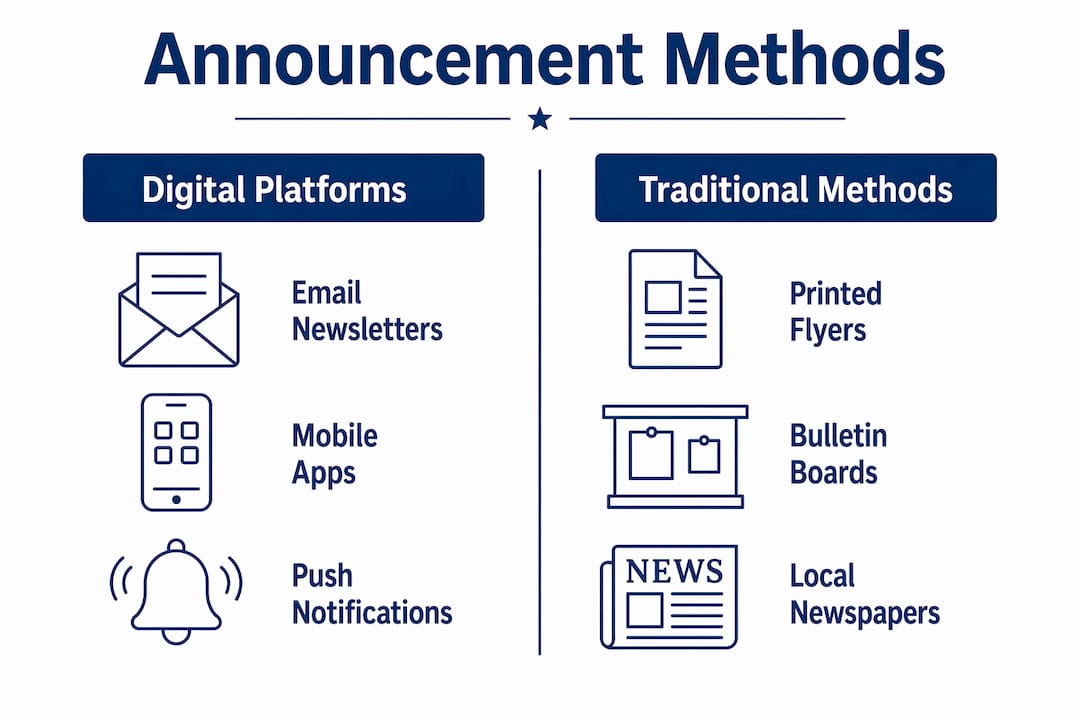
Flyers and in-school announcements remain effective traditional methods for engaging both students and parents. When a student hears about an event during a school assembly, that child often becomes the messenger at home. Student enthusiasm generated by live announcements translates directly into parent notification, which no app can fully replicate.
Traditional channels schools commonly use include:
- Printed newsletters mailed home or sent in backpacks on a set schedule
- Flyers tucked into student folders or backpacks for parents to find at pickup
- Assembly announcements delivered by principals or student council members
- Posters placed in hallways, cafeterias, and near school entrances
- Bulletin boards in common areas visible to parents during drop-off and pickup
Community channels such as local newspapers, library bulletin boards, and neighborhood boards increase event visibility beyond the school’s own network. These outlets add credibility and reach families who are less connected digitally. Thecentralgeorgian, for example, regularly covers local nonprofit events and school activities that affect Central Georgia families.
Pro Tip: Ask your child’s teacher which day of the week flyers typically go home in backpacks. Many schools send them on Thursdays. Checking the backpack on that specific day prevents important notices from sitting unread until the weekend.
The Rule of Seven applies directly here. Multi-channel repetition across newsletters, social media, banners, and direct emails reinforces message recall. A parent who sees a flyer on Monday, reads a newsletter on Wednesday, and gets a push notification on Friday is far more likely to mark that event on the calendar than one who receives a single email.
When do schools send event announcements, and why timing matters?
Timing is one of the most underestimated factors in school event communication. Schools that announce events too early risk parents forgetting. Schools that announce too late leave families without enough time to plan.
The Golden Hour for event promotion falls 2–3 weeks before the event date. Parents are most likely to notice and add events to their calendars when announcements arrive 14–21 days in advance. That window gives families enough time to arrange schedules without the announcement fading from memory.
For major or annual events such as graduation ceremonies, science fairs, or school fundraisers, communication should begin months in advance. A single early announcement followed by scheduled reminders keeps the event visible without overwhelming parents with repeated identical messages.
The table below outlines a practical announcement timeline for a typical school event:
| Timing | Action |
|---|---|
| 6–8 weeks before | Initial save-the-date notice via newsletter and school portal |
| 3–4 weeks before | Full event details posted across all channels |
| 14–21 days before | Primary promotion push, the Golden Hour window |
| 1 week before | Reminder with logistics, volunteer sign-up deadline |
| 1–2 days before | Final call to action, last-minute details confirmed |
Synchronized announcements across all channels prevent confusion. A parent who receives conflicting dates from the school app and a printed flyer loses trust in both sources. Schools that coordinate their messaging through a single source of record, then push reminders from that source, avoid this problem entirely.
A numbered sequence works well for planning the announcement campaign:
- Confirm the event date and all logistics before any public announcement goes out.
- Post the event to the centralized school portal first.
- Send the initial newsletter or email with a link back to the portal.
- Schedule push notifications and social media posts to follow at set intervals.
- Distribute printed flyers and backpack notices during the Golden Hour window.
- Send a final reminder 24–48 hours before the event with parking, timing, and contact details.
How parents can stay on top of school event notifications
Parents receive announcements through many channels simultaneously, which creates its own challenge. The goal is to capture every relevant notice without spending hours checking multiple platforms.
Automated calendar syncing solves most of this problem. Setting up calendar syncing with school emails takes about 5 minutes and eliminates manual event tracking entirely. AI tools extract event dates from school emails and push reminders directly to a parent’s calendar. That process prevents the “10 PM panic” that hits when a parent discovers the next morning’s field trip permission slip is still unsigned.
Practical steps parents can take to stay informed include:
- Sync your school email to your phone’s calendar app to capture event dates automatically.
- Customize notification preferences on the school’s communication platform to separate urgent alerts from routine updates.
- Follow the school’s social media pages for real-time updates and event photos that signal upcoming activities.
- Check the school portal weekly, ideally on the same day each week, to catch any new postings.
- Sign up for volunteer roles early through digital signup sheets, which often appear weeks before the event and close quickly.
Relying solely on email is ineffective for staying fully informed. Integrating teacher emails, homeroom communications, social media, and newsletters creates a complete picture. Parents who monitor only one channel consistently miss announcements that appear exclusively on another.
Pro Tip: Create a dedicated folder in your email app labeled “School Events.” Set a filter to route all messages from the school domain directly into that folder. A five-minute weekly review of that folder keeps you current without constant inbox monitoring.
Local news sources also serve as a useful supplement. Community coverage of school events often includes details that school channels omit, such as parking arrangements, community sponsors, or related activities happening the same weekend.
Key Takeaways
Schools reach parents most effectively when they combine digital alerts, traditional print methods, and community channels across a timed sequence of announcements.
| Point | Details |
|---|---|
| Multi-channel is the standard | Schools use digital apps, email, flyers, and community boards together to reach all families. |
| Golden Hour drives action | Announcements sent 14–21 days before an event produce the highest calendar add rates. |
| Rule of Seven applies | Parents need seven exposures across multiple channels before committing to attendance. |
| Automation reduces missed events | Syncing school emails to a calendar app takes 5 minutes and prevents last-minute surprises. |
| Single source of truth prevents confusion | Schools that centralize event details and push reminders from one portal avoid conflicting information. |
What I’ve learned about school-to-family communication after years of covering it
The biggest gap in school event communication is not the tools. Schools now have access to apps, mass notification systems, and social media. The gap is coordination. A school that sends a push notification with one date and a flyer with another date has not solved a communication problem. It has created a new one.
The schools that do this well treat one platform as the record and everything else as a pointer back to it. That discipline is harder to maintain than it sounds, especially when different staff members manage different channels. But parents notice when the information is consistent, and they trust those schools more.
Timing matters more than frequency. A single well-timed announcement during the Golden Hour window outperforms three poorly timed ones. Schools that front-load their communication calendar with early save-the-date notices and then follow a structured reminder sequence see better attendance and volunteer turnout.
Parents also have more control than they realize. Spending five minutes setting up calendar syncing or adjusting notification preferences changes the entire experience. The “10 PM panic” is almost always avoidable. The families who stay ahead of school events are not the ones with more time. They are the ones who set up the right systems once and let automation handle the rest.
Community involvement in announcements strengthens the school-to-family connection in ways that no app can replicate. When a local news outlet covers a school fundraiser or a library posts a flyer for a science fair, the event gains credibility and reaches families who might never open the school app. That community layer is worth cultivating deliberately, not treating as an afterthought.
— Ernie
Thecentralgeorgian keeps Central Georgia parents informed
Parents in Central Georgia have a reliable resource beyond the school’s own channels. Thecentralgeorgian covers community events, school activities, and local news that affect families across the region.
Thecentralgeorgian publishes timely updates on events, public notices, and community activities that schools and local organizations announce throughout the year. Parents who follow the platform stay informed about events that affect their neighborhoods and their children’s schools. For a broader view of local event schedules and community news, Thecentralgeorgian is a practical first stop. Visit thecentralgeorgian.com to stay current on what is happening across Central Georgia.
FAQ
How are school events typically announced to parents?
Schools announce events through a combination of digital platforms and traditional methods. Common channels include school apps with push notifications, email newsletters, printed flyers, and assembly announcements.
What is the best time for schools to announce an upcoming event?
The most effective window for event promotion falls 14–21 days before the event date. Announcements during this period produce the highest rates of calendar adds and confirmed attendance.
How can parents avoid missing school event notifications?
Parents can sync their school email to a calendar app in about 5 minutes to capture event dates automatically. Customizing notification preferences on the school’s communication platform also helps separate urgent alerts from routine updates.
Why do schools use so many different channels to announce events?
The Rule of Seven explains that parents need to encounter event information seven times before committing to attendance. Using multiple channels, including newsletters, social media, and flyers, ensures that repeated exposure happens naturally.
Do local news outlets help with school event announcements?
Local news platforms extend event visibility to families who are less connected to school digital channels. Community announcements add credibility and reach a broader audience than school-only communication can achieve.