Georgia’s State Bird: The Brown Thrasher, Explained
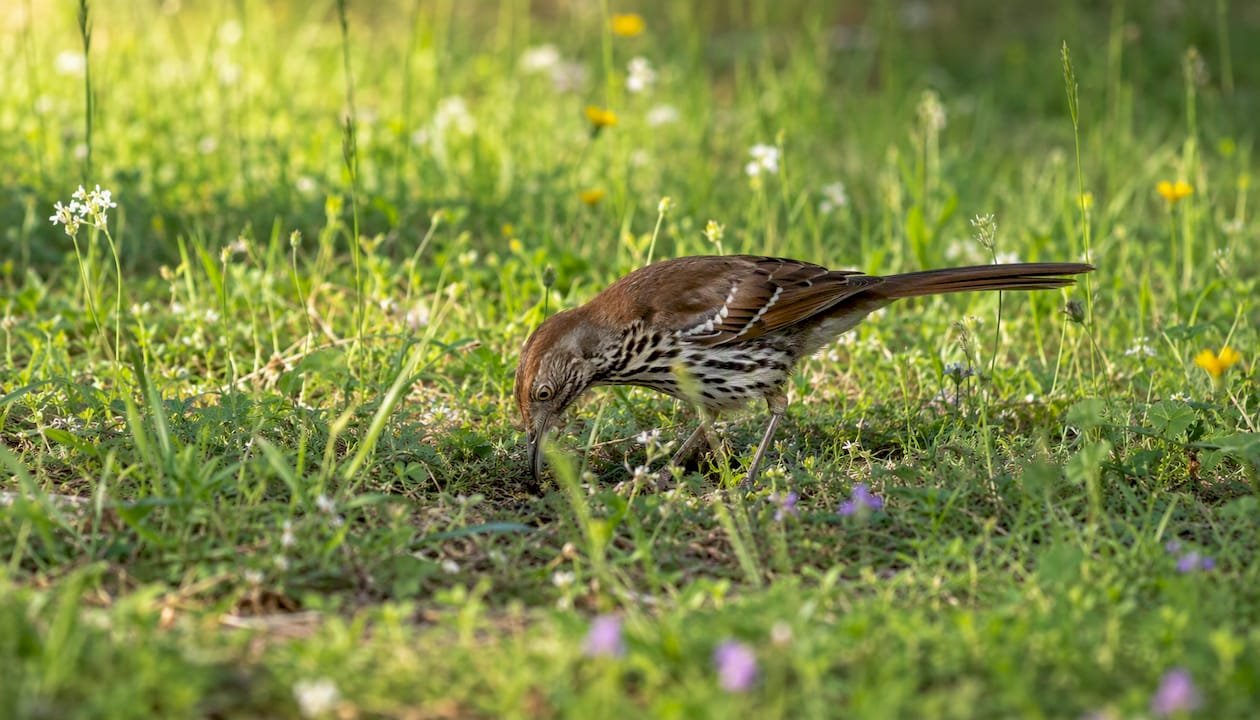
Georgia’s state bird is the brown thrasher, Toxostoma rufum. It stands out with a rufous back, a heavily streaked white breast, and a body roughly 11.5 inches long. Lawmakers made it official under Georgia Code § 50-3-50, following a 1935 governor’s proclamation.
- Name: Brown thrasher (Toxostoma rufum)
- Size: About 11.5 inches long, roughly 2.75 ounces
- Field mark: Dark, teardrop-shaped streaks across a creamy white breast
- Legal status: Georgia Code § 50-3-50
| Quick Fact | Detail |
|---|---|
| Scientific name | Toxostoma rufum |
| Length | About 11.5 inches |
| Weight | About 2.75 ounces |
| State designation | Georgia Code § 50-3-50 (1970) |
Key Takeaways
Georgia’s state bird, the brown thrasher, was chosen for its statewide presence, pest-control value, and legislative backing under Georgia Code § 50-3-50.
| Point | Details |
|---|---|
| Identity | The brown thrasher (Toxostoma rufum) is Georgia’s official state bird. |
| Quick ID | Look for a rufous back, streaked white breast, yellow eyes, and a curved bill. |
| Range | Found statewide, favoring thickets, brushy edges, and dense suburban shrubs. |
| Legal history | Proclaimed in 1935, made law in 1970 under Georgia Code § 50-3-50. |
| Backyard action | Keep some brush cover and use low feeders to support local thrashers. |
Table of Contents
- What Does Georgia’s State Bird Look Like?
- Where Do Brown Thrashers Live in Georgia?
- How Does Georgia’s State Bird Behave, and What Does It Eat?
- How Can You Identify a Brown Thrasher in the Field?
- When and Why Did the Brown Thrasher Become Georgia’s State Bird?
- What Cultural Role Does the Brown Thrasher Play in Georgia?
- Is the Brown Thrasher a Conservation Concern in Georgia?
- Why Did Georgia Choose the Brown Thrasher Over Other Birds?
- Primary Sources and Further Reading
- Sources
What Does Georgia’s State Bird Look Like?
The brown thrasher earns its name honestly. Its back and long tail are a warm, foxy brown, almost rust colored, while the breast underneath is creamy white and covered in dark, teardrop-shaped streaks that run from throat to belly. Two white wing bars cross each wing, and the eyes are a striking bright yellow, one of the easiest features to spot once you know to look for it.
Adults measure about 11.5 inches from bill to tail tip and weigh roughly 2.75 ounces, noticeably longer than an American robin, though much of that length comes from the tail rather than a bulkier body. The bill curves slightly downward, a shape built for digging through leaf litter rather than cracking seeds. Males and females look identical, so you can’t tell them apart by plumage alone.
- Rufous brown back and long tail
- Creamy white breast with dark, teardrop-shaped streaking
- Two white wing bars on each wing
- Bright yellow eyes
- Slightly down-curved bill
- Sexes are visually identical
The combination of yellow eyes, a curved bill, and heavy breast streaking rules out the birds people most often confuse it with. Northern mockingbirds are grayer with no streaking, cardinals are solid red or brown without stripes, and towhees are chunkier with a shorter tail.
Where Do Brown Thrashers Live in Georgia?
You’ll find brown thrashers across the entire state, from the mountains of North Georgia down to the coastal plain. Distribution shifts a little with the seasons: the birds are common statewide but less frequent north of the fall line during winter months, as some individuals move south or concentrate in milder areas.
Habitat preference matters more than exact location. Thrashers gravitate toward:
- Dense thickets and shrub tangles
- Brushy fence-rows and forest edges
- Suburban yards with heavy shrub cover
- Overgrown field margins
They’re ground foragers by habit, so a yard with thick, low cover near open dirt or leaf litter is far more attractive to a thrasher than a manicured lawn with scattered ornamental bushes. If your neighborhood still has a few unruly hedges or a brush pile at the property line, that’s likely where the local thrashers are spending most of their time.
How Does Georgia’s State Bird Behave, and What Does It Eat?
Watch a brown thrasher for five minutes and you’ll notice it spends almost all of that time on the ground, not in the air. It forages by flipping leaves aside with its curved bill, digging through leaf litter to expose insects hiding underneath. Homeowners often notice small “craters” in garden beds and mulch before they ever see the bird responsible, a telltale sign the thrasher has been working the area.
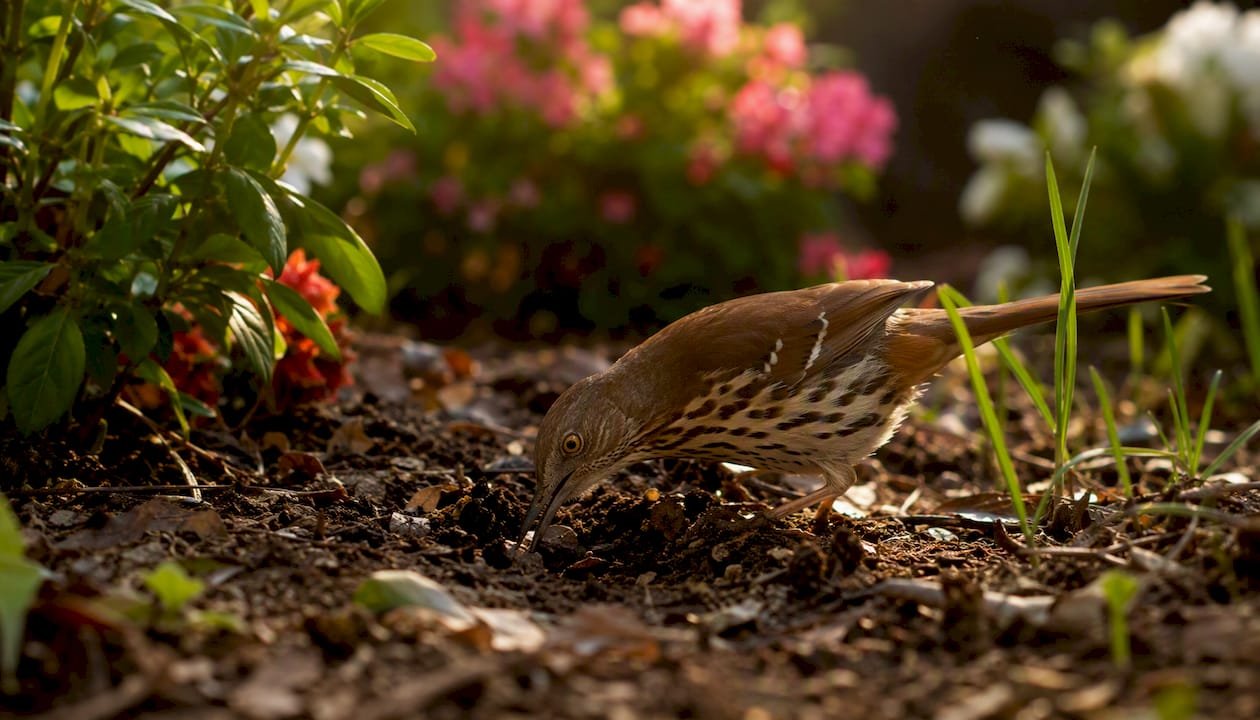
Its diet leans heavily on insects: beetles, grasshoppers, and caterpillars make up a large share, supplemented by spiders and, occasionally, small vertebrates. Fruits and berries round out the menu, especially in late summer and fall.
The thrasher’s voice is where it truly separates itself from other backyard birds. Males sing from exposed high perches in spring, and their repertoire can exceed 1,100 distinct song types, one of the largest song catalogs of any bird in North America. That range means the song is often mistaken for a mockingbird’s or a catbird’s, since all three species borrow and repeat varied phrases.
- Ground foraging with distinctive leaf-flipping
- Diet: beetles, grasshoppers, caterpillars, spiders, fruits, and berries
- Song repertoire exceeding 1,100 types, sung from high perches
- Nests built 1 to 10 feet up in shrubs or small trees
- Typical clutch: 3 to 6 pale blue, speckled eggs
Males singing from a high perch with an almost endless variety of phrases is one of the most reliable clues that a thrasher, not a mockingbird, is nearby.
How Can You Identify a Brown Thrasher in the Field?
Run through this checklist next time you see brown movement low in a hedge:
- Size close to a robin, but with a noticeably longer tail
- Rufous brown back paired with heavy dark streaking on the breast
- Two white wing bars
- Long, slightly down-curved bill
- Bright yellow eyes
- Feeding alone on the ground, flipping leaves rather than pecking seed
Behavior narrows it down fast. Thrashers forage low and solitary, and they defend feeding spots aggressively, chasing off other birds that get too close. If a bird is perched high and mimicking a dozen other species’ calls with a grayish body, that’s a northern mockingbird, not a thrasher. A solid red bird with a crest is a cardinal. A chunky bird scratching loudly under a feeder with a shorter tail is more likely a towhee.
Pro Tip: Listen before you look. Thrashers often reveal themselves through rustling leaf litter or a burst of song from a treetop long before they come into view on the ground.
When and Why Did the Brown Thrasher Become Georgia’s State Bird?
- 1935: Georgia’s governor issued a proclamation naming the brown thrasher the state bird, largely on the strength of a campaign by schoolchildren and civic groups who favored a bird found across the whole state.
- Mid-1900s: The Garden Clubs of Georgia took up the cause, pushing for formal legislative recognition rather than leaving the designation as a proclamation alone.
- 1970: The Georgia General Assembly made it official, and the designation now lives in Georgia Code § 50-3-50.
The gap between the 1935 proclamation and 1970 legislative action shows how long grassroots advocacy, in this case led by garden clubs and schoolchildren, can take to become binding law.
What Cultural Role Does the Brown Thrasher Play in Georgia?
The brown thrasher’s reach extends beyond birdwatching circles. It gave its name to Atlanta’s former NHL team, the Atlanta Thrashers, a nod that kept the bird visible in popular culture long after most residents had forgotten the legislative history behind it.
State officials picked a common, widespread species over a flashier one for a reason: the brown thrasher represents Georgia’s habitat diversity, from mountain thickets to coastal brush, in a way a regionally limited bird never could.
- Namesake of the former Atlanta Thrashers hockey franchise
- Recognizable statewide rather than tied to one region
- A working symbol of Georgia’s varied landscapes, not just a mascot
Is the Brown Thrasher a Conservation Concern in Georgia?
The brown thrasher remains a common species across Georgia, but its favored habitat, brushy fence-rows and hedgerow edges, has been shrinking for decades. Modern agricultural practices that clear brushy field margins have reduced available thrasher habitat in many parts of the state, and nest parasitism from brown-headed cowbirds adds further pressure on breeding success.
You don’t need acreage to help. A few practical steps go a long way:
- Leave a strip of dense shrub cover instead of clearing it entirely
- Provide ground-level water sources
- Set out low platform feeders rather than hanging tube feeders
- Avoid pesticide use in areas where thrashers forage for insects
Why Did Georgia Choose the Brown Thrasher Over Other Birds?
The Georgia Department of Natural Resources credits the selection to two practical factors: the bird’s presence in every corner of the state, and its dual role as both an accomplished singer and an effective pest controller. Thrashers eat large numbers of beetles, grasshoppers, and tent caterpillars, making them genuinely useful to gardeners.
State wildlife officials favored a bird that represented Georgia’s full geographic range over a rarer, more localized species, even one with brighter plumage.
- Statewide distribution across every habitat type in Georgia
- Practical value as a garden pest controller
- Backed by decades of schoolchildren and Garden Club advocacy
- Confirmed by Georgia Code § 50-3-50
Thrashers turn up in backyards across Middle Georgia often enough that most longtime residents have heard one singing without realizing what it was. If your yard still has a patch of thick shrubs near the fence line, keeping it intact does more for local wildlife than a bird feeder ever will. For readers who want to stay on top of community efforts around local green spaces and conservation, The Central Georgian covers the events and initiatives shaping Central Georgia neighborhoods.
Primary Sources and Further Reading
- Georgia DNR: Out My Backdoor: the state’s own explanation for choosing the thrasher and backyard attraction tips.
- Georgia Code § 50-3-50 (Justia): the actual statutory text designating the state bird.
- Digital Library of Georgia: natural-history pamphlet with behavior, diet, and nesting detail.
- National Geographic Kids: concise physical description and measurements.
- StateSymbolsUSA: timeline of the 1935 proclamation and 1970 legislative recognition.
A Local Note From Central Georgia
Brown thrashers show up in ordinary Middle Georgia yards more often than people notice. If you’re curious about local wildlife or civic history, the sources above are worth a look.
Sources
- Brown Thrasher | National Geographic Kids
- Out My Backdoor: Invite the State Bird to Your Backyard | Georgia DNR
- Brown thrasher, Toxostoma rufum — Digital Library of Georgia
- Georgia Code § 50-3-50 — Justia
- Georgia State Bird | Brown Thrasher — StateSymbolsUSA