How Digital Journalism Differs From Print, Task by Task
Digital journalism differs from print mainly in four ways: speed, format, audience interaction, and workflow. A digital journalism outlet publishes on internet platforms and updates a story within minutes, while print operates on daily or weekly cycles fixed by press deadlines. That single structural difference reshapes everything downstream, from what skills a reporter needs to how a newsroom measures success.
- Speed: Digital updates in real time; print locks at deadline.
- Formats: Digital uses video, interactive maps, and data visualization; print uses text and static images.
- Interaction: Digital readers comment and share; print communication runs one way.
- Workflow: Digital reporters file into a CMS built for screens; print reporters file into a page layout process.
- Measurement: Digital tracks clicks and time on page; print tracks circulation counts.
Each of these differences carries practical consequences for reporters, editors, and readers, which the sections below break down with specific examples.
Key Takeaways
Digital journalism differs from print through faster publishing cycles, platform-native formats, two-way audience interaction, and a CMS-driven, digital-first production workflow.
| Point | Details |
|---|---|
| Speed changes editorial risk | Real-time publishing demands built-in verification steps, not a slower deadline, to catch errors. |
| Formats expand storytelling | Interactive maps, data visualization, and video convey complex stories print’s static format cannot. |
| Skills now include multimedia and data | Reporters handle CMS publishing, basic data analysis, and audio/video capture alongside core sourcing skills. |
| Monetization splits across models | Digital revenue mixes display ads, metered paywalls, and sponsored content instead of print’s subscriber-and-ad-inch formula. |
| Permanence requires deliberate archiving | Digital stories need version logs and archived pages since nothing is fixed the way a printed edition is. |
| Thecentralgeorgian applies digital-first locally | Real-time public safety alerts paired with in-depth follow-up reporting serve Central Georgia’s need for both speed and depth. |
Table of Contents
- How Digital Journalism Differs Print: A Quick-Scan Comparison
- What Tasks and Skills Set Digital Reporters Apart?
- Which Story Formats Only Work Online?
- What Does a Digital-First Workflow Actually Look Like?
- How Do Readers and Platforms Shape Digital Coverage?
- How Do Newsrooms Balance Speed With Accuracy?
- How Does A Local Newsroom Put This Into Practice?
- How Do Digital and Print Journalism Make Money Differently?
- Why Is Misinformation Harder To Contain Online Than In Print?
- What Happens To A Story After It’s Published?
- What Does The Shift To Digital-First Really Ask Of Journalists?
- Follow Local Coverage As It Happens
- Frequently Asked Questions
- Sources
How Digital Journalism Differs Print: A Quick-Scan Comparison
The contrast between digital and print becomes clearest when you line up the operational details side by side.
- Temporality: Digital newsrooms push updates the moment new facts arrive; print runs on a fixed daily or weekly cycle set by the press schedule.
- Distribution: Digital stories travel through search rankings, social shares, and app notifications; print circulates through physical delivery and newsstand sales.
- Formats: Digital packages combine video, audio, interactive maps, and data visualizations; print relies on columns of text and still photography.
- Measurement: Digital success is tracked through page views, time on page, and click-through rate; print success is tracked through circulation and readership surveys.
- Editorial consequence: A digital story is never really finished. Editors version it, correct it, and append updates as a situation develops, while a print story is locked the moment the press runs.
That last point matters more than it sounds. A single article on a digital platform might get updated six times in a day as a breaking story unfolds, something no print edition can do until tomorrow’s run.
What Tasks and Skills Set Digital Reporters Apart?
A digital reporter’s job includes tasks that never existed in a print-only newsroom, alongside core reporting skills that never go away.
- CMS-driven publishing and SEO-aware headlines. Reporters write directly into a content management system and often draft two headline options, one for print-style clarity and one built to perform in search results.
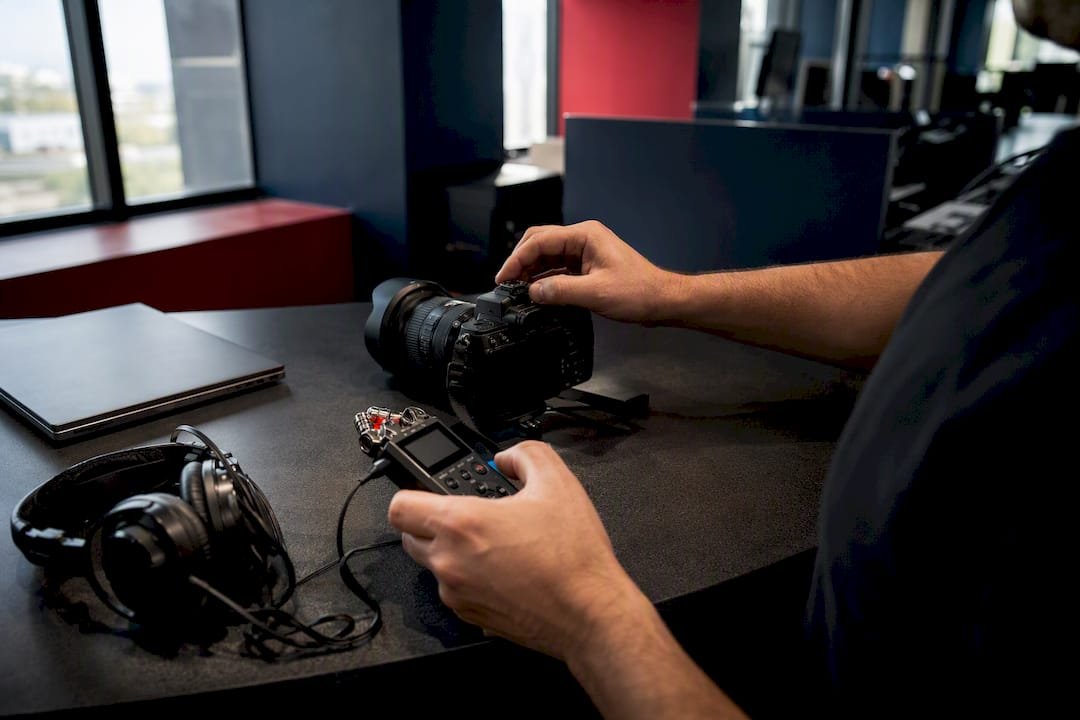
- Audio and video capture and editing. Many reporters now shoot and edit their own footage, a shift scholars describe as the rise of the backpack journalist, someone expected to gather multimedia and file across platforms as part of a normal day.
- Basic data skills. Pulling a spreadsheet of police reports or health department records and turning it into a chart is now a baseline expectation, not a specialist task, and it supports the kind of data visualization that helps readers spot patterns a text-only story would bury.
- Analytics monitoring. Reporters check which stories are gaining traction and use that signal to decide what to cover next, rather than waiting for letters to the editor.
- Reporting fundamentals. Sourcing, verification, and clean writing remain the backbone. No CMS shortcut replaces a reporter who knows how to build trust with a source.
Pro Tip: Draft your headline twice. Write one version for clarity and one built around the terms a reader would actually type into a search bar. They’re rarely the same sentence.
Which Story Formats Only Work Online?
Digital platforms support storytelling formats that print physically cannot reproduce, but that doesn’t mean every story needs the fanciest format available.
- Interactive maps and graphics earn their place when a story involves geography or layered data. A map showing crime density across a county tells readers more in five seconds than three paragraphs of description.
- Modular storytelling lets a newsroom publish a developing story in pieces: a breaking update, then a timeline, then a full explainer once facts settle.
- Native social formats, including short vertical video and threaded posts, meet readers where they already scroll, often on a phone during a commute.
- Longform features still work digitally, but they need pacing adjustments, shorter paragraphs, embedded pull quotes, and photo breaks, so depth survives the jump from page to screen. A longform local journalism piece built for digital reading keeps the reporting depth of a print feature while structuring it for a scrolling reader.
The multimedia layer, according to research on digital journalism practice, makes complex information accessible in ways static print pages simply cannot match.
What Does a Digital-First Workflow Actually Look Like?
Digital-first does not mean “print the same story online first.” It means building the story for a screen from the first note taken, with multimedia assets planned alongside the writing rather than bolted on afterward, a distinction laid out in research on what digital-first actually requires of a newsroom.
Signs a newsroom has genuinely adopted digital-first practice:
- SEO-conscious headlines get drafted alongside the story, not added at the last minute.
- Photo, video, or data visualization assets get assigned before the reporter finishes a draft.
- Correction protocols are visible: a dated update log rather than a quiet, silent edit.
- Reporters follow a filing checklist covering headline, multimedia, sourcing links, and a plan for updates as the story develops.
Print corrections run once, in a later edition, often a full day after the error. Digital corrections happen at the point of the mistake, logged and dated on the same page.
How Do Readers and Platforms Shape Digital Coverage?
Distribution channels decide who ever sees a digital story, which is a very different problem than print circulation ever faced. Social platforms, search rankings, email newsletters, and direct app traffic each reward a different kind of headline and pacing, and a newsroom that ignores that mix loses readers before the story even loads.
Audience interaction changes the story too. Comments and social replies let readers contribute tips or corrections directly, a two-way relationship that research on digital journalism identifies as fundamentally different from print’s one-way delivery. A reporter watching those replies in real time often finds the next angle for a follow-up sitting in the comment thread itself.
- Time major stories around when your audience is actually online, not around a press deadline.
- Build short-form video or a single strong image for social, even when the full story runs longform.
- Write headlines that answer the question a reader would type into a search bar.
- Track which stories readers finish, not just which ones they click, since audience metrics increasingly guide which follow-up angle gets assigned.
How Do Newsrooms Balance Speed With Accuracy?
Speed is digital journalism’s biggest advantage and its biggest liability. Publishing fast increases the odds of an error slipping through, and digital newsrooms need transparent correction workflows specifically because that risk is baked into the format.
Common trouble spots include treating an unverified social post as confirmed fact, misreading a raw dataset under deadline pressure, and misattributing a quote pulled from a livestream.
- Preserve original source documents and archive live pages before they change or disappear.
- Disclose sampling methods and anonymization choices when using survey or health data.
- Link raw datasets whenever possible so readers can check the numbers themselves.
- Publish a visible update log and label corrections explicitly rather than editing quietly.
Pro Tip: Screenshot and archive any social media post you plan to cite before you publish. Posts get deleted, and “it was right there yesterday” doesn’t hold up in a correction.
How Does A Local Newsroom Put This Into Practice?
Thecentralgeorgian applies digital-first practice directly in Central Georgia coverage: a breaking alert on a police operation goes up first, followed by a longer piece once records and interviews are confirmed.
- Real-time alerts on public safety situations, followed by in-depth criminal indictment explainers once charges are filed.
- Data-informed coverage of community safety awareness that turns incident patterns into context readers can act on.
- A local outlet that lets readers judge how newsroom decisions get made earns more trust than one that publishes without explanation.
How Do Digital and Print Journalism Make Money Differently?
Print journalism built its business on two revenue streams that rarely competed with each other: subscriber payments for physical delivery and display ads sold by the column inch. That model held for most of the twentieth century because there was no alternative distribution channel eating into either stream.
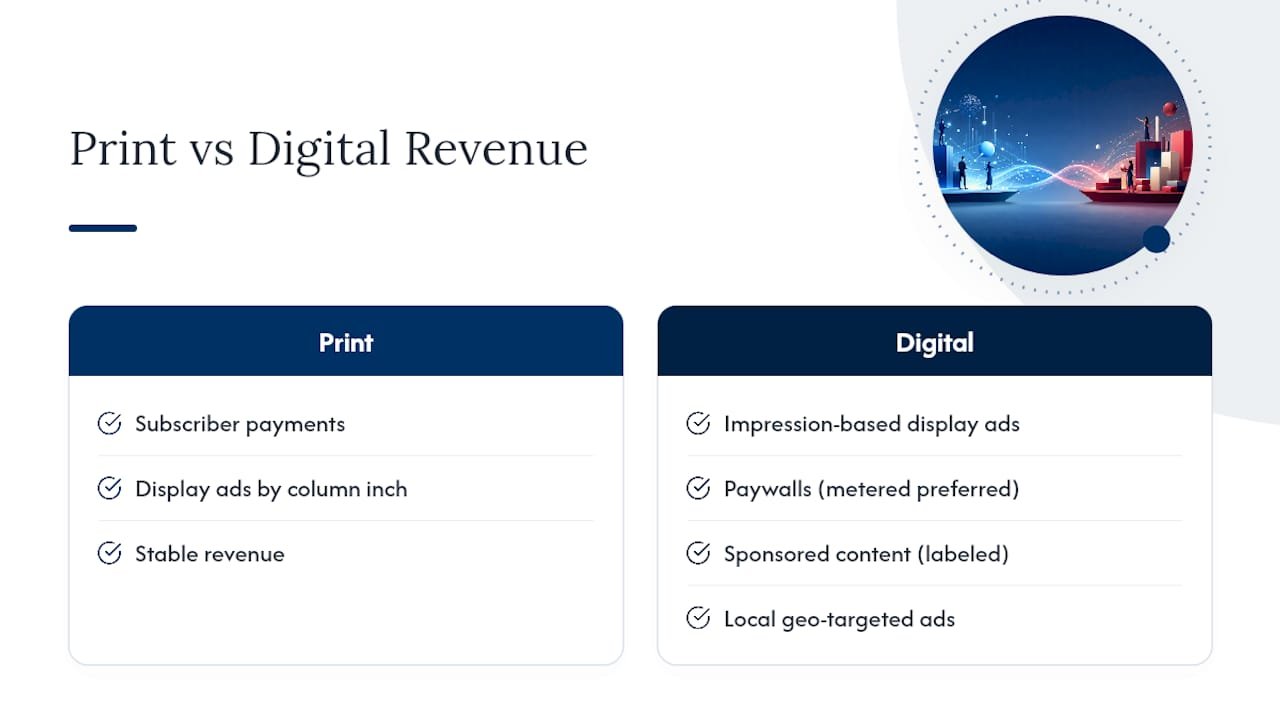
Digital journalism fractures that model into several competing revenue types running at once. Display advertising still exists, but it’s sold by the impression rather than the inch, and a story needs real traffic volume to earn meaningful ad revenue. Paywalls and digital subscriptions have become the dominant strategy at many outlets, though metered paywalls (a set number of free articles per month) tend to convert better than hard paywalls for local audiences still deciding whether a subscription is worth it. Sponsored content, sometimes labeled “partner content” or “sponsored post,” blurs the line between editorial and advertising in a way print’s clearly bordered ad sections never did, which is why credible outlets label sponsored pieces explicitly.
Ad-supported digital publications, including community outlets like Thecentralgeorgian, depend on a different metric entirely: engaged local readership that advertisers value because it’s geographically targeted. A regional business buying a display ad on a Central Georgia news site reaches a far more relevant audience than the same ad running in a national print buy ever could. That local specificity is digital journalism’s monetization advantage over both national digital competitors and legacy print classifieds, which have mostly disappeared. The tradeoff is volatility. Ad rates fluctuate with traffic in ways a print subscriber base, once secured, rarely did.
Why Is Misinformation Harder To Contain Online Than In Print?
Print journalism had a built-in speed limit that doubled as a quality control mechanism. A story couldn’t reach readers until it cleared editing, layout, and a press run, which gave editors hours or days to catch an error before ink hit paper. Digital journalism removed that limit, and removing it removed the built-in delay that used to catch mistakes.

That speed creates three distinct credibility risks print rarely faced at the same scale. First, unverified claims from social media can get treated as sourced fact under deadline pressure, especially during a fast-moving breaking story. Second, the same platforms that distribute legitimate digital journalism also distribute deliberate misinformation, often optimized with the same SEO and social techniques a newsroom uses for real reporting, which makes credible and fabricated stories look nearly identical in a social feed. Third, corrections online can fail to reach everyone who saw the original, uncorrected version, because a story shared and reshared across platforms leaves copies an editor can’t always track down and fix.
The fix isn’t slowing down to print’s pace. It’s building verification into the fast workflow itself: preserving original sources, archiving pages before they change, and publishing visible correction logs rather than quiet edits, the same steps outlined in the verification and ethics practices above. Readers trust a newsroom that shows its work, and showing your work is something digital formats, with their links and embedded documents, can do far more transparently than a print column ever could.
What Happens To A Story After It’s Published?
A print newspaper is a physical object. Once it’s printed, that edition exists exactly as it was, sitting in library microfilm archives, bound volumes, and personal scrapbooks, immune to editing but also difficult to search, share, or update.
A digital story lives differently. It can be updated, corrected, reformatted, or in the worst case, quietly deleted, all without leaving the kind of physical trace a printed page leaves. That flexibility is an advantage for accuracy (a correction reaches every future reader instantly) and a liability for permanence (a deleted story can vanish without anyone noticing unless it was archived elsewhere first).
This is where digital journalism has had to borrow a discipline print never needed: deliberate archiving. Tools like the Wayback Machine and newsroom-side content management systems now serve the preservation function that a bound volume of newspapers used to serve automatically. A responsible digital-first newsroom archives its own pages before major edits, keeps dated version histories, and treats its CMS as a permanent record rather than a live document that can be silently rewritten.
The practical lesson for readers: a digital story’s credibility depends partly on whether the outlet publishing it treats permanence as a responsibility rather than an afterthought. An update log and a visible correction history do for a digital story what the fixed print edition did automatically, they create a record readers can trust wasn’t quietly rewritten after the fact.
What Does The Shift To Digital-First Really Ask Of Journalists?
The hardest part of digital-first reporting isn’t learning a new tool. It’s learning to hold two instincts at once: move fast enough to serve a community that expects updates in real time, and slow down enough to verify before publishing. Those instincts pull against each other constantly, and the newsrooms that manage it well are the ones that build verification into the speed rather than treating it as a separate, slower step.
Thecentralgeorgian exists because Central Georgia needs both halves of that equation. A community facing a public safety alert needs the fast version now and the accurate, complete version once the facts settle. Readers who want that balance delivered consistently should follow local alerts as they’re issued rather than waiting for a weekly recap.
Follow Local Coverage As It Happens
Thecentralgeorgian gives Central Georgia readers something a weekly print cycle never could: real-time alerts on breaking situations paired with the same depth of follow-up reporting a print feature would deliver, just delivered fast enough to matter while a story is still unfolding.

That combination shows up across the site’s coverage, from real-time public safety alerts to fuller explainers once the facts are confirmed, like the recent breakdown of what a criminal indictment actually means for a case moving through the local court system. Readers who want the fuller picture on how coverage decisions get made can also see how a newsroom decides coverage at Thecentralgeorgian. And because digital publishing raises real questions about what outlets and commenters can legally say online, readers interested in that boundary can see how First Amendment protections are expanding online. Visit Thecentralgeorgian and follow the site’s alerts to get Central Georgia’s breaking news and in-depth reporting as it happens, not a day later.
Frequently Asked Questions
What is digital-first journalism?
Digital-first journalism means building a story for screen delivery from the start, planning multimedia assets and SEO-aware headlines alongside the reporting, rather than simply posting a print-style story online first.
What are the main advantages of digital journalism over print?
The biggest advantages are speed of publishing, the ability to use interactive and multimedia formats, direct audience interaction through comments and social shares, and detailed engagement metrics that shape coverage decisions.
What challenges does print media face that digital journalism does not?
Print media faces fixed deadlines, slower correction cycles, physical distribution costs, and limited formats compared to digital’s real-time updates, multimedia storytelling, and instant correction logs.
How does digital journalism handle corrections differently than print?
Digital newsrooms typically post visible, dated update logs at the point of correction, while print corrections run in a later edition, often a full publishing cycle after the original error.
Is print journalism disappearing because of digital journalism?
Print circulation has declined as digital reading grows, but many outlets, including community newsrooms, run digital-first while maintaining print or archival products for readers who prefer them.
Sources
- Digital journalism — Wikipedia
- The SAGE Handbook of Digital Journalism (extract)
- Digital journalism study (USF) — DigitalCommons
- Digital journalism visualization & storytelling — UF online masters