Free Community Programs: 25+ Examples to Start Now
Free community programs fall into eight repeatable categories, and most require nothing more than a willing group, a public space, and one local partner to launch.
The strongest starting points by category:
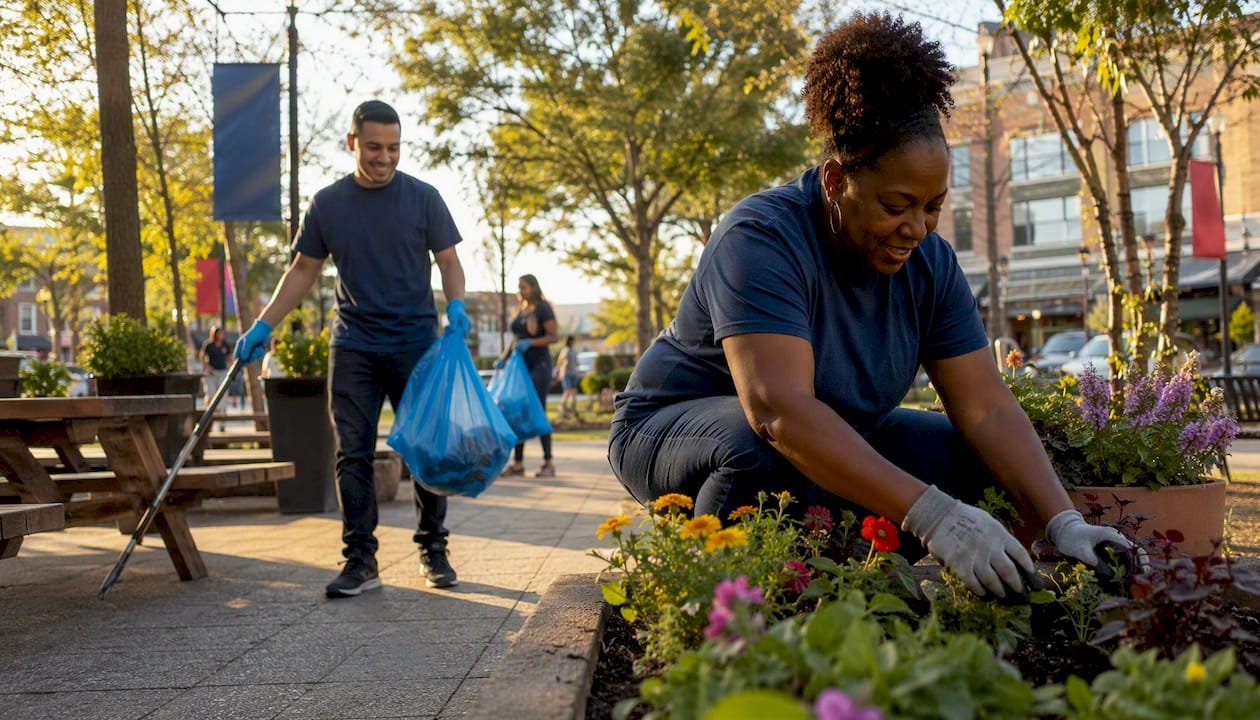
- Environment: Neighborhood park cleanup (contact your municipal parks department to request supplies and a permit waiver)
- Youth & education: Free homework help sessions at your public library (coordinate with the branch manager for a weekly room reservation)
- Health & wellness: Free walking groups organized through a local YMCA or public health department
- Arts & culture: Outdoor family music nights in a public park, registered through your city’s parks and recreation office
- Seniors: Tech help hours at a senior center or library, staffed by college volunteers
- Fundraising/support: Neighborhood food drives with scheduled drop-off windows, partnered with a local food bank
- Civic/advocacy: Voter-registration tables at community events, coordinated with your county elections office
- Animal welfare: Neighborhood pet-food collection points, partnered with a local animal shelter
The single fastest step: Call or email your nearest public library, municipal parks department, or school principal today. All three regularly host free programs and can connect you with permits, space, and volunteers at no cost.
Public institutions such as NYC Parks and the USDA’s summer-meal network already run free programming at scale. The examples below show how to replicate that model at the neighborhood level, with minimal overhead.

Table of Contents
- Free community programs that improve local green spaces
- Free programs to support students and young people
- Free programs to boost community health and safety
- Free creative programs that build community connection
- Accessible, free programs for seniors and people with disabilities
- Low-cost drives and direct support programs for your neighborhood
- Free civic programs that increase community participation
- Animal welfare programs your community can run for free
- How to plan and run a free community program
- Research-backed ways to boost participation and keep programs running
- Key Takeaways
- Why free community programs are worth covering and supporting
- Useful sources and further reading
Free community programs that improve local green spaces
Environment programs are among the most accessible free local activities to organize. They require no specialized credentials, and municipal parks departments often supply gloves, bags, and signage at no charge when you register in advance.
Practical examples:
- Invasive-species removal mornings: — Partner with a local university extension office or conservation district. They often provide trained staff to lead the work and supply tools.
Timeline: One-off cleanups need two to three weeks of planning. Recurring programs (monthly garden workdays, quarterly stream audits) benefit from a fixed schedule posted at least 60 days in advance.
Minimal cost estimate: $0–$50 for printed flyers and backup supplies when the parks department does not cover materials.
Pro Tip: Ask your parks department whether they have a community volunteer program with a standing permit. Many cities maintain blanket permits for registered volunteer groups, which eliminates the per-event application process entirely.
Free programs to support students and young people
Youth programs are most effective when they run in spaces students already use: libraries, school cafeterias, and community centers. The barrier to entry is low, and schools and PTAs are generally receptive to outside volunteers who follow their established safety protocols.
Ready-to-run examples:
- Free homework help sessions: Reserve a library meeting room for two hours on weekday afternoons. Recruit retired teachers, college students earning service hours, or parents with subject-matter knowledge.
- Peer mentoring clubs: Partner with a middle or high school counselor to match older students with younger ones. The school handles parental consent and scheduling; volunteers provide structure and activities.
- Book-exchange programs: Set up a free little library box or a designated shelf at a community center. Restocking requires no ongoing cost when the community donates.
- No-cost STEM drop-in workshops: University engineering or science departments often send student chapters to run free workshops. Contact the department’s outreach coordinator directly.
- Youth sports skills clinics: Coordinate with a local recreation department or parks district. Many already have equipment and fields; they need volunteer coaches.
- College-application mentoring hours: Recruit recent college graduates or school counselors to hold open office hours at the library. One two-hour session per week during September and October covers the peak application period.
Volunteer roles: Lead facilitator (plans the session), assistant (manages materials and attendance), and check-in volunteer (greets participants and handles sign-in sheets).
Safeguarding note: Most schools and libraries require background checks for adults working with minors. Submit your volunteer application at least three weeks before the program start date to allow processing time. Follow the host institution’s volunteer policy exactly.
Portland’s Summer Free for All program demonstrates what a structured youth partnership looks like at scale: free lunch and supervised activities for youth 18 and under, run under USDA summer-meal guidelines with clear on-site consumption and age rules.
Recruiting tip: College service organizations (fraternities, sororities, honor societies, and pre-professional clubs) need documented volunteer hours each semester. A single email to a campus service-learning office can fill your volunteer roster for an entire academic year.
Pro Tip: Frame your ask to college departments as a “community partnership” rather than a volunteer request. Departments with service-learning requirements will often assign a faculty liaison, which gives your program an institutional anchor and reduces your administrative load.
Free programs to boost community health and safety
No-cost wellness programs work best when they run on a fixed schedule and remove logistical barriers for participants. The Care & Connection program at Clarkston Community Center demonstrates the model: a free 8-week creative wellness cohort that provides free transportation, on-site childcare, and refreshments to lower participation barriers.
Program examples:
- Free walking groups (meet at a fixed park entrance, same day and time weekly)
- Community mindfulness or MBSR cohorts (8–12 weeks, led by a trained facilitator; a free 8-week MBSR program has been offered at zero cost when tied to academic or public health initiatives)
- Pop-up first-aid or CPR training sessions, partnered with a local American Red Cross chapter
- Free health screenings at libraries or community centers, coordinated with a county public health department or university nursing program
Partner contacts to reach first:
- Local YMCA community health coordinator
- County or city public health department
- University health or nursing school outreach office
- American Red Cross local chapter
Suggested schedule: 6–12 weekly sessions, same day and time, at a fixed accessible location. Consistency is the single largest driver of repeat attendance.
Logistical needs: A room that holds your expected group (confirm ADA accessibility), a volunteer facilitator, and a sign-in sheet. For higher-risk activities such as CPR training or paddling programs, waivers are standard practice even for walk-up participants. Collect signed waivers before the session begins.
The Peninsula Family YMCA’s Community as Medicine cohort ran as a 12-week healthy-living program with limited capacity and ZIP-code eligibility, showing that even small, targeted programs can deliver measurable health outcomes when structured consistently.
Free creative programs that build community connection
Arts and culture programs draw participants who may not respond to civic or health framing. They also tend to generate strong word-of-mouth and local media interest, making them useful anchors for broader community engagement efforts.
Program examples:
- Free First Sunday museum access: Many cultural institutions follow the Barnes Foundation’s model of no-cost admission plus family activities on the first Sunday of each month. Registration is required because capacity is limited. Contact your nearest museum about co-hosting or promoting their existing free days.
- Outdoor family music nights: Organize a 90-minute acoustic or amplified concert in a public park. Recruit local school music programs or community bands.
- Community mural paint days: Partner with a property owner and a local arts organization. The property owner provides the wall; the arts group often supplies paint through grants.
- Neighborhood movie nights in the park: Rent or borrow a projector and screen. Licensing a public-performance film screening costs $50–$200 through services like Swank Motion Pictures or Criterion Pictures.
- Instrument or art-skill share sessions: Participants teach each other. No outside facilitator is needed; a library meeting room and a sign-up sheet are sufficient.
Permission checklist for outdoor programs:
- Park use permit from your municipal parks and recreation department
- Property owner written permission (for murals or private-property events)
- Noise ordinance review (most cities restrict amplified sound after 9 PM or 10 PM)
- Public assembly notification to local police non-emergency line if your expected attendance exceeds your city’s threshold (commonly 50–100 people)
On adapting for space: A program designed for a 200-person park works indoors for 30 people with minor adjustments. Reduce the number of activity stations, shift from amplified to acoustic, and confirm the venue’s occupancy limit before promoting the event.
Pro Tip: Contact your city’s arts council or a local university fine-arts department for teaching artists. Many artists need documented community engagement hours for grant applications, so they will often participate at no cost in exchange for a letter confirming their involvement.
Accessible, free programs for seniors and people with disabilities
Programs for older adults and people with disabilities require more logistical planning than general-public events, but the participation barriers are well-defined and addressable with modest coordination.
Concrete program examples:
- Free transportation-assisted social hours (coordinate with a senior center’s existing van service or a volunteer driver network)
- Low-impact exercise classes (chair yoga, gentle stretching) held at a senior center or faith community hall
- Tech help hours: one-on-one smartphone and tablet assistance, staffed by high school or college volunteers
- Home-visiting check-in programs: trained volunteers make weekly phone or in-person visits to isolated older adults
- Library large-print book clubs: the library supplies the books; volunteers facilitate the discussion
Accessibility checklist:
- Confirm the venue is ADA-compliant (ramp access, accessible restrooms, adequate seating)
- Arrange transportation or coordinate with an existing senior transport service
- Offer sensory-friendly options (reduced noise, good lighting, clear signage in large print)
- Provide seating for all participants, not just those who request it
- Schedule programs mid-morning or early afternoon to align with older adults’ preferred activity windows
Volunteer staffing template: One host (manages the room and welcomes participants), one activity lead (runs the session), and one floater (assists with mobility, tech questions, or individual needs). For home-visiting programs, add a coordinator who tracks visit logs and flags welfare concerns.
Pro Tip: Senior centers and faith communities already have established trust with older adult populations. Partnering with them rather than starting a separate program from scratch cuts your recruitment time significantly and gives participants a familiar, trusted context.
Low-cost drives and direct support programs for your neighborhood
Resource drives are among the most direct examples of outreach programs. They require minimal planning, produce visible results quickly, and are easy to repeat on a seasonal schedule.
Program examples:
- Neighborhood food drives with scheduled two-hour drop-off windows (avoids all-day staffing)
- Hygiene-kit assembly parties: volunteers sort and pack donated items into individual kits
- Back-to-school supply drives: collect and redistribute notebooks, pencils, and backpacks in August
- Winter coat swap: accept gently used coats in October, redistribute in November
- Holiday meal kit distribution: assemble and deliver non-perishable meal kits in late November or December
Logistics checklist:
- Designate a collection point (library lobby, church entrance, school front office)
- Confirm storage space for collected items before the drive begins
- Set a redistribution date and partner with a food bank, school social worker, or faith group for distribution
- Track inventory with a simple spreadsheet: item type, quantity received, quantity distributed
Partners to contact:
- Local food bank (for food drives and distribution logistics)
- School social workers (for supply drives and family referrals)
- Faith community leaders (for storage space and volunteer networks)
- Local businesses (for in-kind donations of bags, boxes, or kit materials)
Volunteer roles: Collection lead (manages the drop-off point), sorter (organizes and inventories items), distribution lead (coordinates handoff to recipients or partner organizations).
Minimal cost estimate: $0–$30 for printed collection-point signs and inventory tracking sheets. Kit materials are typically donated.
Free civic programs that increase community participation
Civic engagement programs are most effective when they are nonpartisan, clearly framed around information rather than persuasion, and anchored to a trusted public institution.
Program examples:
- Voter-registration tables at community events, farmers markets, or library entrances
- Civics 101 pop-ups: 30-minute informal sessions explaining how local government works
- Neighborhood listening sessions: structured conversations where residents identify shared concerns
- Public-issue letter-writing nights: participants draft letters to elected officials on a topic of their choice
Action steps for nonpartisan civic work:
- Secure a location through your library, community center, or municipal parks office
- Frame all materials around information and participation, not specific candidates or positions
- Partner with your county elections office for voter-registration materials (they supply official forms at no cost)
- Recruit volunteers from civic organizations, university political science departments, and neighborhood associations
- Post event details at least two weeks in advance on community bulletin boards and local event calendars
Keeping daily action items under one minute is a proven tactic for sustaining civic challenge participation. Research on community challenge design recommends micro-actions at that threshold to lower the barrier to habit formation and repeat engagement.
Adapting for language and community size: For multilingual communities, translate one-page materials into the two or three most common languages in your area. For small towns, a listening session of 15 people in a library meeting room is as valid as a 200-person town hall.
Pro Tip: For nonpartisan civic events, invite a local news reporter to attend as an observer, not a participant. Media presence signals legitimacy and often generates coverage that extends your reach without additional promotion costs.
Animal welfare programs your community can run for free
Pet-support programs fill a real gap in many neighborhoods, particularly for low-income households and seniors who may struggle with veterinary costs or pet-care logistics.
Program examples:
- Neighborhood pet-food collection points at a library, laundromat, or community center
- Volunteer dog-walking networks for seniors or people with mobility limitations
- Pet-care information sessions hosted by a local veterinary clinic or animal shelter staff
- Community lost-and-found pet boards (physical bulletin board plus a neighborhood social media group)
- Adoption pop-up events in partnership with a local shelter
Partners to contact:
- Local animal shelter or humane society (for adoption events, educational materials, and volunteer coordination)
- Mobile veterinary clinics (for low-cost or free vaccination information nights)
- Local pet supply retailers (for in-kind donations of food, leashes, and supplies)
- Veterinary practices willing to offer free 30-minute educational sessions
Operational notes: Adoption pop-ups require a shaded, secure outdoor space and a clear crowd-management plan. Vaccination information nights are educational only; actual vaccination administration requires a licensed veterinarian and appropriate liability coverage. Collect signed waivers for any hands-on animal interaction events and confirm insurance requirements with your venue.
How to plan and run a free community program
The planning process follows the same sequence regardless of program type. Working through each step in order prevents the most common organizational problems: missing permits, insufficient volunteers, and no plan for measuring results.
Sequential planning checklist:
- Define the idea: Name the program, the target participants, and the intended outcome in two sentences.
- Identify partners: Contact your library, parks department, school, or faith community before anything else. They provide space, credibility, and often volunteers.
- Confirm permits: Check with your city’s parks and recreation office or municipal clerk for any required permits. Allow two to four weeks for processing.
- Recruit volunteers: Send a one-paragraph message to community boards, neighborhood apps, and local service organizations. Specify roles, time commitment, and date.
- Gather supplies: Request donated or loaned materials from partners before purchasing anything.
- Promote the event: Post on community bulletin boards, neighborhood social media groups, and submit a listing to local news outlets at least two weeks out.
- Run the program: Assign roles before the day. Brief all volunteers 15 minutes before participants arrive.
- Follow up: Send a thank-you to volunteers and partners within 48 hours. Record attendance and any feedback.
Minimal budget template:
| Line Item | Typical Low-Cost Range |
|---|---|
| Printed flyers and signs | $0–$20 (library printers or donated) |
| Basic supplies (bags, markers, tape) | $0–$30 |
| Refreshments (optional) | $0–$50 (donated or sponsored) |
| Film screening license (if applicable) | $50–$200 |
| Permit fees | $0–$50 (often waived for nonprofits) |
| Total | $0–$300 |
Measurement template: Track attendance (headcount), participant satisfaction (a five-question paper survey), and materials distributed (count). Three data points are enough to decide whether to repeat or scale a program. If attendance grows by 20% or more from the first to the third session, the format is working.
Grassroots organizers consistently succeed by using local assets — skills, relationships, and existing spaces — rather than waiting for external funding. That approach keeps overhead near zero and makes programs easier to sustain.
Research-backed ways to boost participation and keep programs running
The most common reason free community programs stall after the first session is inconsistent scheduling. Participants who cannot predict when a program meets stop planning around it.
Predictability drives retention. Hold recurring programs on the same day and time every week or month. Theme your forward calendar at least 60 days out so participants can plan ahead. This single adjustment reduces the post-launch attendance drop that affects most new programs.
Community service experts recommend classifying projects as Direct (hands-on service), Indirect (collecting resources), or Advocacy (raising awareness) to match opportunities with volunteers’ available time and skills. A volunteer with two hours per month fits an indirect drive; one with two hours per week fits a direct tutoring program. Mismatching the two is the primary cause of volunteer dropout.
On micro-experimentation: Run a 20-minute pilot cleanup or a single-session skill-share before committing to a full recurring program. A small pilot tests your format, volunteer roles, and location with minimal risk. If it works, scale it. If it does not, adjust one variable and try again.
Pro Tip: Theme each month’s session around a specific topic or goal (“March: storm drain cleanup,” “April: native plant identification”). Themed sessions give returning participants a reason to come back and give new participants a clear entry point.
The benefits of community initiatives compound over time. Programs that run for three or more consecutive months typically develop a core volunteer group that self-organizes, reducing the lead organizer’s workload significantly.
Key Takeaways
Free community programs are most sustainable when they start small, partner with an existing local institution, and track three simple metrics from the first session.
| Point | Details |
|---|---|
| Start with a local partner | Libraries, parks departments, and schools provide space, permits, and volunteers at no cost. |
| Match program type to volunteer capacity | Direct programs need weekly volunteers; indirect drives work with monthly contributors. |
| Keep daily actions under one minute | Micro-tasks at that threshold improve habit formation and repeat participation in civic challenges. |
| Confirm permits and waivers early | Even low-risk activities may require a signed waiver or park permit; allow two to four weeks. |
| Measure three simple outcomes | Track attendance, satisfaction, and materials distributed to decide whether to repeat or scale. |
Why free community programs are worth covering and supporting
Local reporting and community organizing share the same foundation: both depend on people showing up, paying attention, and acting on what they find. Covering free community programs is not a secondary assignment at Thecentralgeorgian. It is central to the platform’s purpose of increasing civic awareness and encouraging participation in Central Georgia.
The programs described in this article are not abstract. They are the kinds of events that appear in Thecentralgeorgian’s community calendar, that residents call in to report, and that occasionally become the subject of longer feature stories when they demonstrate measurable impact. A neighborhood food drive that distributes 500 pounds of groceries in a single afternoon is a news story. A youth tutoring program that runs for two consecutive school years is a story about institutional persistence.
Readers who organize programs in Central Georgia are encouraged to submit event listings and program updates directly to the Thecentralgeorgian newsroom. The platform covers local nonprofit events and civic initiatives as part of its standard reporting, and organizers who pitch their programs early are more likely to receive advance coverage that drives attendance.
Useful sources and further reading
The following resources provide authoritative guidance for organizers planning free community programs in the United States.
- 366 Community Service Ideas — Purdue University Extension: A comprehensive PDF listing hundreds of categorized service ideas across environment, youth, seniors, animals, and civic engagement. Useful as a brainstorming reference.
- NYC Parks Events and Programming: Shows how a large municipal parks department structures free public programming and manages registration for capacity-limited events.
- Community as Medicine — Peninsula Family YMCA: Details a 12-week free healthy-living cohort with ZIP-code eligibility and limited capacity. A practical model for partner-led recurring programs.
- Barnes Foundation Free First Sunday: Illustrates how cultural institutions structure free family days with required registration and capacity management.
- Care & Connection — Clarkston Community Center: An 8-week wellness cohort that removes participation barriers through free transport, childcare, and refreshments.
- Summer Free for All — Portland Parks: Documents USDA-linked free lunch and activity programming for youth, including operational rules and age requirements.
- Bonterra: Community Service Project Categories: Explains the Direct/Indirect/Advocacy classification system for matching projects to volunteer capacity.
- Circle: How to Run a Community Challenge: Covers micro-action design and predictable scheduling as retention tactics for community programs.
- The Grassroots Playbook — Kubair Shirazee: Practical guidance on using local assets and micro-experimentation to build resilient, low-cost community programs.
- Portsmouth Mindfulness — Free 8-Week MBSR Program: An example of a free evidence-based mindfulness cohort tied to academic research, useful for health program planners.
- Thecentralgeorgian.com: Central Georgia’s local news platform. Submit program listings, event announcements, and community stories for coverage and promotion.