
How a Newsroom Decides Coverage: What Readers Should Know

Newsrooms decide coverage by ranking story candidates against a set of established news values, then filtering the results through editorial mission and available capacity. The core decision factors are: (1) timeliness, (2) impact, (3) proximity, (4) prominence, (5) conflict or novelty, (6) human interest, and (7) independent verification. The workflow runs from tip or beat observation to editorial meeting to assignment to reporting and verification to publication. If you want to understand a specific coverage choice, three questions cut to the point: “What news values drove this assignment?” “Who approved it and at what editorial level?” “What resource or deadline constraints shaped the decision?”
Table of Contents
- How newsrooms decide coverage: the core news values
- How a story moves from idea to publication
- Who decides: roles and authority in a newsroom
- What practical limits force coverage choices
- How analytics and audience input shape editorial decisions
- Ethics, conflicts of interest, corrections, and transparency
- When should newsrooms explain their coverage choices?
- A real example of how resources shape daily coverage
- A practical checklist for evaluating coverage choices
- Key Takeaways
- The editorial view on what transparency actually requires
- Thecentralgeorgian’s approach to coverage decisions
- Further reading and primary sources
How newsrooms decide coverage: the core news values
Editors apply a mental checklist to every story candidate. Journalism training materials describe this as a scoring process: a story rarely needs all seven values, but stronger combinations increase the probability of coverage. Here is what each criterion means in practice.
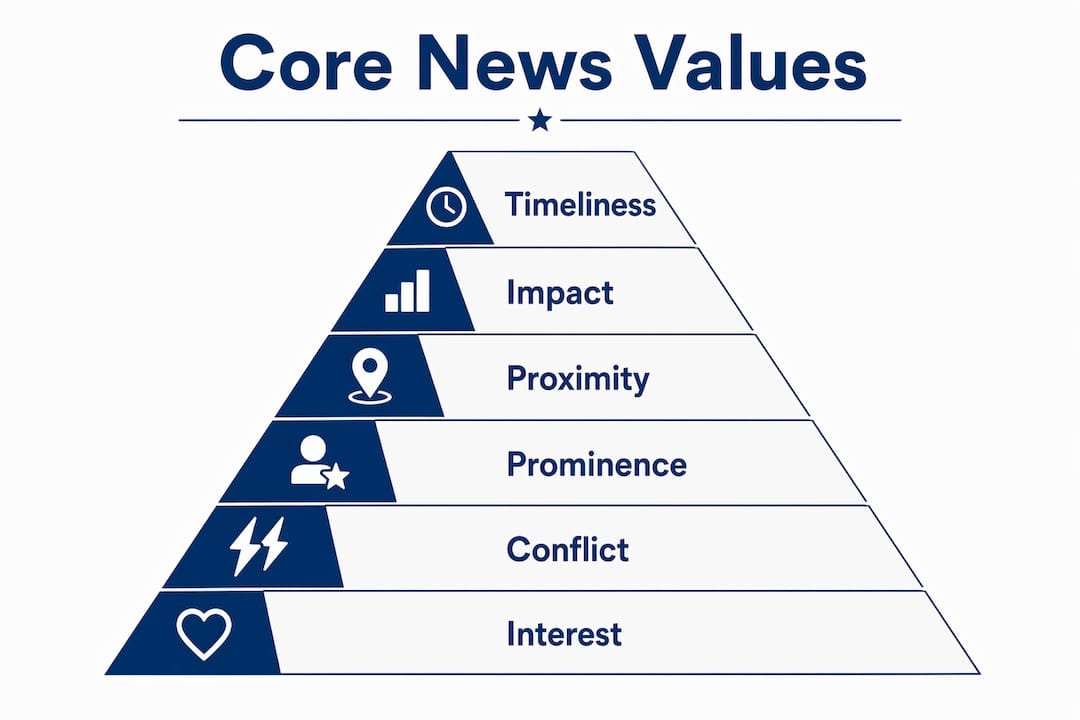
Timeliness asks whether the event is happening now or just happened. A city council vote scheduled for tonight scores high; a vote from three weeks ago scores low unless new information surfaces.
Impact measures how many people are affected and how severely. A water-main break affecting one block is local news. A contamination advisory affecting an entire county is front-page news. Stories that affect daily life for a large share of the readership consistently rank high on this dimension.
Proximity reflects geographic and social closeness to the audience. A school-board decision in a neighboring county matters more to local readers than a similar decision in a distant state, even if the distant case is objectively larger.

Prominence applies when a named public figure, institution, or well-known organization is involved. The mayor’s budget proposal draws coverage that an identical proposal from an unknown private citizen would not.
Conflict and novelty capture the tension or the first-time quality of an event. A labor dispute at a major employer, a rare crime pattern, or a policy reversal all carry this value. Novelty alone can elevate an otherwise modest story.
Human interest is the factor that makes a story worth reading even when the stakes are not high. A neighbor who organized a free meal program for elderly residents may not affect city policy, but the story reflects community character. Julie Hirshan Hart, editor of the Laconia Daily Sun, put it plainly: “We’re particularly always interested in people stories. If somebody did something cool. You know, not necessarily just the president of the Rotary Club, but somebody’s neighbor down the street who did a kind deed for somebody in the community.”
“Gatekeeping remains central: editors act as filters who decide which information reaches the public, and transparency about that process builds trust.” — Journalism researchers on editorial decision-making
An outlet’s editorial mission also weights these criteria. A public-safety-focused local newsroom will rank proximity and impact above novelty. A statewide policy outlet will weight prominence and conflict more heavily. Coverage of local elections, for example, scores high on proximity, impact, and timeliness simultaneously, which is why most local newsrooms treat election coverage as a standing priority regardless of staffing pressure.
How a story moves from idea to publication
The path from raw tip to published article follows a consistent sequence, though the pace varies by outlet size and story urgency.
- Story idea surfaces. Reporters on assigned beats observe events, monitor public records, and build source relationships. Tips from community members, press releases, and social listening also feed the queue. Beat reporters function as the newsroom’s primary early-warning system.
- Pitch to editor. The reporter or editor frames the idea as a brief pitch: the core claim, the news value argument, the proposed sources, and a rough reporting timeline. A strong pitch answers two questions editors ask immediately: “So what?” and “Why now?”
- Editorial meeting. Daily stand-ups and formal assignment meetings are where decisions happen. Editors weigh competing pitches against available staff, deadlines, and the outlet’s coverage priorities. Editorial meetings are the practical forum where assignments are confirmed, held, or dropped.
- Assignment and reporting. The assigned reporter gathers facts, contacts sources, and collects documentation. Verification happens at this stage, not after publication. The 24/7 digital cycle creates speed pressure, but editors are responsible for holding publication until claims are confirmed.
- Copy editing. A second set of eyes checks facts, sourcing, fairness, and legal exposure before the story moves forward.
- Publishing and distribution. The story goes live, and placement decisions (homepage, social, email newsletter) are made based on editorial priority and, secondarily, on audience data.
For a deeper look at how story prioritization works at the assignment stage, the process involves explicit trade-offs between competing stories with similar news value scores.
Who decides: roles and authority in a newsroom
Coverage decisions are distributed across several roles, and authority scales with the size of the outlet.

| Role | Typical Responsibilities | Example Decisions |
|---|---|---|
| Reporter / Beat Reporter | Generates story ideas, conducts reporting, files copy | Pitches stories, flags breaking news from beat |
| Assignment Editor | Manages daily story queue, approves pitches | Confirms or rejects assignments, sets deadlines |
| City / Metro Editor | Oversees local coverage area, coordinates beats | Allocates reporters across topics, approves sensitive stories |
| Managing Editor | Runs daily operations, enforces editorial standards | Approves major investigations, resolves disputes between desks |
| Editor-in-Chief | Sets editorial direction, represents the newsroom publicly | Final authority on front-page placement, corrections policy |
In a small local newsroom, one or two people may fill all of these roles simultaneously. At a regional outlet, each role is distinct. Cross-functional staff also influence decisions: audience editors analyze reader data and recommend placement; photo and video editors determine visual coverage; legal counsel reviews stories with defamation or privacy exposure before publication.
The editor-in-chief holds final authority on the most consequential decisions, including whether to publish a story that a source has asked to suppress, how to handle a correction on a high-profile error, and whether to pursue an investigation that may affect an advertiser. That last point is where editorial independence and business model intersect, and where a published code of ethics becomes the clearest signal of how a newsroom handles the tension.
What practical limits force coverage choices
Staffing is the most direct constraint on coverage. Some local outlets operate with as few as two reporters covering nearly 20 communities. At the Berlin Daily Sun, one full-time journalist covers an entire region. Those numbers mean that every assignment is also a decision not to cover something else.
Time is the second constraint. A story that requires three days of document review competes directly with three days of daily news. Budget affects travel, data subscriptions, and the ability to hire freelancers for specialized reporting. Safety is a real factor in crime and disaster coverage: reporters cannot enter active crime scenes, hazardous zones, or situations where their physical safety is not assured.
Geography shapes the coverage map as well. Editors at the Laconia Daily Sun noted that the core communities in their immediate area receive more coverage than outlying towns, not because those towns matter less, but because proximity to staff determines practical access.
Local editors consistently report that readers misunderstand newsroom capacity, interpreting gaps in coverage as intentional neglect rather than resource limits. The decline of local news outlets has compounded this problem. Understanding why local news is declining provides useful context for why coverage gaps exist even when community need is clear.
Pro Tip: If you want a story covered, time your tip to arrive before the morning editorial meeting, attach any available documentation (meeting agendas, public records, photos), and name at least two people willing to speak on the record. A tip with sources attached is far more likely to survive the pitch stage than a general complaint or observation.
How analytics and audience input shape editorial decisions
Newsrooms track page views, time on page, social shares, and email open rates. Each metric serves a different purpose. Page views inform homepage placement decisions. Time on page signals whether a story format is working. Social shares indicate which topics generate community conversation. Email open rates help editors understand which beats their most engaged readers follow.
Analytics influence decisions at the margins, not at the core. Top editors retain authority to prioritize mission-driven stories over high-traffic content. A story about a city council vote on affordable housing may generate fewer clicks than a viral crime report, but editors committed to civic coverage will assign it anyway.
- Page views: used to adjust homepage placement and determine whether a follow-up story is warranted
- Time on page: signals whether long-form or short-form treatment fits the topic
- Social shares: inform which story angles resonate with the audience and may prompt follow-up coverage
- Email open rates: guide newsletter curation and help editors identify which beats have the most loyal readers
- Reader tips and advisory boards: some outlets, like the Concord Monitor, use a monthly reader advisory board to gather direct community input on coverage priorities
The risk of over-relying on analytics is real. Traffic data reflects what readers clicked on, not necessarily what they needed to know. Mission-first judgment, particularly for investigative or civic-critical stories, remains the standard that separates credible newsrooms from click-driven aggregators.
Ethics, conflicts of interest, corrections, and transparency
Editorial ethics shape both which stories get covered and how they are framed. The core principles are fairness (presenting multiple perspectives on contested issues), minimizing harm (protecting vulnerable sources and avoiding gratuitous detail), respecting privacy (distinguishing between public figures and private individuals), and applying a public interest standard (asking whether the benefit of publishing outweighs any harm caused).
Conflicts of interest arise when a reporter or editor has a personal, financial, or political relationship with a story subject. Standard practice requires disclosure or recusal. A reporter who owns stock in a company should not cover that company. An editor whose family member is a candidate should not assign or approve election coverage involving that candidate.
“The 24/7 digital cycle raises speed pressures that editors must balance with verification and ethics. Publishing first and correcting later is not a neutral choice — it distributes misinformation before the correction reaches most readers.” — Practitioner and scholarly sources on digital-era newsroom pressures
Corrections policies define what happens when errors occur. A credible corrections policy names the error, states the correct information, and timestamps the update. Retractions are reserved for stories that cannot be corrected because the core claim was wrong. Both corrections and retractions affect future coverage decisions: a reporter whose story required a retraction will face closer editorial scrutiny on subsequent assignments.
Readers should expect to find bylines on every story, a published code of ethics or editorial standards page, disclosure statements on sponsored content, and a clear corrections policy. These are not optional features of a credible newsroom. They are the baseline. Community trust is built on consistent application of these standards, not on individual stories.
The influence of sponsored content and advertising relationships on editorial decisions is a separate concern. Credible newsrooms maintain a strict separation between the advertising department and the editorial department. Media coverage arrangements that blur this line require explicit disclosure to readers.
When should newsrooms explain their coverage choices?
Transparency about coverage decisions is a practice, not a policy statement. The most effective explainers share several characteristics:
- They are published promptly, ideally within the same news cycle as the coverage decision they address.
- They name the specific criteria that drove the decision, not just general principles.
- They acknowledge constraints honestly, including staffing limits, access restrictions, or verification gaps.
- They name the editor or editorial team responsible for the decision.
- They link to the newsroom’s published editorial standards so readers can evaluate the decision against stated policy.
A “why we covered this” post does not need to be long. A three-paragraph explainer that states the news values at play, the reporting steps taken, and the editorial authority that approved the story is sufficient. Some newsrooms publish these as standalone articles; others append them as editor’s notes at the bottom of the story itself.
Transparency about gatekeeping decisions reduces misperceptions and builds reader trust. Readers who understand why a story was covered are less likely to interpret coverage gaps as bias or neglect. The Trusting News project at trustingnews.org offers practical templates for newsrooms building this practice.
If you want to request an explanation from a newsroom, direct your inquiry to the managing editor or editor-in-chief by name. State the specific story, the specific decision you are questioning, and the specific information you are seeking. A vague complaint about bias is unlikely to generate a substantive response. A precise question about a named editorial decision is.
A real example of how resources shape daily coverage
The Granite State News Collaborative documented a clear case of resource-driven coverage decisions at the Laconia Daily Sun. With two reporters covering 18 Lakes Region communities, editor Julie Hirshan Hart described a daily triage process: “Is something time-sensitive? Is something happening for the first time? Is something happening in more than one community? And I would say we just put our heads all together and sort through, what can we do now? What can we maybe hold for later?”
That process is not unique to New Hampshire. Small local newsrooms across the country face the same arithmetic: finite staff, finite hours, and a community that generates more news than any two reporters can cover. The result is a coverage map that prioritizes public safety, local government, and major institutions, because those topics carry the highest combined news value scores and the most direct community impact.
The business model of a newsroom also shapes its priorities. Ad-supported outlets depend on reader traffic, which creates pressure to cover topics that generate engagement. Nonprofit newsrooms funded by grants and reader donations may have more latitude to pursue long-term investigations with lower immediate traffic potential. Understanding how local media is funded helps readers interpret the coverage priorities they observe.
A practical checklist for evaluating coverage choices
Use these items when reading a published story or deciding whether to contact a newsroom.
When reading a story:
- Check for a byline and the reporter’s beat designation.
- Confirm that named sources are identified with their role or relationship to the story.
- Look for links to primary documents, public records, or official statements.
- Check for a correction or editor’s note at the bottom of the story.
- Look for a disclosure statement if the story involves a sponsor or advertiser.
Red flags to notice:
- No byline or a generic staff byline with no named reporter.
- All sources are anonymous with no explanation of why anonymity was granted.
- Claims are attributed to “reports” or “sources say” without any named institution.
- No correction policy is linked or published on the site.
How to submit a tip or request coverage:
- Identify the reporter or editor who covers the relevant beat.
- Write a brief summary: what happened, when, where, who is involved, and why it matters to the community.
- Attach any documentation you have (meeting agendas, photos, public records).
- Name at least two people willing to speak on the record.
- State your contact information and availability.
Media literacy experts recommend that readers also look for transparency about editorial processes and funding as a baseline indicator of newsroom credibility.
Key Takeaways
Newsrooms decide coverage by scoring story candidates against established news values, then filtering results through editorial mission and available staff capacity.
| Point | Details |
|---|---|
| Core news values drive selection | Timeliness, impact, proximity, prominence, conflict, novelty, and human interest are the primary criteria editors apply. |
| Resource limits shape the coverage map | Small local newsrooms often face very limited staffing that requires daily triage of story candidates across many communities. |
| Analytics inform but do not control | Editors use page views and engagement data for placement decisions, but mission-driven stories take priority over high-traffic topics. |
| Transparency is a credible newsroom standard | Bylines, corrections policies, codes of ethics, and coverage explainers are baseline expectations, not optional features. |
| Thecentralgeorgian applies these principles locally | Thecentralgeorgian covers Central Georgia by prioritizing public safety, local government, and community events within its editorial mission and staffing capacity. |
The editorial view on what transparency actually requires
Most discussions of newsroom transparency stop at the policy level: publish a code of ethics, post a corrections page, add a byline. Those are necessary, but they are not sufficient. The harder question is whether a newsroom explains its decisions in real time, when the explanation is inconvenient, not just when it is easy.
The coverage gap problem is a good example. When a community notices that a particular town, school district, or neighborhood receives less coverage than others, the instinct is to assume bias. The actual explanation is almost always staffing arithmetic. Two reporters cannot cover 20 communities with equal depth. But that explanation only reduces misperception if the newsroom states it explicitly and repeatedly, not just in a mission statement buried in the “About” page.
The same logic applies to story framing. Readers who disagree with how a story was framed often assume the framing reflects the reporter’s personal views. In most cases, it reflects the news values that were dominant at the time of assignment, the sources who were available, and the deadline that was in force. None of that is obvious to a reader who was not in the editorial meeting. Naming those factors, even briefly, changes the reader’s interpretation.
The outlets that do this well treat transparency as a reporting beat, not a PR function. They assign editors to write coverage explainers the same way they assign reporters to cover city hall. The result is a reader base that understands the newsroom’s constraints and is more likely to submit useful tips, support the outlet financially, and extend good faith when errors occur.
Thecentralgeorgian’s approach to coverage decisions
Thecentralgeorgian covers Central Georgia with a direct editorial commitment: public safety, local government, and community events receive priority coverage because those topics carry the highest combined news value for Central Georgia residents. Every story assignment goes through an editorial review process that applies the same news values described in this guide, timeliness, impact, proximity, and verification, before a reporter is dispatched.
Readers who want to understand a specific coverage decision can contact the editorial team directly. Thecentralgeorgian publishes bylines on all original reporting and maintains a corrections process for factual errors. For readers interested in how in-depth local reporting is produced and why some stories require longer investment, the guide to longform local journalism explains the process and the editorial standards that govern it. To submit a tip, identify the relevant beat, attach any documentation, and name at least one source willing to speak on the record. The editorial team reviews all tips and responds when a story meets the coverage criteria outlined above.
Further reading and primary sources
| Source | What it offers |
|---|---|
| Granite State News Collaborative | Documented case study of resource-driven coverage decisions at small local newsrooms, with direct editor quotes. |
| Trusting News — Explaining Coverage | Practical templates and guidance for newsrooms building coverage-transparency practices. |
| Poynter Institute | Ethics training and trust-building frameworks for working journalists and editors. |
| Journalism University — News Development Process | Foundational explanation of news values and how editors apply them as a scoring checklist. |
| InsightfulPost — How News Editors Choose Stories | Overview of gatekeeping theory and the role of editorial transparency in credibility. |
| The Hornet Online — Story Prioritization | Practical description of editorial meeting dynamics and pitch evaluation criteria. |
| Knight Foundation — State of Public Trust in Local News | Research data on reader trust levels and the factors that increase or erode confidence in local news. |
| Daily Northwestern — How to Pitch a Story | Student newsroom guide explaining tip submission, coverage criteria, and editorial decision-making from the inside. |