
Why Is Local News Declining? Causes and Consequences Explained

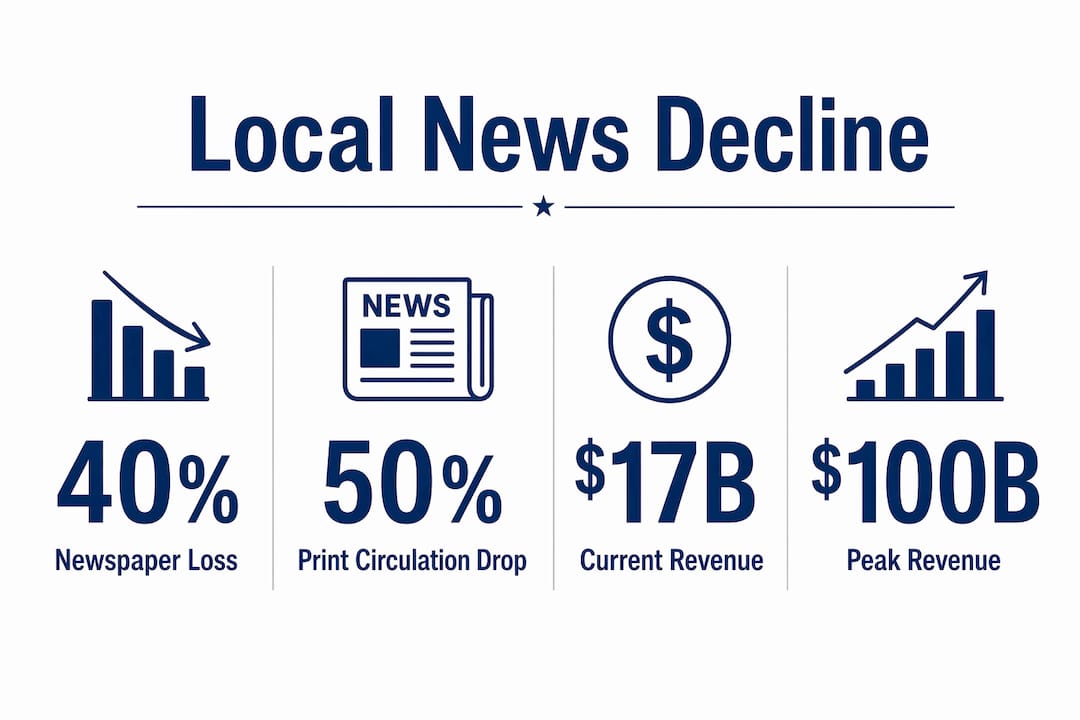
Local news in the United States is collapsing under the combined weight of lost advertising revenue, ownership consolidation, and digital disruption. Nearly 40% of all local U.S. newspapers have disappeared since 2005, leaving 50 million Americans with limited or no access to reliable local coverage. The scale of this decline is not a gradual fade. It is a structural breakdown with measurable consequences for civic life, public health, and democratic accountability.
The core drivers are well-documented:
- Revenue collapse: Print advertising, once the financial backbone of local newspapers, has shifted almost entirely to digital platforms, stripping newsrooms of the income needed to sustain reporting staff.
- Ownership consolidation: Corporate chains and hedge funds acquired local papers and cut costs aggressively, reducing original reporting and replacing it with wire content.
- Staff reductions: The U.S. newspaper industry lost 57% of its employees between 2008 and 2020, gutting the capacity for watchdog journalism.
- News desert expansion: Counties with no local news source grew from roughly 150 in 2005 to 213 in 2025, with 1,524 additional counties served by only one outlet.
- Digital disruption: Social media platforms and search engines redirected audience attention and advertising dollars away from local outlets, while generative AI now suppresses direct traffic to news sites.
The consequences extend beyond the media industry. Communities without local news show lower voter turnout, weaker government accountability, and higher levels of political polarization.
How news deserts are growing and what communities lose
A news desert is a county with no professional source of local news. In 2025, 213 counties meet that definition, up from roughly 150 in 2005. Another 1,524 counties have only one remaining news source, typically a weekly paper with a reduced staff. Taken together, about 50 million Americans have limited to no access to local coverage.
| Year | News desert counties | Americans with limited local news access |
|---|---|---|
| 2005 | ~150 | 50 million |
| 2025 | 213 | ~50 million |
| 2025 | 213 | ~50 million |
News deserts are not evenly distributed. They cluster in rural areas and small towns where digital infrastructure is also weak. In the 212 news desert counties tracked by the Local News Initiative, fewer than half of residents have access to the fastest speeds of terrestrial internet connectivity on average. That dual gap, no local news and limited internet access, places these communities at the edge of a widening information divide.
The civic costs are concrete:
- Residents have less knowledge of local government decisions, school board actions, and public safety developments.
- Social trust declines as shared community narratives disappear.
- Local officials face less scrutiny, which research links to higher rates of government corruption and increased municipal borrowing costs.
- Voter turnout in local elections falls when residents lack information about candidates and ballot measures.
Pro Tip: If you want to check whether your county has a local news source, the Local News Initiative at Northwestern University’s Medill School maintains an interactive map updated annually.
Why newsroom employment cuts are accelerating the crisis
The U.S. newspaper industry lost 57% of its employees between 2008 and 2020, a reduction that directly translates to fewer reporters covering city halls, school boards, courts, and public health agencies. Newspapers are closing at a steady rate each week in recent years. Many papers shut down in the past year alone.
Staffing cuts do not just reduce the volume of stories. They eliminate the institutional knowledge and source relationships that make accountability journalism possible.
The factors driving employment decline are layered:
- Revenue shortfalls force publishers to cut the highest variable cost, which is labor.
- Reduced print frequency means fewer pages to fill, which reduces the need for reporters.
- Consolidation by chains brings centralized content production that replaces local reporters with shared national copy.
- Hedge fund ownership prioritizes short-term cost extraction over long-term editorial investment.
- Digital ad revenue does not scale for local outlets the way it did for national publishers, leaving smaller papers without a viable replacement income stream.
Coverage of state and congressional political scandals decreased to about 25% of past levels, and research shows that reduced reporting volume corresponds directly with lower sanctions for elected officials implicated in wrongdoing. Fewer reporters means less accountability, and less accountability has measurable costs for the public.
How ownership changes and media consolidation reduce local news quality
Corporate chains and hedge funds reshaped the local news industry over the past two decades. Their acquisition strategy typically followed a pattern: buy a paper, cut staff, reduce print frequency, consolidate production with other properties, and fill pages with wire content. The result is what researchers call a “ghost newspaper,” an outlet that retains its legacy brand name but produces little or no original local reporting.
Harvard Professor Thomas Patterson, the Bradlee Professor of Government and the Press, describes the structural damage clearly:
The ownership picture has shifted in a notable way in recent years. Most recent closures are by smaller, independent, family-owned outlets struggling with local economic pressures, not large chain consolidations. In the past year, only a tenth of the newspapers that closed were controlled by one of the 10 largest companies. Four Minnesota papers closed after citing combined revenue below expenses. The Wasatch Wave in Utah, operating for 136 years, closed when its long-time owners retired.
The consequences of ownership consolidation include:
- Loss of reporters with deep community ties and source networks.
- Replacement of original reporting with national wire content that does not serve local information needs.
- Ghost newspapers that mislead communities about the availability of real local coverage.
- Reduced editorial independence as cost-cutting directives override journalistic judgment.
How circulation declines and shifting consumption patterns affect local news revenue
Print circulation of local newspapers dropped by about 50% from 2015 to 2020, according to Pew Research Center data. Digital circulation increased somewhat during that period, but not enough to offset print losses. Web traffic to 100 of the largest newspapers has since plummeted more than 45% in the past four years, according to a Medill analysis of Comscore data.
| Period | Change in print circulation | Notes |
|---|---|---|
| 2015–2020 | Down ~50% | Digital circulation rose modestly |
| 2021–2025 | Web traffic down 45%+ | Driven by AI search summaries and platform algorithm changes |
The consumption shift is not simply a move from print to digital. It reflects a fragmentation of audience attention across social media, content creators, and AI-generated summaries. In a Medill poll of Chicago news consumers, nearly a third of respondents said they received news from content creators rather than traditional outlets. Generative AI integration into search engines now surfaces headlines and summaries without directing readers to the underlying news sites, which particularly affects high-traffic content like product reviews and evergreen journalism.
Key consumption and monetization challenges include:
- Readers conditioned by free online access are less willing to pay for subscriptions.
- Digital advertising auction pricing drives down per-impression revenue for local outlets.
- Social media platforms provide distribution but capture the advertising value of that audience.
- Reduced print frequency, with more than 80% of daily papers now printing fewer than seven days a week, signals further audience erosion.
Understanding how local media is funded helps clarify why these circulation trends translate so directly into newsroom cuts.
What communities lose when local news coverage shrinks
The civic consequences of declining local news are documented across a growing body of social science research. A 10-point increase in the share of residents living in low-news areas correlates with a 1.4-point rise in reported loneliness scores. Voter turnout in local elections falls. Government corruption increases. Municipal borrowing costs rise as financial oversight weakens.
Political polarization is a direct downstream effect. When communities lose local news, residents default to national media sources that prioritize engagement over civic information. The decline in local reporting drives a default toward outrage-driven national sources, deepening partisan divisions that local journalism historically helped moderate. The connection between local news and civic engagement is not theoretical. It shows up in measurable outcomes across communities of every size.
Media vacuums also attract low-quality replacements. Political dark money funds partisan “pink slime” websites that mimic local news outlets while spreading misinformation, further eroding public trust in local information sources.
How Thecentralgeorgian serves Central Georgia amid the national decline
Thecentralgeorgian operates as a direct counter to the trends described above. While newsrooms across the country reduce staff and cut local coverage, Thecentralgeorgian maintains a focus on the specific events, investigations, and public safety developments that affect Central Georgia residents.
Thecentralgeorgian’s coverage of police operations, crime investigations, and public health advisories gives Central Georgia residents access to the kind of accountability reporting that disappears first when newsrooms cut staff.
The outlet’s approach reflects several practices that sustain local journalism in a difficult environment:
- Real-time breaking news coverage on incidents affecting public safety, including law enforcement operations and emergency alerts.
- In-depth crime investigations that hold local institutions accountable and inform residents about ongoing public safety concerns.
- Community event coverage that maintains the shared narrative function local news has historically provided.
- Civic engagement reporting that connects residents to local government decisions and election coverage.
Thecentralgeorgian’s coverage of local election accountability exemplifies the kind of reporting that directly counters the civic damage caused by news deserts. Readers who understand how news stories are prioritized can better evaluate the editorial choices that distinguish genuine local journalism from wire-fed ghost newspapers.
Pro Tip: Bookmark Thecentralgeorgian’s public safety section for real-time updates on law enforcement activity and health advisories in Central Georgia. These are the stories that disappear first when a local newsroom closes.
How digital disruption and social media accelerated the local news decline
Digital disruption did not simply shift readers from print to online. It dismantled the closed news ecosystem that local newspapers had dominated for over a century. The internet lowered the cost of entry for both news providers and advertisers, creating competition that local papers were structurally unable to match.

Social media platforms and search engines became the primary distribution layer for news, but they captured the advertising value of that distribution rather than passing it to publishers. Platforms consistently prioritized engagement over civic content, which meant local government coverage, school board reporting, and public health journalism received less algorithmic visibility than content designed to provoke reaction. The rise of narrative-driven politics in national media filled the attention space that local journalism vacated, accelerating polarization in communities that had already lost their local outlets.
Generative AI has added a new pressure layer. AI-powered search summaries now answer user queries without directing traffic to the underlying news sources, cutting into the page-view revenue that digital-era local outlets depend on. This affects evergreen content and topic-based journalism most severely, which are often the highest-traffic, highest-revenue content categories for smaller outlets.
How advertising revenue shifted from local news to online giants
Newspapers were once a $100 billion industry in the United States. That figure has shrunk to approximately $17 billion today, according to Nancy Gibbs, director of the Shorenstein Center at Harvard Kennedy School. The revenue did not disappear. It migrated to technology platforms. Google’s advertising business now exceeds $200 billion annually. Amazon alone generates more advertising revenue than every newspaper in the world combined.
Classified advertising was the first major casualty. After 2000, platforms like Craigslist offered cheaper and more efficient alternatives for local buying and selling, eliminating a revenue stream that had subsidized local reporting for decades. Display advertising followed as businesses shifted budgets to digital platforms offering lower costs and better targeting. The auction-based pricing model of internet advertising drove down per-impression rates across the board, but local outlets with smaller audiences absorbed the worst of those declines.
The local news industry once generated $50 billion in annual revenue. It now generates about $17 billion. The missing $33 billion represents the financial gap that no combination of subscriptions, philanthropy, or government support has yet closed.
Why monetizing local news in the digital age remains difficult
Local news outlets face a structural monetization problem that national publishers do not. Their audience is geographically bounded, which limits the scale that digital advertising requires to generate meaningful revenue. A national outlet can aggregate millions of readers across topics. A local paper in a mid-sized county cannot.
Subscription models work better for outlets with strong brand loyalty and unique content, but local papers competing against free national news sources face significant resistance. Research shows that only about 15% of Americans paid for news in the past year, despite high stated trust in local journalism. That gap between valuing local news and paying for it creates a persistent free-rider problem.
Membership models, events revenue, and philanthropic support have emerged as partial solutions, but none scales easily to rural or underserved markets. Digital-only local news startups have grown in number, but they remain heavily concentrated in urban areas and have not appeared fast enough to offset losses in rural and suburban communities. Organizations like the American Journalism Project provide seed capital to nonprofit news startups, and Report for America places reporters in local newsrooms, but these programs reach a fraction of the communities that have lost coverage. Understanding how local media relations work can help community organizations and businesses support the outlets that remain.
What models are working to preserve and revitalize local news
The most viable path forward for local news runs through the nonprofit sector. The GAO, Pew Research Center, and academic researchers broadly agree that a nonprofit model, financed by philanthropy and public funding, offers the best structural fit for public-interest journalism in markets where advertising revenue cannot sustain for-profit operations.
Public radio is already filling some of the gap. Nearly 300 public radio stations produce local reporting across the country. In nine counties, public radio is the sole remaining news source. Harvard Professor Thomas Patterson’s research found that half of NPR’s senior editors and managers said their stations could become the leading news outlet in their community with additional funding. “Public radio has the capacity to fill much of the gap in local news created by the decline of the newspaper,” Patterson said. “Strengthening local public radio stations is a democratic imperative.”
Other models showing results include:
- Community-owned cooperatives that convert failing for-profit papers into reader-owned organizations.
- University-affiliated newsrooms that combine professional journalism with student training.
- Philanthropic foundations funding investigative and public-interest reporting in underserved markets.
- Government tax incentives for local news subscriptions and nonprofit news organizations, as examined by the GAO.
- Platform content licensing agreements that compensate publishers for content used in AI summaries and search results.
One calculation cited in Georgetown Law scholarship suggests that if every American paid just $4.30 annually for news, it would fund enough reporters to reverse the decline of the past two decades. The financial gap is large, but the per-person cost of closing it is not.
Key Takeaways
The decline of local news in the United States is driven by economic collapse, ownership consolidation, and digital disruption, with direct consequences for civic health, government accountability, and community cohesion.
| Point | Details |
|---|---|
| Scale of newspaper loss | Nearly 40% of U.S. local newspapers have closed since 2005, leaving 50 million Americans with limited local news access. |
| News desert growth | News desert counties rose from roughly 150 in 2005 to 213 in 2025, with 1,524 more counties down to a single source. |
| Employment collapse | Newspaper employment fell 57% between 2008 and 2020, directly reducing watchdog and accountability reporting. |
| Civic consequences | A 10-point rise in low-news area share correlates with a 1.4-point increase in reported loneliness scores; voter turnout and government accountability also decline. |
| Viable solutions | Nonprofit models, public radio expansion, and philanthropic funding represent the most documented paths to sustaining local journalism. |
The local news crisis is worse than the numbers suggest
The data on local news decline is stark, but the numbers undercount the actual damage. Ghost newspapers, outlets that retain their brand names while producing almost no original reporting, are counted as active news sources in most surveys. That means the real number of communities without genuine local journalism is higher than the 213 news desert counties the Local News Initiative tracks.
What concerns me most is the replacement problem. Digital startups are growing, but they cluster in cities with educated, affluent populations and reliable broadband. The communities that have lost the most, rural counties, small industrial towns, lower-income suburbs, are precisely the ones that digital entrepreneurship is not reaching. The information divide is widening along the same geographic and economic lines as other forms of inequality.
The optimism around nonprofit models is warranted but conditional. Public radio has real capacity, as Patterson’s research demonstrates, but only with funding that does not currently exist at scale. The American Journalism Project and Report for America are doing important work, but they are operating at a fraction of the volume needed to replace what has been lost. The local news industry once generated $50 billion in annual revenue. It now generates about $17 billion. Closing that gap requires policy intervention, not just philanthropy.
Thecentralgeorgian’s model, focused on real-time public safety coverage, crime investigation, and civic reporting for a defined geographic community, represents the kind of outlet that communities need. It is not a ghost newspaper. It produces original reporting that residents cannot get anywhere else. That specificity, knowing your community and covering it with depth, is what distinguishes journalism from content aggregation.
Supporting local outlets, through subscriptions, engagement, and civic pressure on platforms to compensate publishers fairly, is not a sentimental act. It is a practical response to a documented civic problem.