
Avoid a $500 Fine: Move Over Law in Georgia for Central GA Drivers
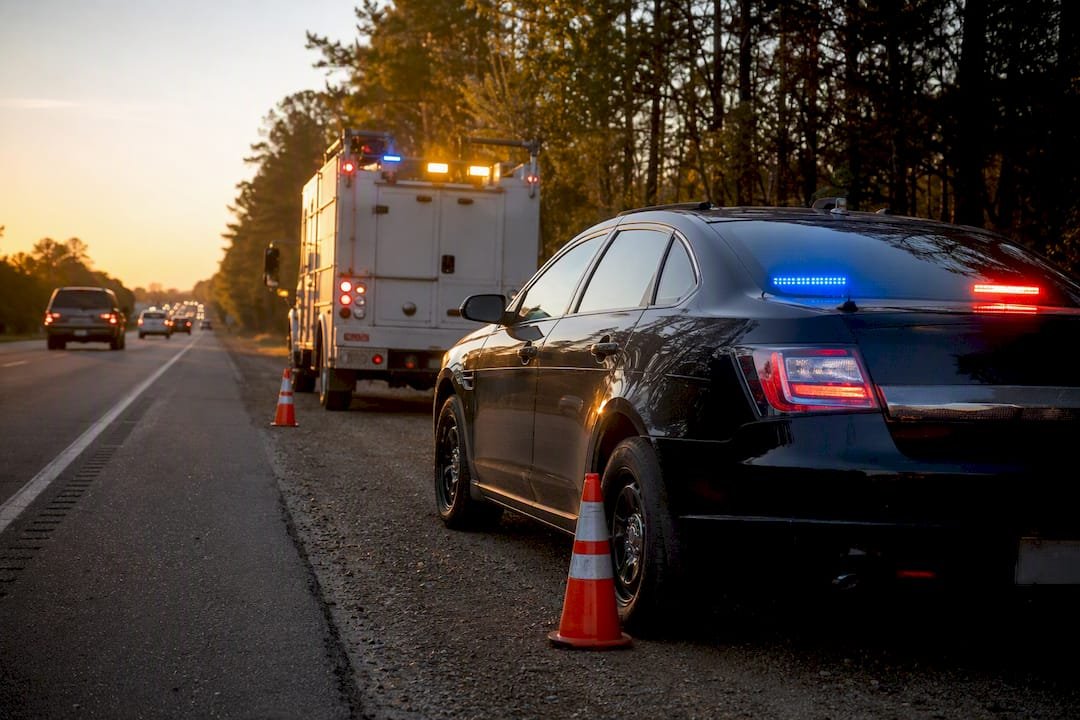
Under O.C.G.A. § 40-6-16, the Spencer Pass Law, drivers approaching a stopped authorized vehicle with flashing lights or cones must change lanes away from it if that move is safe. If a lane change isn’t possible, drivers must slow below the posted speed limit and be ready to stop. This applies to emergency vehicles, tow trucks, DOT and utility crews, and sanitation vehicles. Ignoring it risks fines up to $500, license points, and real legal exposure.
TL;DR:
- Failing to change lanes when possible can result in fines up to $500 and three license points, especially if the violation leads to a crash.
- The law covers more vehicles than drivers realize, including utility trucks, sanitation vehicles, and any stopped vehicle with flashing lights or cones, regardless of agency.
- When lane changes are unsafe or impossible, drivers must slow below the posted speed limit and remain alert to roadside workers.
- Strict enforcement is common in high-traffic, rural, and highway areas, with tickets often based on officer observation or camera evidence.
- Drivers often underestimate the law’s scope, mistakenly believing it applies only to police cars, but it legally covers any vehicle with flashing lights or cones.
Table of Contents
- Move Over Law Georgia: What the Statute Actually Requires
- Which Vehicles Trigger the Move Over Rule
- Fines, License Points, and CDL Risk
- How Officers Enforce It and What Defenses Actually Hold Up
- How to Comply Every Time You See Lights or Cones
- What to Do After You Get a Move Over Ticket
- Why Central Georgia Takes Move Over Enforcement Seriously
- Read the Law and Official Guidance Directly
- The Gap Between Knowing the Law and Actually Following It
- Sources
Move Over Law Georgia: What the Statute Actually Requires
O.C.G.A. § 40-6-16 breaks the duty into two parts, and the order matters. Subsection (b) says that when you approach a stationary authorized vehicle displaying flashing yellow, amber, white, red, or blue lights, you must move into a lane not adjacent to it, provided the move can be made safely. Subsection © is the fallback: if changing lanes isn’t possible or safe, you must reduce speed below the posted limit and be prepared to stop.
The statute’s text doesn’t name specific agencies. It responds to lights and cones, not the logo on the vehicle. That distinction trips up a lot of drivers who assume the rule is only about police cars. The Georgia Department of Driver Services confirms the same two-step structure: move over when safe, slow down and stay alert when you can’t. Georgia lawmakers named the statute after Spencer Pass, a tow operator killed while working roadside, which is part of why the law treats the shoulder as a workspace, not just a parking spot.
Which Vehicles Trigger the Move Over Rule
Georgia’s Move Over policy covers more categories than most drivers realize. The Governor’s Office of Highway Safety lists the vehicles the law protects:
- Police cars, fire trucks, and ambulances responding or stopped with emergency lights on
- Tow trucks and roadside recovery vehicles assisting a disabled car
- Georgia Department of Transportation maintenance vehicles working on shoulders or lanes
- Utility service trucks repairing power lines, gas lines, or telecom equipment
- Active sanitation vehicles collecting trash or recycling, provided their lights are engaged
Flashing amber, white, yellow, red, or blue lights are the trigger. So are orange traffic cones marking a work zone. If you see either, the law applies, regardless of which agency or company owns the vehicle.
Fines, License Points, and CDL Risk
Penalties scale with which part of the statute you violate. A failure to move over under subsection (b) can bring a fine up to $500. Failing to slow down under subsection ©, when a lane change wasn’t possible, tops out at $250, according to FindLaw’s summary of the code.
Money isn’t the only cost. Georgia DDS assigns points to moving violations, and Move Over infractions carry weight on your driving record.
Move Over violation consequences at a glance:
- Fines can be imposed for failing to change lanes when safe (subsection b)
- Up to $250 fine for failing to slow down when a lane change wasn’t possible (subsection c)
- 3 points added to your license under DDS penalty rules
- Possible commercial license consequences for CDL holders, since point accumulation affects federal driving eligibility (depending on state and federal regulations)
If a violation causes a crash, the exposure gets worse. Because the statute sets a clear standard of care, a Move Over violation that leads to injury or property damage can support a negligence per se claim in civil court. That means a plaintiff’s attorney doesn’t have to prove you were careless in the abstract. Breaking the statute itself becomes the evidence of negligence.
How Officers Enforce It and What Defenses Actually Hold Up
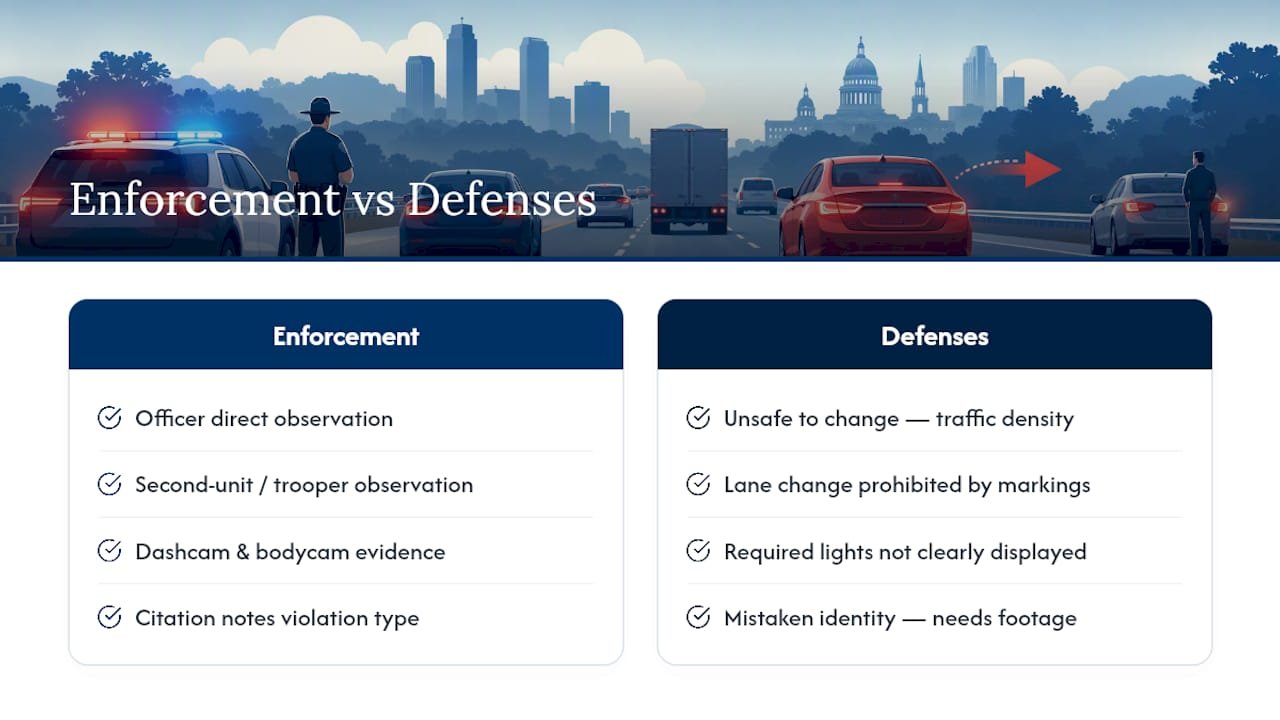
Move Over citations usually start with direct officer observation. A trooper or deputy working a scene, or riding along in a second unit, watches whether passing traffic shifts lanes or slows down. Dashcam and body camera footage increasingly back this up, especially in incidents where a worker was struck or nearly struck.
Officers typically distinguish between two violations on the citation: failure to move over when it was safe to do so, versus failure to reduce speed when a lane change wasn’t an option. That distinction affects which fine applies.
Common defenses include arguing the lane change was unsafe due to traffic density, that a lane change was legally prohibited by road markings, or that the vehicle in question wasn’t clearly displaying required lights. Mistaken identity, where a driver argues they weren’t the vehicle the officer observed, comes up too, but it’s a hard sell without conflicting evidence like traffic camera footage or a dashcam showing another car in the lane. Defenses tied to genuine unsafe conditions, backed by weather data, traffic flow, or witness accounts, tend to carry more weight in court than defenses built on general disagreement with the ticket.
How to Comply Every Time You See Lights or Cones
The safest habit is to treat every set of flashing lights or cones the same way, regardless of what agency you think you’re looking at.
- Check your mirrors and blind spot as soon as you spot lights or cones ahead.
- Signal early and move into a lane not adjacent to the stopped vehicle, if the shift can be made safely.
- If a lane change isn’t possible, ease off the accelerator and drop your speed clearly below the posted limit.
- Increase your following distance behind the car ahead, since sudden braking is common near roadside incidents.
- Stay alert for workers stepping into the lane, since the entire point of the law is to protect people standing near live traffic.
Single-lane roads and heavy congestion make lane changes impossible more often than drivers expect. In those situations, subsection © is your legal obligation: slow down meaningfully, not just tap the brakes. Georgia’s 2023 legislative update, House Bill 1193, reinforced this “reasonable and proper speed” standard for utility and sanitation vehicles specifically, closing a gap where some drivers assumed those crews weren’t covered.
Pro Tip: In construction zones or poor visibility, don’t just meet the posted limit reduction. Slow well below it. Officers and courts look at whether your speed reduction was meaningful, not technical.
What to Do After You Get a Move Over Ticket
Start by reading the citation carefully. It lists the specific charge code (subsection b or c), your court date, and your payment or hearing options. That distinction affects your maximum fine exposure.
If you plan to contest it, gather evidence quickly. Dashcam footage, photos of the scene, weather conditions, and traffic density at the time all matter. Witness contact information helps if a passenger or nearby driver saw the same conditions you did.
From there, you have three paths: pay the fine and accept the points, request a hearing to contest the charge, or consult a traffic attorney if a commercial license or civil liability is at stake. Georgia DDS handles citation reporting, and your local municipal or state court will have the hearing process for your county. If you need documentation like an incident report to support your case, Thecentralgeorgian’s guide to requesting public records walks through how to file that request.
Why Central Georgia Takes Move Over Enforcement Seriously
Thecentralgeorgian has covered enough roadside incidents involving tow operators, utility crews, and sanitation workers to know this law isn’t abstract for Middle Georgia drivers. Interstate corridors and rural highways in the region see frequent breakdowns and utility work, which means frequent Move Over triggers. Local sheriffs’ offices coordinate with the Governor’s Office of Highway Safety on periodic enforcement campaigns, often timed around holiday travel weeks when roadside incidents spike.

Staying current on when and where enforcement tightens helps you avoid an avoidable ticket. Thecentralgeorgian’s guide to road closure alerts is a practical way to track incidents before you’re driving into one.
Read the Law and Official Guidance Directly
- O.C.G.A. § 40-6-16: the full statutory text
- DDS Section 1.3.9: state guidance on compliance and covered vehicles
- GOHS Move Over Law page: public safety summary
- DDS penalties document: point assignments for violations
The Gap Between Knowing the Law and Actually Following It
Most Georgia drivers can recite the basic idea of the Move Over Law if you ask them. Almost nobody applies it consistently to sanitation trucks or utility crews the way they do to police cars. That gap is where most citations happen, not from drivers who don’t know the law exists, but from drivers who mentally narrow its scope to blue lights and sirens.
The statute doesn’t care about that mental shortcut, and neither does the officer writing the ticket. If Georgia lawmakers wanted this rule limited to police and ambulances, the code would say so. It doesn’t. It says lights or cones, full stop. Treating every roadside worker, whether they’re clearing a wreck, reading a utility meter, or hauling trash, as someone standing three feet from live traffic isn’t just legally correct. It reflects what’s actually happening on the shoulder when you pass.
The bigger failure point isn’t ignorance of the law. It’s drivers underestimating how much of Georgia’s roadside workforce falls under it, and treating a slow-down as optional rather than the actual legal floor when a lane change isn’t safe.
— Ernie
Sources
- Georgia Code § 40-6-16 (2025) – Procedure for passing …
- Section1.3.9 – Georgia Department of Driver Services
- Move Over Law – Home | Georgia …
- 375-3-3-.01 Penalties for Violations of Uniform Rules of the Road