Can You Burn in Georgia? EPD May 1 to Sept 30 vs GFC Bans
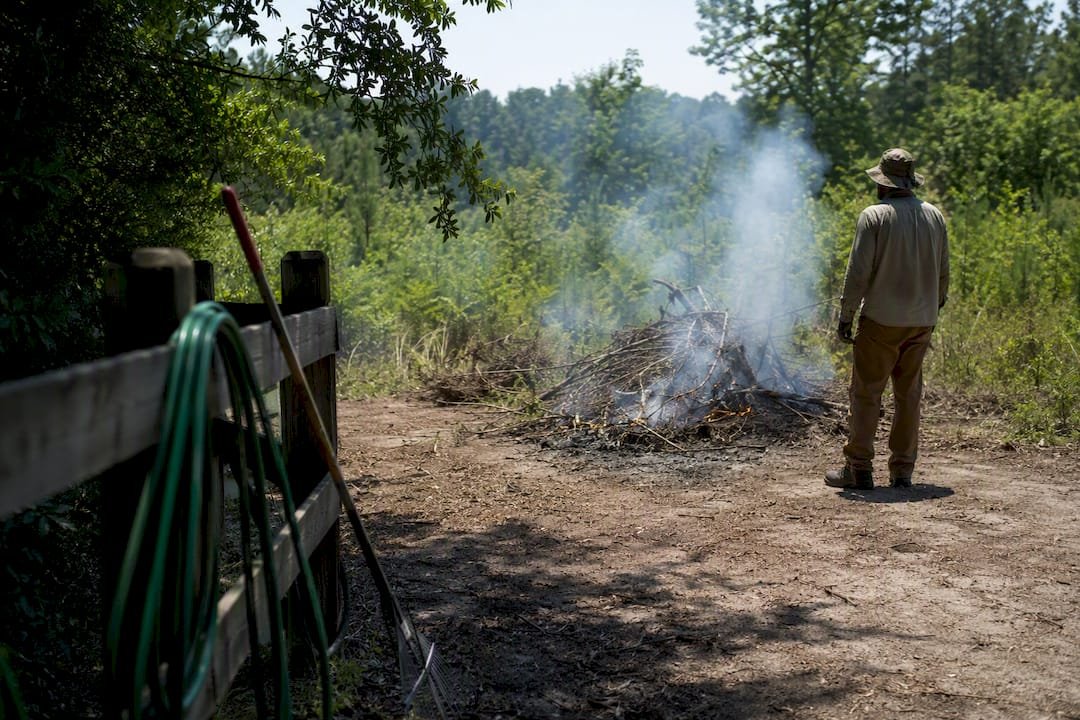
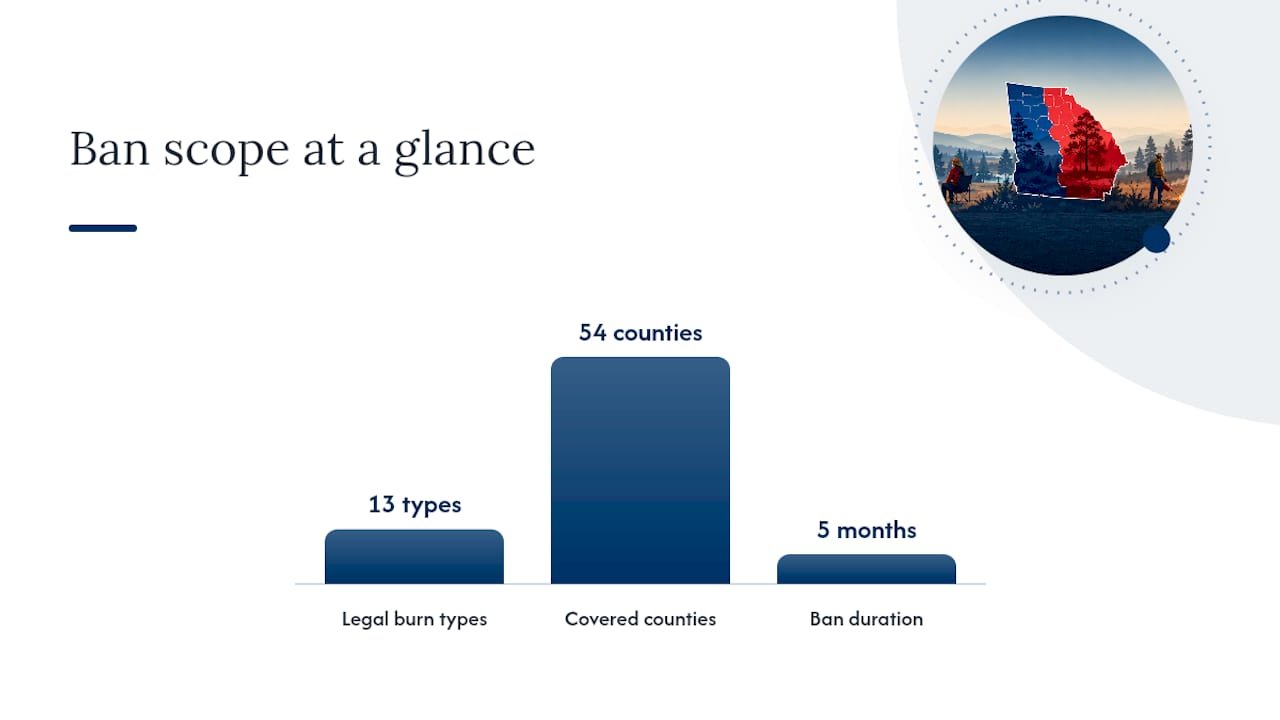
Georgia’s summer open burning ban is in effect right now for 54 counties, running every year from May 1 through September 30 to cut down on ground-level ozone. Recreational fires, cooking, and grilling are exempt, but burning yard debris in a fire pit is not. That ban is separate from any emergency wildfire ban the Georgia Forestry Commission might issue, so check both the EPD and GFC before you strike a match.
TL;DR:
- Only yard debris, land-clearing, and some agricultural burns are restricted during the seasonal ban, which applies from May 1 to September 30 in 54 counties mainly around Atlanta.
- The ban is separate from wildfire restrictions, which can expand to more counties in response to drought or fire danger, and both must be checked independently.
- Recreational fires, grilling, and cooking are always legal, but household trash burning remains illegal statewide year-round.
- Linking county-specific burn permits and monitoring weather, wind, and air quality data is essential for legal and safe burning during the season.
- Violations include burning household trash, unattended fires, or ignoring emergency wildfire bans, with enforcement by local authorities and the EPD.
Table of Contents
- What Does the EPD Summer Burn Ban Actually Cover?
- Is My County Covered? How to Check
- What Can You Legally Burn During the Summer Ban?
- EPD Seasonal Ban vs. GFC Emergency Wildfire Bans: What’s the Difference? Learn about related safety courses like the Georgia Boating & PWC Certification Course Online to enhance your safety knowledge.
- How to Burn Legally and Safely in Georgia
- What Happens if You Violate the Ban?
- How The Central Georgian Keeps You Informed on Local Burn Restrictions
- Why This Distinction Matters More Than People Think
- Sources
What Does the EPD Summer Burn Ban Actually Cover?
The Georgia Environmental Protection Division (EPD) runs this ban for one reason: ground-level ozone climbs during hot summer months, and open burning adds pollutants that make it worse. The rule isn’t new. It’s a recurring, predictable seasonal restriction tied to Open Burning Rules 391-3-1-.02, and it kicks in the same window every year.
The current ban applies from May 1 through September 30 across 54 counties, most of them in the metro Atlanta area and other higher-population regions where ozone tends to spike. This isn’t a wildfire measure. It targets air quality specifically, which is why it doesn’t touch recreational fires the way an emergency wildfire ban might.
What the summer ban restricts:
- Burning yard and land-clearing debris (leaves, limbs, brush)
- Land-clearing and construction debris burns
- Certain agricultural and forestry burn types within the 54 counties
Household garbage burning stays illegal statewide, every day of the year, regardless of season.
Is My County Covered? How to Check
Not every Georgia county falls under the summer ban, and the list skews heavily toward metro and north Georgia. The 54 counties are concentrated around Atlanta and other urbanized areas where ozone monitoring shows the biggest problem, a pattern tied to population density and vehicle emissions rather than wildfire risk.
Here’s how to confirm your county’s status:
- Pull up the EPD’s official county list and map, published alongside the annual ban announcement
- Call your local EPD district office directly if the map is unclear or your county sits near a boundary
- Check separately for prescribed burning restrictions, which apply in a smaller list of 19 counties rather than all 54
- Use the Georgia Forestry Commission’s interactive map to cross-reference any additional local or emergency restrictions
That 19 county prescribed burning list matters for landowners specifically. A county can sit outside the 54-county summer ban and still restrict prescribed burns, so don’t assume one clears you for the other.
What Can You Legally Burn During the Summer Ban?
Georgia’s Open Burning Rules define 13 legal burn types statewide, and the summer ban restricts specific ones within the 54 covered counties rather than banning fire outright. Understanding which category your burn falls into is the difference between a legal fire and a citation.
Generally exempt, even during the ban:
- Recreational campfires, fire pits used for actual recreation, and grilling
- Fires for cooking or warmth in a contained, small setting
- Certain agricultural burns that fall outside the restricted categories, depending on county
Generally prohibited in the 54 counties from May through September:
- Yard debris burning, including leaves, limbs, and brush
- Land-clearing debris from construction or development
- Open burning tied to agricultural or forestry operations where restricted
The confusion trips a lot of people up here. A fire pit itself isn’t illegal. Filling that same fire pit with raked leaves and calling it recreational is exactly the workaround the Open Burning Rules close off. The material matters more than the container.
Pro Tip: If you’re not sure whether your planned burn counts as “recreational” or “debris disposal,” ask yourself what you’d tell an inspector standing in your yard. If the honest answer involves cleanup, it’s probably restricted.
EPD Seasonal Ban vs. GFC Emergency Wildfire Bans: What’s the Difference? Learn about related safety courses like the Georgia Boating & PWC Certification Course Online to enhance your safety knowledge.
The EPD summer ban and a Georgia Forestry Commission (GFC) emergency ban solve two different problems, and mixing them up is the single most common mistake residents make. The EPD ban is about ozone and air quality. It runs on a fixed calendar every year, whether Georgia is in a drought or not.
GFC emergency bans respond to something else entirely: dry conditions, fire risk, and active wildfire danger. These can be issued through Governor’s executive orders or GFC administrative orders, and they move fast. One executive order during a drought or wildfire emergency expanded burn restrictions to 91 counties, far beyond the EPD’s standard 54.
Key distinctions:
- EPD summer ban: predictable, calendar based (May 1 to September 30), air quality focused, applies to 54 counties
- GFC emergency ban: condition based, can start or end with little notice, driven by drought and wildfire risk, and can cover more counties than the EPD list
- Where they overlap: a county can be under both bans at once, meaning the stricter rule applies
Check the EPD’s press release page for the seasonal ban and the GFC’s interactive map for anything issued in response to drought or active fire conditions. The map layers show daily burn permits, current restrictions, and even PM2.5 and wind data that affect whether a permitted burn is a good idea that day.
How to Burn Legally and Safely in Georgia
If your burn falls into an allowed category, follow these steps before you light anything:
- Confirm your county’s status on the EPD and GFC maps, since both can apply independently.
- Check whether you need a permit. Larger operations, air curtain destructors, and land-clearing burns typically require one through your local GFC or EPD district office.
- Sign up for notifications. The GFC map includes burn restriction layers, daily permit status, and smoke/wind forecasts, all useful for planning a legal, low-risk burn.
- Prep your site. Clear a perimeter down to bare soil, keep water or a hose on hand, and never leave a fire unattended, even briefly.
- Call ahead if you’re unsure. Your local fire marshal or the nearest EPD district office can confirm rules specific to your address faster than any general guide.
Pro Tip: Keep a garden hose actually connected and running, not just nearby, while you burn. Escaped fires usually start in the thirty seconds it takes to walk to a spigot.
What Happens if You Violate the Ban?
Burning household garbage is illegal in Georgia every single day of the year, ban or no ban, and it’s one of the most commonly cited violations. Enforcement falls to a mix of authorities: local fire marshals, county code enforcement, and the EPD itself, depending on the violation and location.
Common violations that draw citations:
- Burning household trash or plastics, any time of year
- Leaving a fire unattended, even a legal one
- Burning yard debris in a covered county during the May through September window
- Ignoring a posted GFC emergency ban that supersedes the standard seasonal rules
If you do get a permit or confirm an exemption applies to your situation, keep a record of that confirmation. A quick photo of your cleared burn site and a note of who you spoke with at your local office can save you a headache if a neighbor calls it in.
How The Central Georgian Keeps You Informed on Local Burn Restrictions
Burn bans change fast when drought conditions shift, and official pages don’t always update the moment something happens locally. That’s where local reporting fills the gap. Thecentralgeorgian tracks public safety developments across Central Georgia, including air quality alerts and the kind of on-the-ground detail that state press releases don’t always capture right away.
Pair official sources like the EPD and GFC with local coverage for the fastest, most complete picture. Thecentralgeorgian’s guidance on monitoring local emergency updates walks through how to stay ahead of fast-moving restrictions, and following along means you’ll hear about county-level changes as they develop, not days later.
For readers who want a broader sense of how public safety issues get covered and reported across the region, Thecentralgeorgian’s piece on community safety awareness is worth a look, and the homepage stays updated with the latest.
Why This Distinction Matters More Than People Think
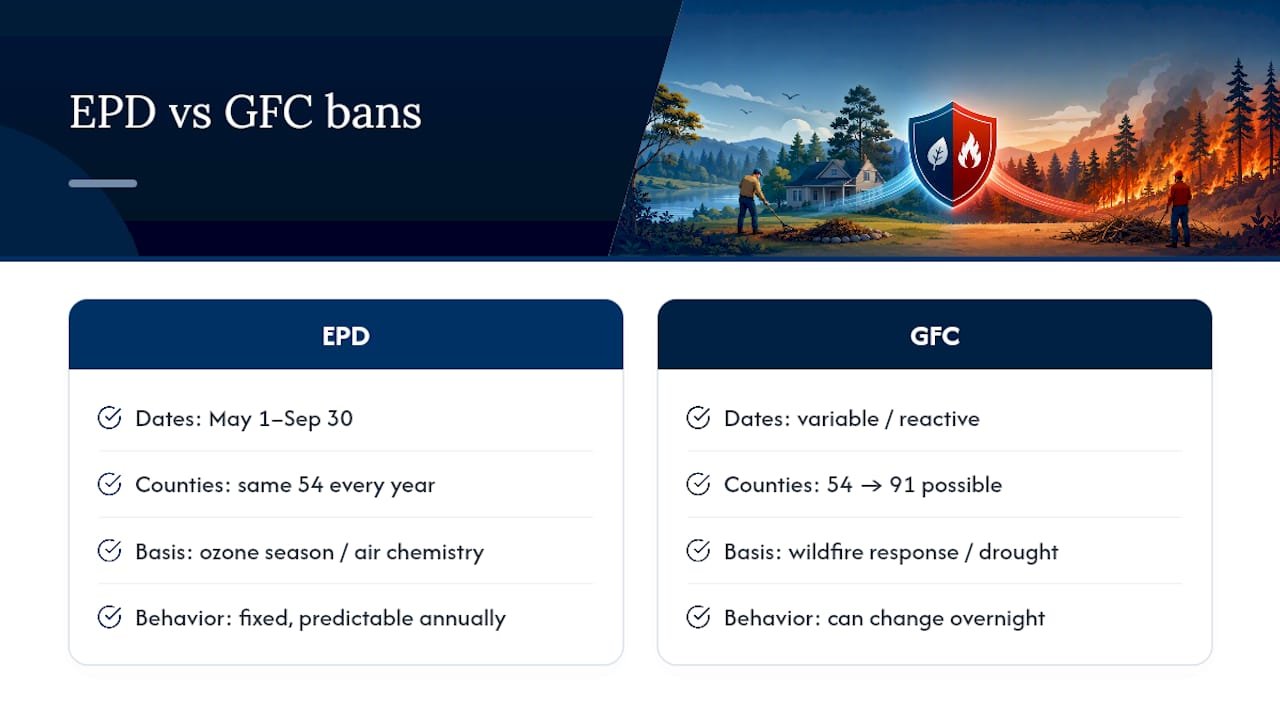
The mistake I see repeated most often isn’t about a specific rule. It’s the assumption that “no burn ban” means one thing, when Georgia is actually running two separate systems that rarely get explained side by side. The EPD’s ozone season ban is boring in the best way: it’s the same 54 counties, the same dates, every year, driven by air chemistry that has nothing to do with how dry your yard is. The GFC’s wildfire response is the opposite. It’s reactive, county lists can swing from 54 to 91 counties overnight, and it exists precisely because drought conditions don’t follow a calendar.
Treating these as the same thing is how people end up burning legally under one rule while violating the other. If there’s a real gap in public understanding here, it’s that state agencies publish clear rules but don’t always connect the dots between them for the person standing in their backyard with a match. That’s a job local reporting is suited for, translating two separate regulatory systems into one clear answer: can you burn today, and where do you double check.
— Ernie
Sources
Bookmark these before burn season catches you off guard:
- Open Burning Rules for Georgia | Environmental Protection Division
- Executive order / State of Emergency for Georgia wildfires