What Is Longform Local Journalism: A Community Guide
Longform local journalism is defined as in-depth, narrative-driven reporting that examines local issues with the detail and context that daily news cannot provide. Unlike a standard news brief, this form of journalism takes weeks or months to develop, using literary techniques such as character development, scene-setting, and chronological storytelling. The United States has lost nearly 40% of its local newspapers since 2005, creating news deserts where communities receive little to no substantive coverage. That loss makes the work of outlets committed to deep local reporting more consequential than ever. Thecentralgeorgian operates in exactly this space, delivering thorough coverage of Central Georgia’s most pressing public concerns.
What is longform local journalism and how does it differ?
Longform local journalism is a specialized form of reporting that prioritizes depth, narrative structure, and investigative rigor over speed. The standard industry term for this practice is “narrative journalism” or “long-form investigative reporting,” and both terms apply when the subject is a local community. Where a daily news article answers who, what, when, and where in a few hundred words, a longform piece answers why and how across thousands of words built on months of research.
The defining characteristics of this format set it apart from conventional reporting:
- Narrative techniques: Writers use scene-setting, character development, and chronological storytelling rather than the inverted pyramid structure common in daily news.
- Extended development time: Longform stories require weeks or months to develop, compared to the hours a standard news article takes.
- Research depth: Reporters conduct multiple rounds of interviews, analyze public documents, and cross-reference sources before writing a single paragraph.
- Structural complexity: Stories follow a narrative arc with a beginning, middle, and end, rather than front-loading all facts in the first paragraph.
- Multimedia integration: Photos, audio, and data visualizations can support the story, but the written narrative carries the weight.
Pro Tip: If you are a journalism student starting your first longform piece, write your narrative arc on a single index card before you begin reporting. If you cannot summarize the story’s beginning, conflict, and resolution in three sentences, you are not ready to report yet.
Longform journalism enhances objectivity by combining factual reporting with emotional depth, providing thorough exploration of local human experiences without sensationalism. That balance is what separates quality local narrative journalism from opinion writing or advocacy. Readers get the facts and the human context at the same time.

How does longform local journalism support democratic accountability?
Local investigative journalism targets institutional failures and corruption at the municipal and county level, producing measurable outcomes such as policy change and prosecutions. That focus on local government, public health systems, and school boards makes it one of the most direct tools citizens have for holding power accountable. National outlets rarely cover a county commissioner’s budget decisions or a local hospital’s patient safety record. Longform local reporters do.
The democratic impact of this work follows a clear pattern:
- Identify the institution: Reporters select a local government body, agency, or organization with public accountability.
- Document the failure: Through public records and interviews, reporters build an evidentiary record of the problem.
- Publish with context: The story explains not just what happened, but why it happened and who is responsible.
- Measure the outcome: Policy changes, resignations, or prosecutions confirm the story’s real-world effect.
“Restoring local investigative journalism is essential to democratic deliberation and oversight, requiring sustainable funding and a commitment to serving local needs.”
Community trust follows from this accountability work. When residents see that a local outlet’s reporting led to a school board policy reversal or a public safety improvement, they recognize the outlet as a reliable civic resource. That recognition builds the kind of community trust that sustains local journalism over time. Thecentralgeorgian’s coverage of police operations and public safety alerts in Central Georgia reflects this same accountability model, connecting residents to information that directly affects their daily lives.
Local election coverage is another area where depth matters. A brief news item tells readers when an election is scheduled. A longform piece explains each candidate’s record, the policy stakes, and the history behind the ballot measure. That depth is what local election reporting requires to genuinely inform voters rather than simply notify them.
What methods and best practices define longform local reporting?
The production of longform local journalism follows a set of established investigative practices that separate thorough reporting from surface-level coverage. The most critical tool is the Freedom of Information Act request, commonly called a FOIA request. FOIA requests and proactive document collection provide the evidentiary backbone for deep local investigations. Official statements and press releases are starting points, not the substance of the story.
Effective longform reporters follow these core practices:
- File FOIA requests early: Public records take time to arrive. Reporters who file requests at the start of a project receive documents before their deadline, not after.
- Conduct layered interviews: Begin with documents, then interview sources to explain what the documents mean, then return to documents to verify what sources said.
- Focus on a specific beat: Reporters who cover one area, such as public health, criminal justice, or education, develop source networks and institutional knowledge that generalist reporters lack.
- Build a human-impact story: Multimedia can enhance a story but cannot replace a strong narrative. The human experience at the center of the story is what readers remember.
- Avoid narrative drift: Long projects accumulate material. Reporters must return regularly to their original story question to avoid losing focus.
Pro Tip: Create a “document log” from day one of your investigation. List every record you have requested, received, and analyzed. This log becomes your fact-checking reference when editors push back on specific claims.
Understanding how news stories are prioritized in a newsroom also helps reporters advocate for the time and resources their longform projects require. Editors allocate space and staff based on perceived public impact. A reporter who can articulate why a story matters to the community is more likely to receive the time needed to do it properly.
The Global Investigative Journalism Network (GIJN) notes that a renaissance of longform reporting is needed to genuinely engage communities with stories that have narrative complexity. That observation applies directly to local outlets, where the temptation to publish quickly often overrides the discipline required to publish deeply.
What challenges does longform local journalism face today?
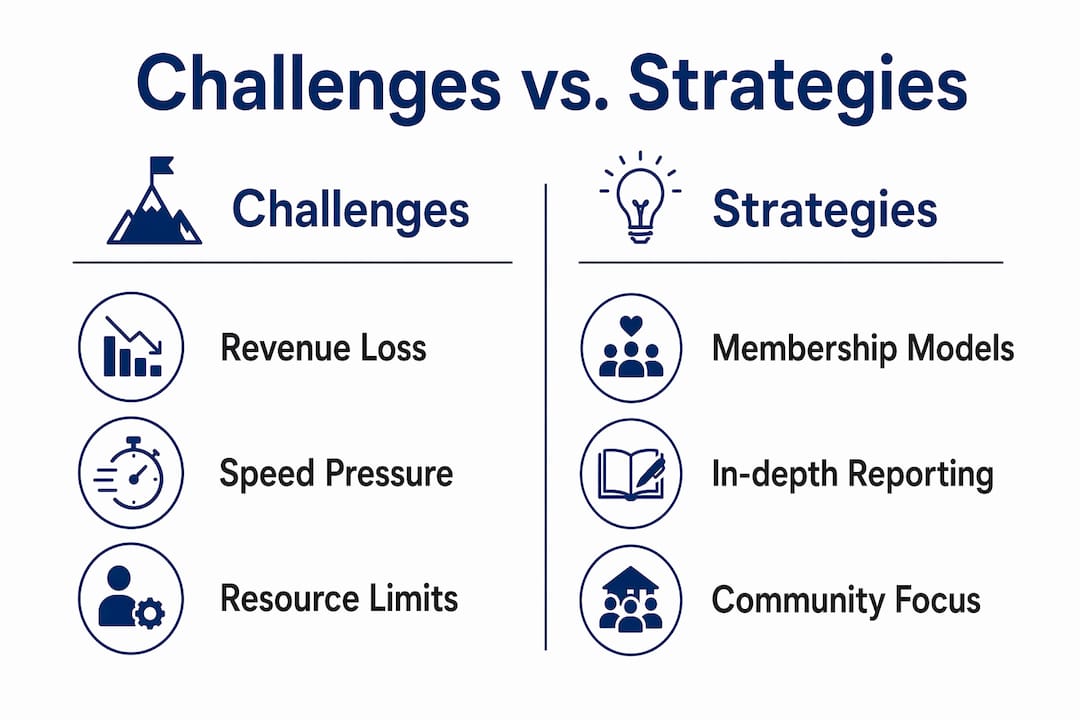
The financial pressures on local journalism are significant and well-documented. The collapse of traditional funding models has contributed directly to the decline of local news, as advertising revenue shifted to national digital platforms and print subscriptions fell. Longform reporting is expensive. It requires reporter time, legal fees for FOIA disputes, and editorial oversight across weeks or months of work.
The table below outlines the primary challenges and the adaptation strategies local outlets are using to address them.
| Challenge | Impact on longform reporting | Adaptation strategy |
|---|---|---|
| Advertising revenue decline | Fewer resources for long projects | Nonprofit funding and reader memberships |
| Staff reductions | Fewer reporters per beat | Collaboration between regional outlets |
| Digital competition | Pressure to publish quickly | Dedicated longform sections with slower timelines |
| Multimedia expectations | Resources diverted from writing | Prioritizing narrative first, multimedia second |
| Audience fragmentation | Harder to reach local readers | Community publishing partnerships |
Digital platforms have created both a problem and an opportunity for local journalism. The problem is speed pressure. The opportunity is that digital formats allow longform stories to include interactive data, audio interviews, and photo essays that print could not accommodate. Understanding community publishing strategies helps local outlets think beyond the traditional newsroom model and build direct relationships with the audiences they serve.
The outlets that survive this period share one characteristic: they serve a specific local interest with reporting that no national outlet will produce. That specificity is both the challenge and the competitive advantage of local longform journalism.
Key Takeaways
Longform local journalism is the most direct tool communities have for holding local institutions accountable, and its survival depends on narrative rigor, public records access, and sustainable funding.
| Point | Details |
|---|---|
| Definition and format | Longform local journalism uses narrative techniques and takes weeks or months to develop, unlike daily news. |
| Democratic accountability | Local investigative reporting produces measurable outcomes including policy changes and prosecutions. |
| Core investigative tools | FOIA requests and layered interviews form the evidentiary foundation of every strong longform story. |
| Narrative over multimedia | Strong writing and human-impact storytelling outperform multimedia production in reader engagement and trust. |
| Funding and sustainability | Traditional advertising models have collapsed; nonprofit funding and reader memberships are the primary alternatives. |
Why longform local journalism matters more than most people realize
Ernie here. After years of watching local news coverage, the pattern I keep returning to is this: the stories that actually change something in a community are almost never the ones published in 24 hours. They are the ones that took a reporter three months, a stack of public records, and six rounds of interviews to complete.
The common assumption is that speed equals relevance. That assumption is wrong for local journalism. A quick report on a city council vote tells you what happened. A longform investigation into why that vote happened, who lobbied for it, and what it will cost residents over the next decade is what actually informs civic decisions. Those are two completely different products, and only one of them requires the kind of time and discipline that most local newsrooms struggle to protect.
The challenge I see most often is not a lack of talent. Local reporters are frequently as skilled as their national counterparts. The challenge is institutional pressure to produce volume over depth. Outlets that resist that pressure and protect time for deep reporting tend to build the strongest community relationships. Readers recognize the difference between a story that was reported and a story that was investigated.
Thecentralgeorgian’s approach to local news coverage reflects this commitment. The outlet’s crime investigations and public safety reporting go beyond the initial incident to provide the context residents need to understand what is happening in their community.
— Ernie
Thecentralgeorgian and in-depth local reporting
Thecentralgeorgian covers Central Georgia with the depth and consistency that residents and civic participants need to stay informed. The outlet’s reporting goes beyond breaking news to provide the context behind public safety events, government decisions, and community developments.

Readers who want to understand how local institutions work, and how journalism holds them accountable, will find practical resources at Thecentralgeorgian. The outlet’s guide to local election coverage explains how reporters cover candidates, ballot measures, and voting processes in Central Georgia. That kind of structured, in-depth coverage is what informed civic participation requires. Visit Thecentralgeorgian to follow ongoing local investigations and community reporting.
FAQ
What is the definition of longform local journalism?
Longform local journalism is in-depth, narrative-driven reporting on local issues that uses literary techniques such as character development and scene-setting, developed over weeks or months rather than hours.
How long does a longform local journalism piece typically take to produce?
A longform local story typically requires weeks or months of reporting, including public records requests, multiple rounds of interviews, and document analysis before writing begins.
What makes journalism “longform” rather than standard news?
Longform journalism uses a narrative arc, extended word count, and deep sourcing rather than the inverted pyramid structure and quick turnaround of standard daily news reporting.
Why is local journalism important for communities?
Local journalism holds municipal governments, school boards, and public agencies accountable, producing measurable outcomes such as policy reforms and prosecutions that national outlets do not pursue.
How can local residents support longform local journalism?
Residents support local journalism by subscribing, sharing investigations, and engaging with outlets like Thecentralgeorgian that prioritize in-depth community reporting over quick content.