
How News Stories Are Prioritized: A 2026 Guide

News story prioritization is the editorial process that determines which events receive prominent coverage based on criteria including impact, timeliness, conflict, and audience relevance. Every newsroom, from a national broadcaster to a local outlet like Thecentralgeorgian, applies a structured set of news values to decide what gets published, when, and how prominently. The industry term for this process is newsworthiness assessment, and it combines traditional journalism principles with modern algorithmic tools. Understanding how news is ranked helps journalism students, aspiring reporters, and civic-minded readers engage more critically with the media they consume.
How news stories prioritized: the core criteria editors use
Newsworthiness assessment rests on five foundational news values: timeliness, impact, conflict, proximity, and relevance. Editors apply these values to every potential story before assigning resources or space. A story scores higher when it affects a large number of people immediately and involves a clear conflict or public figure.
Impact is the most weighted criterion in most newsrooms. A story about a water contamination event affecting 50,000 residents ranks above a story about a minor city council procedural vote, even if both are technically “new.” Severity and scale determine how much editorial attention a story receives.

Research from UC Davis identifies “heat, fuel, and oxygen” as the three ingredients that drive media storm coverage. Heat is the initial public reaction, fuel is the ongoing supply of new developments, and oxygen is the available media space. Stories that generate all three attract disproportionate coverage compared to equally serious events that lack one ingredient.
Economic considerations also shape the news story selection process. Advertisers, audience size, and platform algorithms create financial incentives that can push sensational stories above slower-developing but more consequential ones. This tension between commercial pressure and journalistic duty is a defining challenge in modern newsrooms.
| News value | Definition | Editorial role |
|---|---|---|
| Timeliness | How recently the event occurred | Determines urgency and publication speed |
| Impact | Number of people affected and severity | Primary driver of story prominence |
| Conflict | Presence of opposing forces or controversy | Increases audience engagement and attention |
| Proximity | Geographic closeness to the audience | Raises relevance for local outlets |
| Relevance | Connection to audience interests or concerns | Guides story framing and placement |
How do editorial gatekeeping and AI systems filter stories?
Modern newsrooms use a six-step editorial curation process: fetch, filter, dedupe, freshness check, source verification, and publish. This standard triage system combines automated filtering with human review at each stage. No story moves to publication without clearing every step.
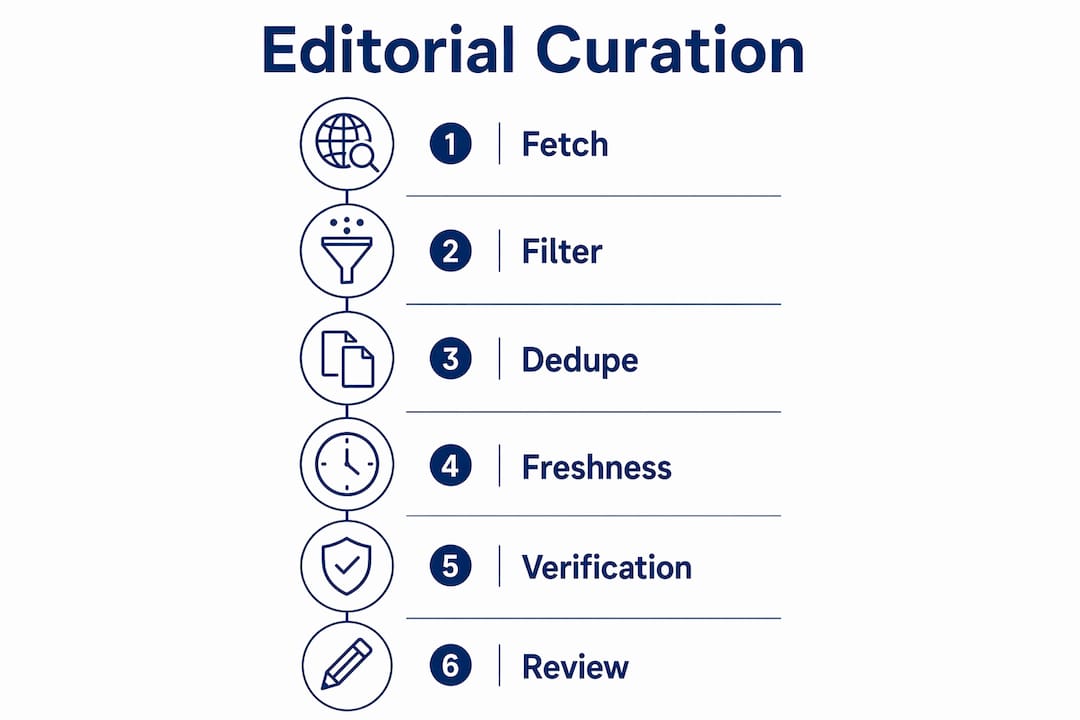
AI-assisted scoring now handles the first several stages. Automated pipelines evaluate stories on relevance, quality, freshness, and audience fit, assigning numerical scores before a human editor ever reads the piece. AI-powered editorial pipelines score stories on these four dimensions, but human editors retain final approval to maintain trust and accuracy. That human gate is the final trust boundary in the process.
The numbered steps below reflect how a disciplined newsroom moves a story from raw input to publication:
- Fetch — Automated systems pull stories from RSS feeds, wire services, and social platforms.
- Filter — Keyword and topic rules remove off-topic or low-quality items.
- Dedupe — Duplicate stories from multiple sources are collapsed into a single entry.
- Freshness check — Stories older than a defined threshold are deprioritized or discarded.
- Source verification — Editors confirm the story traces to a credible primary source.
- Publish — Approved stories are formatted and released based on their score and format assignment.
The “three yeses” test adds a final quality check before publication. This editorial test asks three questions: Does the topic matter right now? Can the newsroom add unique value? Is there a plausible path to audience demand? A story that fails any one of the three gets rejected or held, regardless of its viral potential.
Pro Tip: Speed and accuracy are not interchangeable. When a breaking story arrives, run the source verification step before the freshness check. A fast wrong story costs more credibility than a slow correct one.
What external factors influence which stories get covered?
Agenda-setting theory, developed in mass communication research, holds that the media does not tell audiences what to think but does determine what they think about. The media agenda and the public agenda are not identical. Newsrooms shape public attention by choosing which stories to amplify and which to leave uncovered.
Gatekeeping theory explains that editorial choices reflect a blend of individual journalist values, newsroom policies, and external pressures from advertisers and governments. These filters are not random. They reflect institutional goals, ownership structures, and the economic environment of the outlet. Professor Vartika Nanda describes these filters as functions that shape news selection in predictable, structural ways.
Several external forces consistently affect the criteria for news prioritization:
- Ownership and advertiser pressure — Outlets owned by large media conglomerates may avoid stories that conflict with parent company interests.
- Audience engagement metrics — Click rates, time on page, and share counts create financial incentives to favor emotionally charged stories.
- Social media algorithms — Platforms amplify stories that generate rapid engagement, feeding those stories back into editorial queues as “trending.”
- Community demographics — Community structure theory shows that outlets serving wealthier or more educated audiences tend to cover different topics than those serving working-class communities.
- Safety and funding constraints — Journalists face severe constraints including funding shortfalls and physical safety risks, meaning some story neglect is a systemic issue rather than editorial indifference.
Understanding how agenda-setting works in practice helps readers recognize why certain topics dominate coverage cycles while others receive little attention despite their public importance.
How do audience behavior and algorithms shape news ranking today?
Media oxygen is the finite amount of coverage space available in any given news cycle. Algorithms prioritize stories with high click rates, rapid shares, and social amplification, which means stories that generate immediate emotional reactions consume more oxygen than slower-developing but more consequential topics. This dynamic creates a structural bias toward “loud” stories over “load-bearing” ones.
A loud story generates immediate reaction: a celebrity arrest, a dramatic weather event, or a viral political statement. A load-bearing story carries long-term civic weight: infrastructure funding decisions, public health policy changes, or school board budget allocations. Algorithms favor the former because engagement signals arrive faster. Editors who rely heavily on real-time metrics risk systematically underweighting the latter.
Audience preferences also create economic incentives that reinforce this pattern. When readers click on dramatic stories and skip policy analysis, advertising revenue follows. Newsrooms that depend on digital ad revenue face direct financial pressure to match their editorial choices to audience behavior, even when those choices reduce the overall quality of public information.
Pro Tip: To find underreported topics despite algorithmic bias, search directly for local government meeting agendas, court records, and public health department updates. These primary sources bypass the engagement filter entirely and often contain the most consequential local news.
What practical frameworks do newsrooms use to rank and present stories?
Scoring matrices give editors a repeatable method for evaluating stories across multiple variables simultaneously. Editors assign scores of 1–5 across impact, urgency, and audience fit, then use the combined score to determine both whether to publish and what format to use. A high-scoring story on all three dimensions warrants a full investigative piece. A mid-range score might produce a brief news item or a social post.
The table below maps score ranges to typical content formats:
| Combined score (out of 15) | Recommended format |
|---|---|
| 13–15 | Full investigative or long-form feature |
| 10–12 | Standard news article with multiple sources |
| 7–9 | Brief news item or explainer |
| 4–6 | Social post or newsletter mention |
| 1–3 | Hold or reject |
Editorial review meetings apply these scores within a broader triage framework. Editors set publishing thresholds at the start of each cycle, defining the minimum score required for a full article versus a brief mention. AI tools reduce cognitive load in this process, enabling editors to focus on high-impact judgment calls rather than routine filtering. The scoring matrix does not replace editorial judgment. It structures it.
Content radars or thematic lanes help newsrooms maintain focus across a high volume of incoming stories. An outlet covering Central Georgia, for example, might define lanes for public safety, local government, community events, and public health. Stories that fall outside all defined lanes receive lower priority regardless of their raw newsworthiness score, because they do not serve the outlet’s core audience.
Key Takeaways
News story prioritization combines traditional news values, structured editorial triage, and audience-driven algorithmic signals to determine which stories receive coverage, in what format, and at what prominence.
| Point | Details |
|---|---|
| Core news values drive selection | Impact, timeliness, conflict, proximity, and relevance are the primary criteria editors apply. |
| Six-step triage ensures quality | Fetch, filter, dedupe, freshness check, source verification, and publish form the standard editorial pipeline. |
| The “three yeses” test prevents weak stories | Stories must be timely, offer unique value, and have a path to audience demand before publication. |
| Algorithms favor loud over load-bearing | Engagement metrics create structural bias toward dramatic stories and away from consequential policy coverage. |
| Scoring matrices guide format decisions | Combined scores across impact, urgency, and fit determine whether a story becomes a feature, brief, or social post. |
The part of news prioritization most journalism courses skip
After years of watching newsrooms operate, the most underappreciated factor in how news is ranked is not bias or technology. It is capacity. Newsrooms make prioritization decisions under real constraints: staff hours, legal review time, source availability, and publishing deadlines. A story that would score a 14 on the scoring matrix gets held at a 9 because no reporter is available to develop it properly.
Journalism students often learn the theory of news values in isolation from the operational reality of a newsroom. The agenda-setting framework and gatekeeping theory are accurate and useful, but they describe outcomes without fully accounting for the resource constraints that produce those outcomes. When a local outlet misses a significant story, the explanation is often a staffing gap, not an ideological decision.
The civic implication is direct. Readers who understand how news is ranked can identify coverage gaps and fill them. Submitting a news tip to your local outlet is not a passive act. It is an input into the editorial triage system. A well-documented tip from a credible community member can move a story from the hold pile to the publish queue. Audiences shape coverage more than most people realize.
The most responsible editorial operations are transparent about their prioritization criteria. Outlets that publish their news values, explain their sourcing standards, and acknowledge coverage gaps build more durable public trust than those that treat editorial decisions as proprietary. Thecentralgeorgian’s focus on Central Georgia public safety and community events reflects a defined thematic lane, and that clarity serves readers better than an outlet that tries to cover everything and explains nothing.
— Ernie
Local news coverage and editorial decisions at Thecentralgeorgian
Understanding how news stories are prioritized gives you a sharper lens for reading any outlet’s coverage. Thecentralgeorgian applies these same editorial principles to its reporting on Central Georgia, covering public safety, community events, and local government with a defined focus on stories that directly affect residents.

Readers who want to see these principles in action can review how local elections are covered at the community level, where editorial prioritization decisions are especially visible. For a broader view of why local coverage matters, Thecentralgeorgian’s reporting on why local news matters explains the civic stakes behind every editorial choice. The Central Georgian remains a reliable source for Central Georgia readers who want coverage grounded in community impact rather than algorithmic popularity.
FAQ
What are the main criteria for news prioritization?
The main criteria are impact, timeliness, conflict, proximity, and relevance. Editors weigh these news values against available resources and audience needs to determine which stories receive coverage.
How do AI systems affect the news story selection process?
AI systems score stories on relevance, quality, freshness, and audience fit before human editors review them. Human editors retain final approval to maintain accuracy and editorial integrity.
What is the “three yeses” test in journalism?
The “three yeses” test asks whether a story matters now, whether the newsroom can add unique value, and whether there is a plausible path to audience demand. A story that fails any one question is held or rejected.
Why do some important stories get less coverage than less significant ones?
Algorithms promote stories with high engagement signals, creating structural bias toward dramatic content over consequential policy topics. Newsroom capacity constraints, including staffing and time, also cause significant stories to be held or underdeveloped.
How can readers influence which stories get covered?
Readers can submit documented news tips directly to local outlets, which function as inputs into the editorial triage system. A credible, well-sourced tip can move a story from the hold queue to active coverage.