
How Local Media Is Funded: Explained for Residents

Local media funding is defined as the mix of revenue streams that keeps community journalism operational, including public investment, commercial advertising, nonprofit grants, and reader-supported income. Understanding how local media is funded matters because the financial health of a news outlet directly shapes what stories get told, which communities get covered, and whether a newsroom survives at all. The funding models for local media have shifted dramatically over the past two decades, and that shift has real consequences for civic life. Thecentralgeorgian covers Central Georgia’s community directly because of the same funding realities this article explains.
How is local media funded? The core sources explained
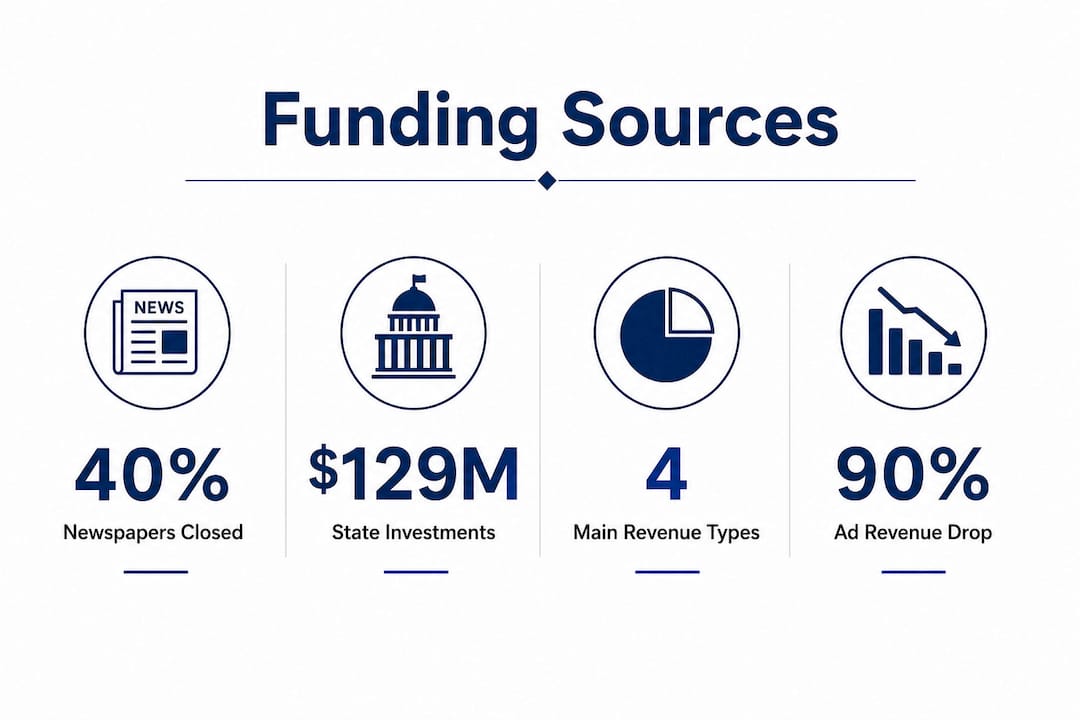
Local media draws income from four primary categories: public funding, commercial advertising, nonprofit and philanthropic grants, and reader revenue. No single source is sufficient on its own. The strongest outlets combine several of these streams to reduce dependence on any one funder. Understanding this mix is the first step toward explaining local media finance in practical terms.
The crisis driving this diversification is well documented. Nearly 40% of U.S. local newspapers have closed since 2005, largely because advertising revenue migrated to global tech platforms. That closure rate represents thousands of communities left without a dedicated local reporter. The funding models that replace traditional advertising must be deliberate, community-specific, and built for long-term sustainability.

What are the primary sources of public funding for local media?
State governments have become a significant, if underappreciated, source of local journalism funding. At least six U.S. states have invested over $129 million in public funding for local journalism from 2020 to 2025, with $74 million projected for 2026. That figure signals a policy shift: lawmakers are beginning to treat local journalism as public infrastructure, not a private business concern.
The mechanisms vary by state. New York offers $30 million annually in tax credits for news organizations that employ local journalists. California runs $15 million fellowship programs to place reporters in underserved communities. New Jersey funds the Civic Information Consortium, which issues grants to independent local outlets. Illinois has passed legislation providing tax credits to newspapers that hire or retain journalists.
These programs share a common goal: sustain reporters in communities that would otherwise go uncovered. They also share a common tension. Critics raise concerns about government influence over editorial decisions when public money enters the newsroom. Most programs address this by routing funds through independent bodies or structuring them as tax credits rather than direct grants, which preserves editorial distance.
- Tax credits: Reduce a news organization’s tax liability based on journalist payroll, as in New York and Illinois.
- Fellowship programs: Place state-funded reporters inside existing newsrooms, as in California.
- Consortium grants: Distribute funds through independent nonprofit bodies, as in New Jersey.
- Direct grants: Awarded competitively to qualifying outlets, often with editorial independence requirements attached.
Pro Tip: If you want to track whether your state has a public journalism funding program, search your state legislature’s website for “local journalism tax credit” or “civic information fund.”
How do nonprofit and philanthropic organizations support local media funding?
Nonprofit investment has become one of the most active areas of local media finance. The American Journalism Project invested $3.25 million in three nonprofit local news organizations in 2026 alone. Its broader portfolio, spanning 38 states and Puerto Rico, has helped earlier grantees grow revenues by $53 million annually. That figure reflects not just grant dollars but the business capacity those investments built.
Philanthropic funders focus on more than writing checks. They support audience development, fundraising infrastructure, and technology adoption. A nonprofit newsroom that receives a grant from a foundation often also receives coaching on how to build a membership program or run a major donor campaign. This approach treats the news organization as a business that needs operational support, not just editorial funding.
The role of local nonprofits in sustaining journalism extends beyond direct grants. Community foundations, health systems, and civic organizations often sponsor specific coverage areas, such as public health reporting or education journalism, without controlling editorial content. This arrangement funds a beat while keeping the newsroom independent.
Key characteristics of effective nonprofit funding models include:
- Focus on underserved communities that commercial outlets have abandoned.
- Multi-year commitments that allow newsrooms to plan staffing and coverage.
- Capacity-building support alongside direct financial grants.
- Accountability structures that protect editorial independence from donor influence.
What role do commercial advertising and reader revenue play in local media funding?
Commercial advertising was once the financial foundation of local journalism. Print ad revenue for U.S. newspapers dropped from $73.2 billion to $6 billion between 2000 and 2023, a collapse of 92%. That decline did not happen because local businesses stopped needing to advertise. It happened because Google and Facebook offered cheaper, more targeted alternatives. Local newsrooms lost the revenue without losing the cost of producing journalism.
Reader revenue has stepped in as a partial replacement. Memberships and subscriptions now form a meaningful share of income at outlets that have invested in audience relationships. Lookout Local in Santa Cruz reports a revenue mix of 40% memberships alongside 60% local advertising. That balance reflects a deliberate effort to reduce advertising dependence while building a loyal paying audience.
Outlets that succeed with reader revenue follow a clear sequence:
- Build audience trust first. Readers pay for journalism they believe serves them directly.
- Offer tiered membership pricing. Membership prices ranging from $17 to $250 annually accommodate different income levels.
- Add unique local services. Obituaries, community guides, and event listings generate revenue that national platforms cannot replicate.
- Test co-sponsorships. Local businesses sponsor specific newsletters or coverage sections without controlling editorial content.
- Target 10–15% profitability. Lookout Local invests 70% of expenses on talent and 10% on technology, keeping overhead lean.
Pro Tip: Readers who pay for a membership are far more likely to share articles and recruit new subscribers. A small, paying audience often delivers more long-term value than a large, passive one.
How are civic partnerships and community collaborations changing local media funding?
Civic partnerships represent one of the newest and most promising local media funding sources. El Tímpano, a hyperlocal outlet serving Latino and Mayan immigrant communities in the San Francisco Bay Area, generated $300,000 in 2024 and $350,000 in 2025 through partnerships with nonprofits and government agencies. The revenue came from services including SMS campaigns, community surveys, and listening sessions. El Tímpano’s model shows that trust with a specific community is itself a monetizable asset.
This approach works because civic organizations need to reach specific populations and lack the relationships to do so effectively. A local news outlet that has spent years earning trust with a particular community can deliver that access in ways that no advertising platform can match. The outlet charges for the service, not for editorial coverage, which preserves journalistic independence.
“Demonstrating ‘lived impact’ through testimonials and direct audience data provides a stronger value proposition to civic partners and sponsors than raw pageview metrics. Funders and partners respond to evidence that journalism changed behavior, not just that it attracted clicks.”
Key elements of a civic partnership model include:
- Identifying community organizations that need to communicate with the same audience the outlet serves.
- Offering specific, bounded services such as multilingual messaging or survey distribution.
- Pricing services based on impact delivered, not audience size.
- Publishing a clear editorial firewall policy so readers understand the distinction between paid services and news coverage.
Why local news matters to civic partners is precisely this trust. An outlet without community credibility cannot sell civic services. The funding model and the editorial mission reinforce each other.
What operational innovations support sustainable local media funding?
Funding diversification alone does not guarantee survival. Sustainability in local media is less a pure funding problem and more an infrastructure challenge. Newsrooms that integrate editorial, revenue, and technology functions into a single operational system reduce burnout and improve financial efficiency. Those that keep these functions siloed spend more time on manual processes and less time on journalism.
Local newsrooms employ lean, multitasking staff who often handle editorial, community outreach, and operational tasks simultaneously. This is an economic necessity, not a sign of editorial weakness. A reporter who also manages the membership newsletter and attends community events is building audience relationships that directly support revenue.
| Operational practice | Effect on sustainability |
|---|---|
| CRM and billing integration | Reduces manual administrative work and improves subscriber retention |
| Newsletter automation | Frees staff time for reporting while maintaining consistent audience contact |
| Impact measurement systems | Provides data to attract civic partners and justify grant renewals |
| Multifunctional staffing | Lowers payroll costs without reducing community presence |
| Platform-ready editorial systems | Connects content production directly to distribution and revenue tracking |
The shift from measuring pageviews to measuring lived audience engagement is particularly significant. A newsroom that can show a funder that its coverage led to a policy change or a community health improvement has a far stronger case for continued support than one that reports monthly traffic numbers.
Key Takeaways
Local media funding depends on a deliberate mix of public investment, nonprofit grants, reader revenue, and civic partnerships, with no single source sufficient for long-term sustainability.
| Point | Details |
|---|---|
| Public funding is growing | Six states invested over $129 million from 2020 to 2025, with more projected for 2026. |
| Advertising has collapsed | Print ad revenue fell 92% from 2000 to 2023, forcing outlets to find new income sources. |
| Nonprofit investment builds capacity | The American Journalism Project’s portfolio grew grantee revenues by $53 million annually. |
| Civic partnerships monetize trust | El Tímpano earned $350,000 in 2025 by offering community services to nonprofits and agencies. |
| Operations determine survival | Integrated editorial and revenue systems reduce burnout and improve financial efficiency. |
The funding picture is more complicated than most readers realize
The conversation about local media funding tends to focus on the dramatic: newsroom closures, advertising collapse, and the occasional philanthropist who saves a beloved paper. Those stories are real. But the more important story is the quiet, unglamorous work of building a revenue mix that does not collapse when one stream dries up.
I have watched outlets receive a large foundation grant and treat it as a solution rather than a bridge. Two years later, when the grant ends, they face the same structural problem they had before. The outlets that survive are the ones that use grant money to build membership programs, civic partnerships, and operational systems. They treat every dollar of outside funding as an investment in self-sufficiency, not a substitute for it.
Public funding programs are genuinely useful, but they require careful design. A tax credit that flows to a newsroom based on journalist headcount rewards hiring without guaranteeing quality journalism or community service. The best programs tie funding to demonstrated community impact, not just employment numbers.
The most encouraging development I see is the civic partnership model. When a local outlet can charge a government agency or nonprofit for community engagement services, it creates a revenue stream that grows with the outlet’s reputation rather than declining with print circulation. That alignment between editorial mission and financial model is rare. When it works, it is the most durable form of local media funding available.
Readers who want to support local journalism do not need to wait for policy action. Paying for a membership, sharing articles, and attending community events hosted by local outlets all contribute to the financial case that keeps a newsroom open.
— Ernie
Thecentralgeorgian and the local media you depend on
Thecentralgeorgian covers Central Georgia with the same commitment to community journalism this article describes. The outlet reports on breaking news, public safety, and civic affairs because informed residents make better decisions for their communities.

Readers who want to understand how local elections get covered, and why that coverage depends on a funded, independent newsroom, can read Thecentralgeorgian’s citizen’s guide to election coverage. For a broader look at how local media influences community life in Central Georgia, the local media influence guide provides additional context. Supporting Thecentralgeorgian directly supports the kind of local journalism that civic partnerships, public funding, and reader revenue are all designed to sustain.
FAQ
What is the main source of funding for local media?
Local media draws from multiple sources, including public funding, nonprofit grants, commercial advertising, and reader memberships. No single source dominates; the most sustainable outlets combine several streams.
Why has local media advertising declined so sharply?
Print advertising revenue fell 92% between 2000 and 2023 as businesses shifted budgets to digital platforms like Google and Facebook. Local newsrooms lost that revenue without a proportional reduction in their operating costs.
How do state governments fund local journalism?
States use tax credits, fellowship programs, and consortium grants to direct public money to local newsrooms. New York allocates $30 million annually in journalist tax credits, and New Jersey funds independent outlets through the Civic Information Consortium.
What is a civic partnership in local media?
A civic partnership is an arrangement where a local news outlet provides community engagement services, such as surveys or multilingual messaging, to nonprofits or government agencies for a fee. El Tímpano generated $350,000 in 2025 using this model.
How does reader revenue work for local news outlets?
Reader revenue includes memberships and subscriptions paid directly by the audience. Lookout Local in Santa Cruz reports that memberships account for 40% of its revenue, with annual membership prices ranging from $17 to $250.